The Hotel Uzbekistan at night did not disappoint. The entire front facade was lit up with neon lights of the Uzbekistan flag. I wonder if guests see the colors outside of their rooms? We also walked into the lobby and it felt a bit old, classic Soviet socialist style, despite the renovation 15 years ago. As with the Hotel Yugoslavia in Belgrade, I always felt that some owner should really play up the Socialist kitsch with the decor and theme of the hotel. Morning calisthenics, posters celebrating the worker, staff dressed from the times, etc. I think it would be a hit!
The Hotel Uzbekistan at Night
We walked around in the center of the city after dinner. The Palace of International Forums next door is another impressive building. The downtown of Tashkent is really quite nice and developed compared to our neighborhood of Mirobad. The term “palace” is appropriate in this case. It reminded Owen of Washington DC.
Uncle Jack and the family (sans Oliver) in front of the Palace of International Forums
I read O’Brien’s book (The Things They Carried – 1990) of fictional short stories on the Vietnam War because my son Owen’s grade 11 IB English class will be reading it this year. The book is commonly read in high school English classes and is one of the preeminent books of the Vietnam War. I watched the classic Vietnam War movies like Platoon and Apocalypse Now and visited Ho Chi Minh City in June of 2017. I started watching Ken Burn and Lynn Novick’s The Vietnam War PBS series. (I should watch the entire series.) Tim O’Brien fought in Vietnam and the stories are based on his experiences and what he heard from fellow soldiers. The details of the stories ring true.
O’Brien’s prose flows easily and many of the stories have memorable lines. The short stories make it a good book to read before bed, one does not need to keep track of complex plot lines. He is a bit older than me, but grew up in small town Minnesota and I can relate to his perspective. The title comes from the first story, a description of the physical and emotional things soldiers carry in their backpacks while on patrol.
The book reinforced many of the themes of war literature. Humans are rarely put in life and death situations and this danger forms close bonds between soldiers. Many of the soldiers are just kids, 18 and 19 years old and the differences between small town America and the rainforests of Vietnam are huge. Just the shock of travelling outside the American midwest and placed in south east Asia would be shocking enough, but add a war and I can see why veterans struggle with PTSD. Another theme is the indifference of the “folks back home” felt by returning veterans. The story of Norman Bowker’s drive around the lake while remembering the death of his friend in a mortar attack really emphasized how returning veterans must feel. Sadly, this continues today with soldiers coming back from Iran and Afghanistan.
I also liked the story “On the Rainy River”. The story is set in the summer after the author is drafted and learns he is heading to Vietnam. He wavers between escaping to Canada or reporting to basic training. O’Brien feels he is a coward by not fleeing and living up to the expectations of his family and friends in his small town. Oh, the value of age and perspective. I am curious to see what class discussions and assignments Owen brings home his in English class.
Some of the nice things about living in an ex-Soviet Union Republic are the wide streets and huge areas of public space. In a capitalist society that values individuals, there is more privately owned land in cities than in socialist societies. For a cyclist, the extra traffic lanes and large sidewalks provide safer cycling paths. This morning I went for my second extended ride and got in about 20 kilometers. The traffic before 7:00 AM is light and on Saturday, you get an extra hour to cycle before it becomes unsafe. Although there are sections where the sidewalks are uneven, a cyclist can get around pretty well around the city. There are also many parks in the city that provide cyclist protection as well.
Another legacy of the Soviets are the unusual architecture gems around the city.
Mention the term ‘Soviet architecture’ and instantly enormous concrete buildings come to mind. The term ‘Brutalist’, from the French ‘beton brut’ (raw concrete), flourished in the 1950s -1970s, inspired by the works of Le Corbusier and Ludwig Mies van der Rohe. As an architectural style it was also associated with social, utopian ideology.
After the devastating Tashkent earthquake of 1966, many large-scale apartment blocks were quickly built to house the homeless. Later, several grand buildings were constructed as well as the marvellous metro system.
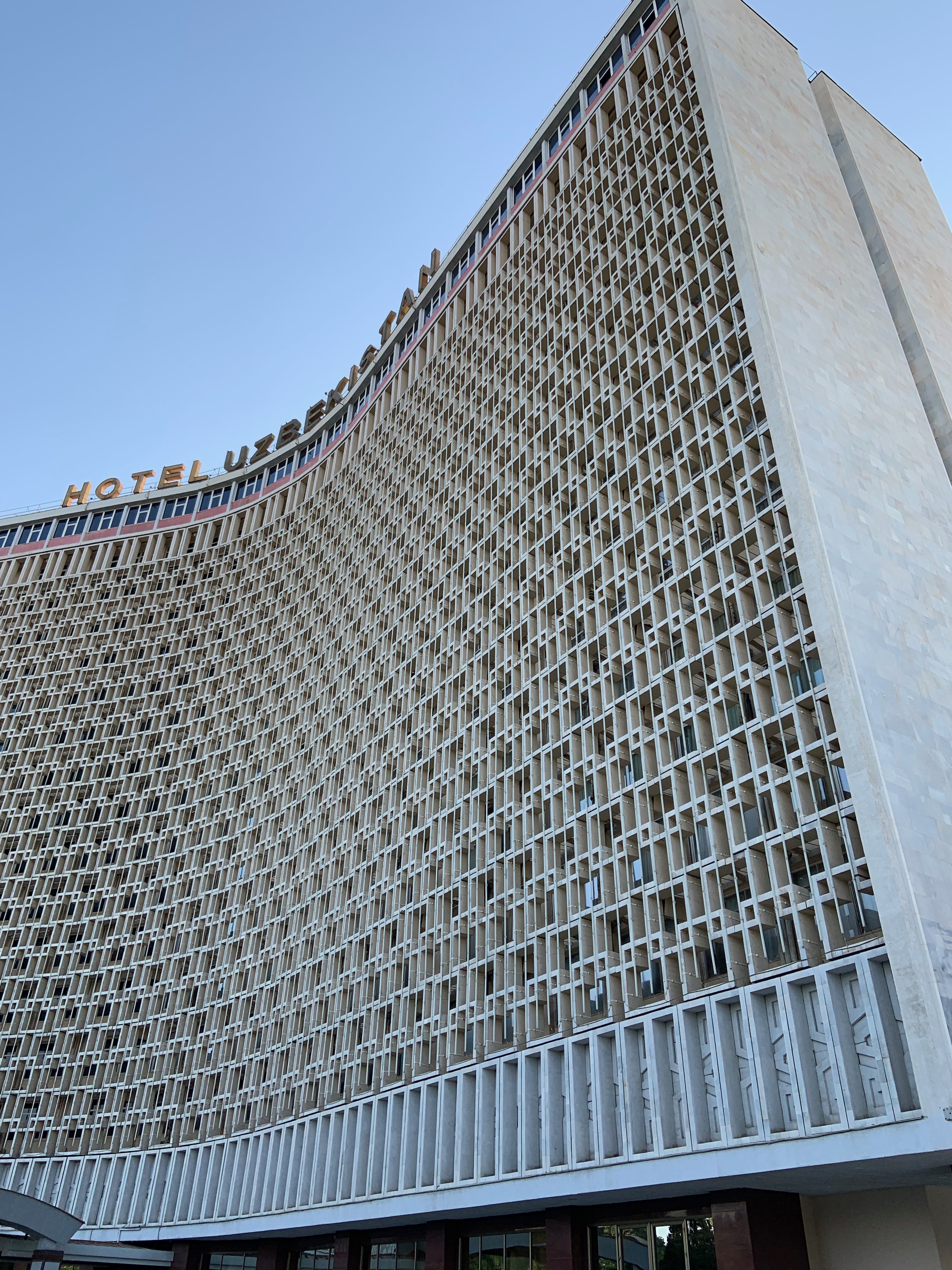
The massive Hotel Uzbekistan, centrally located at Amir Timur square, Tashkent, is a classic example of Soviet 1970’s modernist architectural style. In its heyday celebrities such as Federico Fellini, Marcello Mastroianni and Raj Kapoor stayed there, as well as the power brokers of the USSR.
Uzbek Journeys website September 19, 2011
One of my favorites so far is the Hotel Uzbekistan. The hotel was build in 1974 and has been renovated several times, the last being in 2010. The government was trying to sell its 80% ownership from what I last read. I plan on going inside and checking it out soon.
Nadia posing in one of the many parks in the center of Tashkent
We are settling in to our new lives and are enjoying the school and our new home after 1 week in the city! The weather has been very hot, with day time temperatures over 100 F everyday. This is normal for this time of the year. The low humidity makes is nicer and having a pool at our home is an easy way to cool off.
The first few days we spent at the Hotel Sharq (sharq means “north” in Uzbek language). The hotel, like the city has a cool vibe with a really nice swimming pool and courtyard and a decent breakfast. We moved into a smaller room due to the air conditioners and after figuring out how to cool the fridge, we were comfortable with our stay. As in the Trip Advisor reviews, the desk and lobby workers were not the most attentive employees I have ever seen. I think it may be the long hours they work. They were nice and after a few days of practicing my Russian with them, they warmed up to our family. There is also a nice fitness center in the basement.
One of the many canals flowing through the city
Nadia and I went for several walks and runs along the canals and in the many parks in the center of the city. It is quite beautiful in the mornings for exercise. Unfortunately, our house is located in a different neighborhood and it is a bit more difficult to find parks and areas to exercise. When we get a car and learn the city landscape a bit better, it will be easier. I laughed at watching local guys swimming in the canals every morning. I am tempted to try it myself!
The Thursday portion of plov at Dunyo Family Restaurant
The restaurants are numerous and of high quality. We had several really good meals including L’Opera, an Italian restaurant located in a park near the hotel. I also went for the Uzbek national dish, plov. It is basically rice with carrots and onions, slow-cooked with either beef, mutton, or lamb in huge vats. It is a common dish all through Central Asia and the national dish of Uzbekistan. The Uzbeks take great pride in plov and there are many different varieties. The restaurant Dunyo (“World” in Uzbek) served a style from southern Uzbekistan and featured cow ligaments and tendons. This is the second time I’ve had it and luckily, I enjoy it. My friend Muhktor said Thursdays are plov day.
Most of my time has been spent at school or unpacking. The movers came on Wednesday. The shipment made it to Tashkent from Osaka in about 40 days! We have another shipment coming from the USA later. It is a new home and is missing things like a door bell and curtains, but we are very comfortable and the school is taking good care of us.
Our 141 boxes from Japan arrived this week!
The Uzbeks and Russians we have met so far have been incredible kind and easy-going. The city and culture have a very positive and relaxed feel and I think we will enjoy living here.
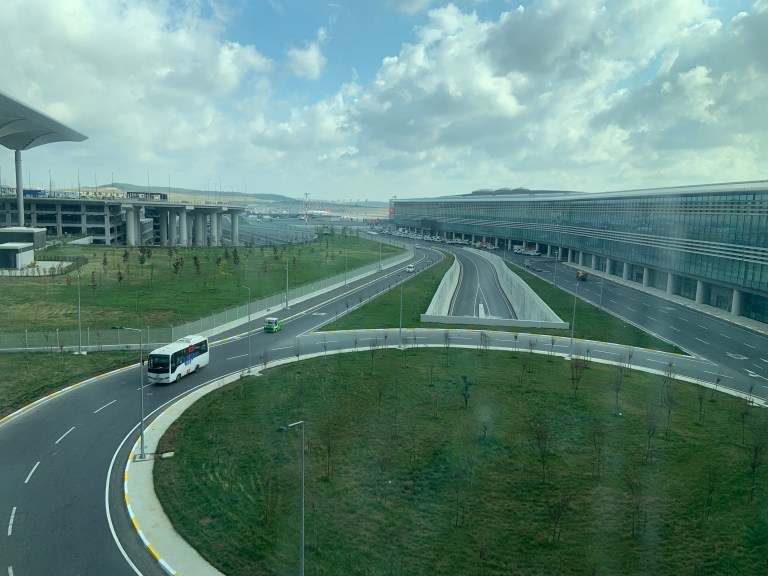
I was curious to see new Istanbul Airport yesterday. We had a two-hour layover coming from Boston and going to Tashkent. The airport is typical of President Erdogan’s tenure in office, an absolutely massive infrastructure project. The airport superlatives are as follows:
projected to be the world’s busiest airport by its completion in 2027; the 200 million annual passengers will surpass Atlanta’s 160 million
76.5 kilometers in area with 6 runways and 4 terminals
cost of 7.5 billion dollars and the deaths of 27 construction workers during the building of the airport
1.5 million trees were cut down on the southern shores of the Black Sea to make room for the airport
From our brief time there, it was impressive. The high ceilings of airports outside the USA make them more impressive looking. There were numerous, high quality and inexpensive priced shops, bars and restaurants. We had a nice meal at one of the food courts. I had a lentil soup and quinoa salad and the boys had a home-made pizza. I did notice there were some empty spaces and areas under construction still, both inside and outside the terminal. It has the largest and nicest smoking terrace I’ve ever seen. I remember Ataturk Airport being extremely crowded and the new airport is quite spacious.
I was disappointed to hear that the forests and marshlands were taken out for the airport. I am an avid bird watcher and nature lover and hate to see prime habitat loss. Below is a gallery of photos of the airport.
We had a classic mid-July summer day in “the valley”. We drove north down the mountain towards the Susquehanna River to Nescopeck. The area consists of beautiful farms, forested hills, gigantic homes with finely manicured lawns, dilapidated barns and even a nuclear plant. It was a picture-perfect day with bright sun, blue skies and low humidity. Nadia loved our stop at Stemmrich Blueberry Farm. We picked three buckets full of blueberries for under $20.
Blueberries are from the Heath Family and the Vaccinium genus are berry-producing shrubs like cranberries and lingonberries. They thrive in acidic soils. Blueberries are produced commercially in several US states including Washington, Oregon, Michigan, New Jersey, etc.
To placate the kids, we had a round of mini-golf and a bit of lunch. I won with 47 (3 under par), Owen had 50, Ocean 51, and Nadia/Oliver 68.
Nadia tees off
I am pro-nuclear power because it does not add to climate change by emitting carbons. However, the visual aspect of the cooling towers and long-term storage of spent fuel rods would concern me. We drove closer to the river so I could get a better look at the Susquehanna Steam Electric Station. It began producing electricity back in 1983 and employs over 1,000 people.
I was considering reading British author Oliver Bullough’s latest book, Moneyland, about tax havens and where corrupt people hide their money, but instead read an older book by him. Last Man in Russia traces the life of Orthodox priest, Dmitry Dudko while elaborating on the history and current state of Russia, circa 2013.
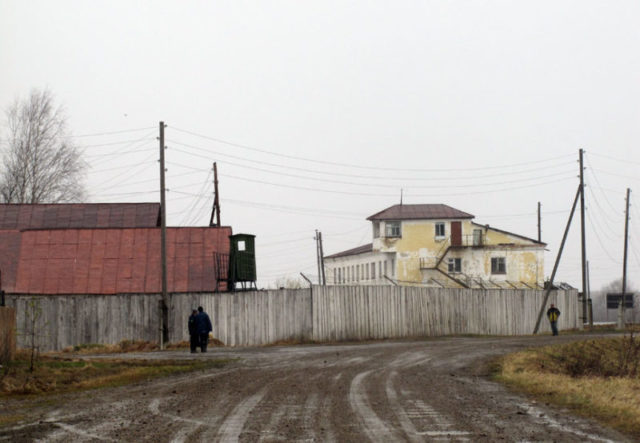
Perm #36 Gulag (courtesy of Ilya Buyanovskiy)
I am taking away a better sense of the “Gulag” or Siberian prison system during Soviet times, which continued all the way through the 1980s. I thought it ended with Stalin. Bullough travels to some of these outposts in both summer and winter. It must have been really tough going to be in a labor camp in those conditions.
He also portrays Russia as a pretty grim place. Rampant alcoholism, declining birth rate, depopulation of rural towns, mistrust in the government, etc. From the Russians I know in Japan, they admire Putin and I thought he was popular, but Bullough talks with a lot of dissidents and people unsatisfied with the country.
Reverend Dudko had an interesting life and a surprising turn which I won’t spoil for readers. I wonder why he picked such an obscure character. He describes going to the important places of Dudko’s life and tracing his steps from a young dissident priest to dying in 2004. His life mirrors the Soviet Union and serves as a metaphor for that form of government.
I am really interested in all things Russia right now due to my moving to Uzbekistan later this month.
The kids had a pleasant day at Knoebels (pronounced kuh-no-belz) Amusement Resort in nearby Elysburg, Pennsylvania yesterday. It is the oldest free admission family-owned amusement park in the USA. After our Universal Studios Japan (USJ) experiences, it was a much more relaxed, enjoyable and cheaper than the expensive and over-crowded USJ.
It gave the kids a taste of Americana culture. The park is set in a beautiful wooded valley and with free parking and admission and tickets for rides ranging from $1.50 – $3.00, there was a wide socio-economic variety of people. It felt like a bit of old-fashioned Americana. Ocean went on 20 rides and Owen went on 18 rides. In the afternoon, the wait times for rides was very short (5-10 minutes). I even did a roller coaster, The Twister. There are three big roller coasters, many smaller rides, a water park with log ride, games, food, entertainment, etc. It felt like a much bigger Iron County Fair that I used to go to as a kid growing up in Michigan, but maintaining that intimate, travelling carnival-like atmosphere.
Stratos Fear
We passed some beautiful scenery on the way there and back. The Pennsylvania forested mountains being cut by rivers in the back ground and beautiful Pennsylvania Dutch farms in the foreground. The weather was almost perfect with lots of sunshine and not too hot.
A couple of observations about life here that really stand out coming from Japan. The conditions of the roads are much worse than the gold standards of Japan. There are many potholes, cracks, and uncared for shoulders. The USA really needs to invest in infrastructure projects. I also notice the size of people here. We were guessing the percentage of obesity and put it at between 1/3 and 1/2 of Pennsylvanian citizens. In looking up the official rate, I see Pennsylvania is ranked #24 with a 31.6 obesity rate. In Japan it is rare to see someone overweight, so it is a bit shocking coming here. It makes me concerned about the future of American health care, as the rate is increasing. A national exercise and healthy eating campaign should be started immediately. Supporting ways for people to eat less, eat healthier and exercise more needs to be a priority. I was surprised to see rentals of motorized wheelchairs for non-handicapped, non-elderly adults so common. They even had a shuttle taking people the 500 meters or so to the parking lot.
My exploration of the Appalachians continued yesterday by a gorgeous hike through Ricketts Glen. In this part of Pennsylvania, a ravine is known as a glen. The hike mostly followed Kitchen Creek, a river that flows down the Allegheny Front (the divide that separates the Mississippi and Chesapeake Bay water sheds) through 23 named waterfalls. I have hike to many waterfalls before in my home state of Michigan and I have never seen so many falls in such close proximity. The approximately 4 mile loop of the Falls Trail and Highland Trail was a good length for a family, with some members not very interested in hiking.
Oliver and Owen climbing above Mohawk Falls
The area is named Civil War colonel R. Bruce Ricketts. He made a fortune as a huge land owner through lumber, clear-cutting much of the area except the area around the ravines. There are many old-growth trees along the hike. Old trees are sacred to me and seeing the 300-year old behemoths is awesome. Ricketts’ ancestors gradually sold pieces of his properties to the Pennsylvania State Games Lands. Eventually conservations became involved after World War II and it became the Ricketts Glen State Park. Ricketts also put in three dams and today swimmers and boaters enjoy Lake Jean, named after one of his daughters.
The king of the waterfalls is 94-foot high Ganoga Falls. Many of the falls on the trail are named after Native American tribes, but the origin of Ganoga is unknown. The second highest falls are “only” 61 feet high, so Ganoga stands out. All of the waterfalls are beautiful in their own right and all of them would be enough to make a hike worth seeing. Walking by so many of them is incredible and I recommend the trail. I see why it is so popular.
My family and I are leaving Japan after 5 years. This post is a reflection on life in Japan and my likes and dislikes about the country and culture. Living a global nomadic life, I’ve lived in many different countries and realized that every place has things that I like about it and things I dislike. Overall, the Japanese treated my family kindly and we will have fond memories of our time here.
Japan is interesting because it is distinct. With increased connectivity of communication and transportation, many places around the world are becoming more similar, especially in richer nations. Japan, however, is like no other place in the world. I think this is because it was closed off from the outside world for over 200 years until the mid-19th century. The isolation enabled the culture to develop independently of others. The second factor is the homogenous population. Japan does not allow immigration at any scale, so ideas brought by residents is limited. We were temporary residents working for a Japanese foundation and not immigrants. There are very few foreigners living in Japan than other countries.
Society is impacted greatly by geography. Japan is a crowded island. The area of the islands of Japan are about the size of the state of California. There are 40 million Californians, compared to the 127 million Japanese. Taking into account the mountainous landscape of Japan’s location on the Pacific ring-of-fire, the amount of suitable living space is limited. In order to make the society function smoothly in this densely populated nation, the behavior of individuals needs to be strictly controlled through laws, rules and etiquette. For example, when I purchased a car, I needed a certificate stating I had an available parking space from my landlord. Often the police will come and inspect the address on the certificate to verify that a space actually exists and is of proper size. The narrow streets do not allow for street parking. I got caught parking overnight in front of our home and the fine was 15,000 Yen ($140 USD). In a place with more space, parking would not be so tightly controlled.
Farewell – Kita Senri Station
Japan is the oldest country in the world demographically. Approximately half a million more citizens are dying each year than are being born here. As with many developed nations, the birth rate has fallen and the government is desperate for Japanese women to have more children. However, in practice, they do not make it easy, with limited and expensive day care, high educational expenses and many jobs for young people are low-paying. The government is worried because of the increasing costs of health care and pensions for its elderly. With less young people entering the work force, there is more pressure on the government to fund these programs. That is the major reason we left Japan: the high tax burden. Around 50% of our income was taxed and that did not include sales taxes, highway tolls and various fees charged for government services. Unlike the government, I am in favor of depopulation here. There are too many people and if they do not allow major immigration, Japan will have a population around 50 million by 2100. That sounds like a reasonable population density to me! The challenge will be to pay for taking care of the big demographic layer of +60 year olds as they age and die.
For every aspect of Japan that I like, there is a side of it I don’t like. Regarding taxes, it drives foreign teachers with children out of the country, but the high taxes do provide a world-class infrastructure of safety. One rarely sees a pot hole on a road in Japan. An ambulance or fire truck will be at an emergency in literally minutes. A small fire at our school had a dozen fire and emergency vehicles at the scene very quickly. If you get in trouble, the system here will save you. That gives residents a peace of mind. After a few days here in the USA, that is one of the first things I notice is the poor condition of the roads.
The aspect I loved the most in Japan was the ability to ride my bicycle anywhere safely. There are a lot of pedestrians and cyclists, both for recreation and just getting one’s daily errands completed. Drivers are courteous and well-trained to be aware of bikes and walkers. The roads and sidewalks are also in mint condition. I biked to all of my meetings at the university from my school, 19 kilometers away. I rode mostly on the busy 171 street and never had even a close call with a vehicle. I really got into cycling while here and it gave me unmeasurable pleasure to cycle through the landscapes of Kansai, both urban and rural. I don’t think I’ll ever have a better place to cycle.
Osaka is the eating capital of Japan and the quality, variety and distinctiveness of Japanese cuisine is outstanding! I ate the best seafood I’ll most like ever have. There were so many different species of fish and marine organisms, from winter conger eel, to tuna sushi to roasted squid on a stick. I even tried whale during my time living in here (not great). I developed my palette for seafood and learned to use chop sticks comfortably.
Everyone takes their job seriously in Japan and tries their best, regardless of how much they earn or how prestigious the position is perceived. It is really nice when the convenience store or parking attendant goes out of their way to make sure you receive the best service. The Japanese pay attention to the details and one can be assured that all options will be considered when you are getting a service, which is especially nice when at the dentist or at the hospital. The flip side of this is people stick to procedures, checklists, etc. and when the occasional out-of-the-box thinking is required, it will not happen.
One of my goals in moving to Japan was to experience the idea of the group being more important than the individual. Working in affluent schools, people with wealth do not flaunt it. It was refreshing to see so much modesty in a culture and people thinking about the feelings of others. At times this is suffocating however, and I am not sure if it is healthy not to be able to express oneself freely. Related to this is the closed and quiet nature of Japan. We missed the warm, open and loud relationships of Latin America and southern Eastern Europe. I didn’t miss open conflict with people, but on the reverse of that, I did miss easily connecting with people. Part of it was language.
The city of Minoh was absolutely a great place to live. Located so close to the Minoh Quasi National Park was the key for me. I loved having access to forest and nature minutes away, especially in a metropolitan area of 18-20 million people. The suburb was less crowded than other areas of the city, with plenty of parks and green areas. Our home was huge according to Japan standards, and for me, I liked having the kids so close to us. They couldn’t hide far away on the other side of the house. I didn’t like the lack of insulation and urge the Japan construction industry to make thicker walls and windows. The winter is too long and too cold and energy costs too much not to have insulation. Heating room-by-room, walking around cold or paying exorbitant utilities trying to heat the entire house to a comfortable temperature.
I also gained an understanding of the power of natural disasters. I’ll never forget the morning of June 18 when 15 kilometers away, a quake of 6.1 struck. One needs to experience the sounds and sensations of the earth moving to appreciate the force of nature.
It was good for us to experience Asia. Nadia and I always wanted to see what it is like here after a long time in Latin America. Commentators say that this is Asia’s century, and in some ways, early into this century, they are right. There is a hustle and bustle that you don’t feel in other parts of the world, especially in East Asia. The airports are much better and they are more advanced in many ways. My problem with is the over crowding. I missed the wide-open spaces. Traveling to Beijing, Hong Kong, Seoul, Singapore, Bangkok, Tokyo, etc. I could feel the force of humanity, too many people living too close together.
Thanks Japan for five pleasurable years. I’ll be following the country from afar and wish good fortune to my friends and colleagues.











 Bill's Blog