Things are very organized in Japan. One example is the candidate boards at polling stations. This is a municipal office in our neighborhood and in preparation for the election on July 10, the 8 candidates are neatly posted in their positions on the board on the left. One does not see signs haphazardly posted around the city. There are strict regulations for all political campaigning.
This is a historic election because it is the first election where 18 year olds can vote. The voting age was recently lowered from 20 to 18. The election is for the upper house of the legislature. The television NHK was at our school this week filming Kwansei Gakuin university students speaking to the Japanese grade 11 and 12 students about voting. The voting rate is around 50% for most elections here. The 18 and 19 year olds are only about 2% of a population that is heavily skewed to an older demographic, so it will probably not affect the outcomes of the elections very much. I think it is good to get younger people voting and hopefully it will bring fresh ideas and innovation to politics and the economy.
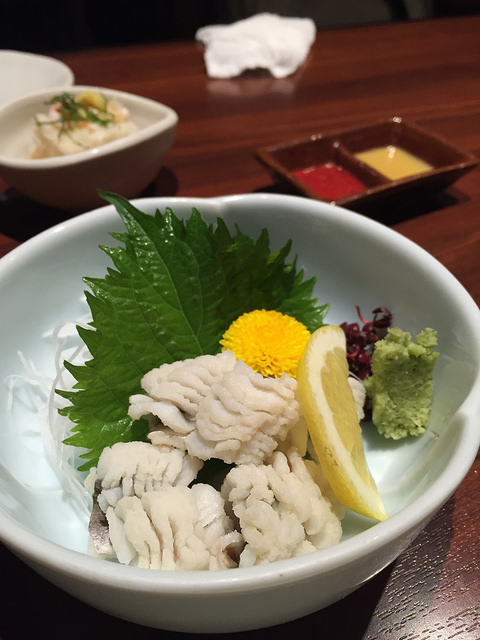
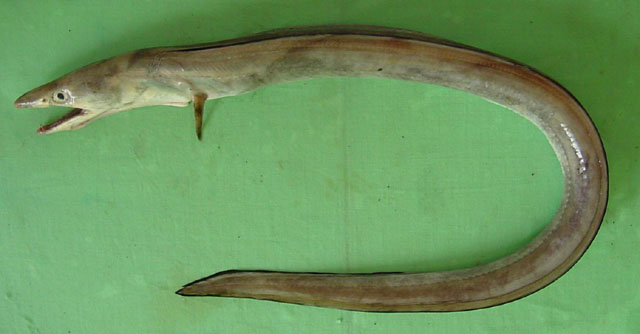
Japan has a “foodie” culture and presentation and delicate tastes are very important at restaurants. They also eat everything that comes from the sea including the summertime Kansai (name for the western region of Japan where we live in Osaka) dish, hamo. It is in the foreground in the photo above and served with beefsteak leaf, wasabi paste and either a spicy red sauce or mustard. It was delicious but when I looked up the English name for hamo, I found it was dagger-tooth pike conger (Muraenesox cinereus) a type of eel. It lives on the sandy bottoms of oceans up to 100 meters deep.
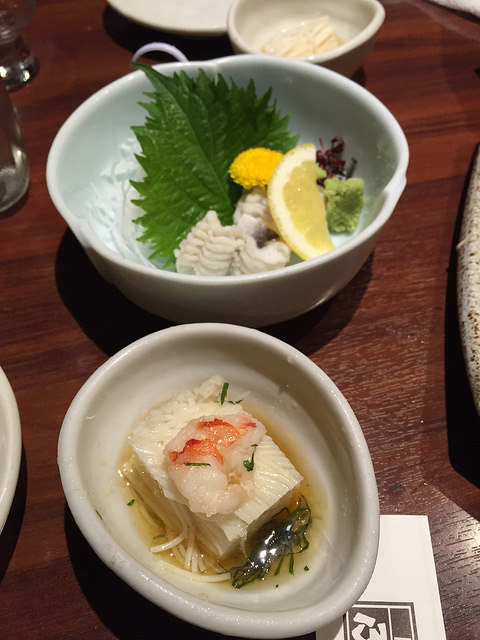
Hamo is best in the summer and I love the seasonality of seafood. Fish are best to eat at certain times of the year and each season brings with it new fish and other creatures to try. I am trying to learn all of the different seasonal fish and also learning how to prepare them. I never grew up eating much seafood, but really like it and I know that it is very healthy for me. One of the starters was the summer noodle, somen, which is in the foreground in the photo below. It is served cold. I had these dishes at Fujiya a restaurant close to the kitaguchi-nishinomiya station.
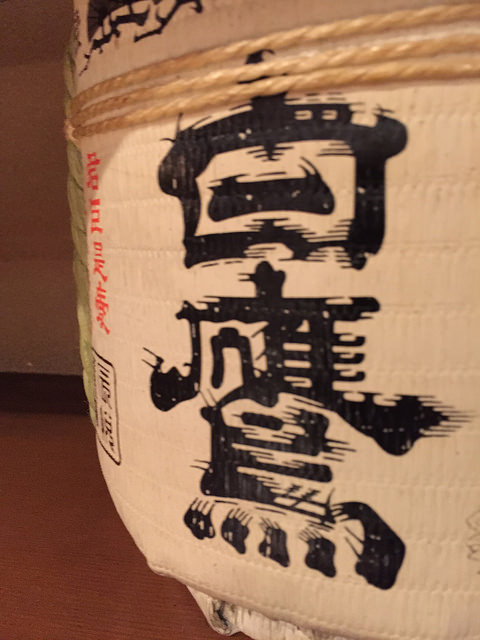
People like to socialize and drink over meals in Japan. Restaurants rather than bars and dance clubs are less popular than restaurants. Meals last a long time and are many courses. It must be the Japanese metabolism that keeps people thin here because when they go out, they eat a lot. Below was my kanji lesson for the night. The top part is the kanji for white and the bottom has a portion for bird and go forward, which signifies “white hawk” and it is a type of sake. I would like to learn more about how sake is made and the different types of sake.
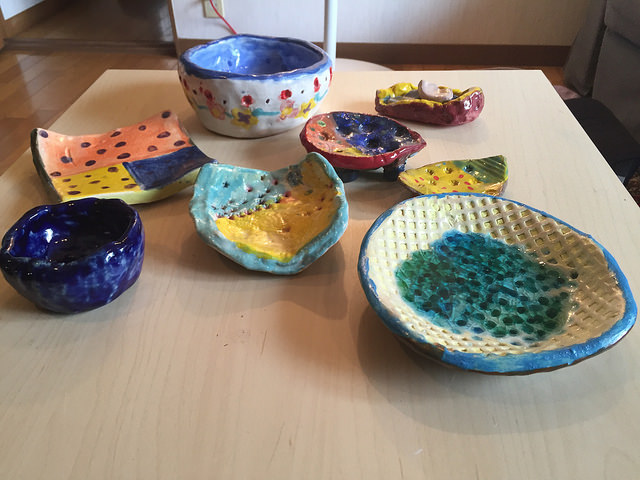
Ocean has a strong artistic bent and is always producing art works. This week she brought home her ceramic pieces from school. She has a great eye for color and shape and they are some pretty impressive dishware from an eight-year old. Our school’s art program is excellent and it is rare that a second grader would have the opportunity to produce this many ceramics.
Nadia and I attended Oliver’s parent teacher conferences last week. He is such a cute little guy! He still writes cartoon stories of violence and technology like he did in grade 1. Ollie is shown above in front of his time machine that he and a couple of classmates constructed. He is slowly maturing and we are proud of his accomplishments. His team lost in the finals of the World Cup Soccer tourney at school in penalty kicks, but he handled it well. I loved his friend Noah’s story about Oliver’s trip to Guam. Hilarious!
Ocean recently has been taking vocal lessons at school and it culminated with a concert. You can see a bit of the video below. She really likes singing, although I think she inherited my lack of musicality. It was very special to watch her perform. She also did a duet with an older student. I’ll link to the full concert when it goes online. Ocean was a bit nervous at the start, but felt more comfortable as the song went on. Performing and presenting oneself is so important for one’s development. Good on ya Ocean!
Nice to see the bullpen car survives in Japan professional baseball!
Owen, Oliver, Kenta and I went to yesterday’s Hanshin Tigers versus Soft Bank (Fukuoka) Hawks Nippon Professional Baseball league game at Koshien Stadium. In a pitchers’ duel, the Hawks defeated the Tigers 1-0. Kodai Senga pitched 8 scoreless innings to improve his record to 7-0 in 12 appearances. Soft Bank, the biggest cell phone and internet company in Japan, really does a good job in baseball operations and has far and away, the best team and organization in the league. They are 44-17 this year to be atop the Pacific League and have won the Japan Series the past two years. Senga is one of many excellent pitchers for the Hawks. They originally were based in Osaka and were owned by a railway company before being purchased by a department store in 1988 and moving to the southern city of Fukuoka.
The Hawks had great pitching from Randy Messenger, the 6-6, 265 American import. He played for the Florida Marlins, San Francisco Giants and Seattle Mariners in his 4-year MLB career. Messenger has played for the Tigers for 7 seasons and is their ace, despite being sent to the minors briefly last year. Messenger pitched 8 strong innings and the Hawks scored the only run in typical fashion in the third inning. After a leadoff hit, a sacrifice bunt moved the runner to second. They love sacrifice bunting here. Senga got a hit to move the runner to third and then a suicide squeeze bunt play brought the runner home. Messenger also had one of the 4 Tigers’ hits and deserved a better fate.
Other observations:
The Asahi beer girls must have been uncomfortable in the hot temperatures but beer sales were quite brisk.
This was a rare interleague game, as the two leagues (Central and Pacific) only play each other from May 31 to June 23 in a 144-game season. There are only 12 teams total, six in each league, so it must get boring to play the same 5 teams all the time.
They still use the bullpen car to bring in relief pitches. The car at Koshien is a convertible. Much better than the golf carts with a baseball on top like in the 1970s MLB.
Our man Tsuyoshi Nishioka got the start at third base for the Tigers and of course struck out twice and grounded out to first base. He has the best song of any player, however. (see video below) The fans are constantly singing or slapping the plastic bats together.
The end of the school year is always busy and I don’t have much time for family and personal reflection. I am catching up on my blogging with a post about last weekend.
Much of my time last weekend and this week has been assembling a basketball hoop. We purchased a plexiglass board, adjustable hoop from Costco, which was on sale. It has pushed my mechanical ability and has required drilling, using two wrenches simultaneously, hoisting the backboard up to connect to the pole, etc. all the while reading through a 70+ page manual. Many of the parts’ bags were open and so searching for nuts, bolts and small parts has been tedious. The only good thing about the experience is spending time with Owen! He is a patient and positive kid and the reason I am putting myself through this. We will certainly enjoy the hoop once it is up. With vacation looming and typhoon season on its way, I am hesitant to finish and put it up while we are away for 6 weeks. Several times in the process I have wanted to write a strongly worded letter to the Lifetime, the manufacturers of equipment. Can you make it a bit more complicated so it will take even longer than the 4 hours normally required to assemble it?
June and July is the rainy season here in Japan and there has been plenty of grey skies. The humidity is crazy high and combined with warm temperatures, it feels like tropics. I always loved summer growing up and would rather be uncomfortably hot rather than painfully cold. It is so humid that paper left on my desk has that soggy feel. Sunday afternoon whiffle ball continues and last weekend, Ocean hit a walk-off double, with Owen scoring the winning run. Oliver had a chance to make a catch that would have extended the game, but he completely missed the ball. We all had a great laugh, even Oliver. I love baseball and think my kids like it too. The rain kept everyone away from our neighborhood, Matsuide park, except for us. A memorable afternoon for me.
On Saturday night the administration team went downtown Osaka for dinner and drinks. We had a lot of laughs. The urban Japan scene is fun and so different from where we live in the suburbs. I wouldn’t want to live down there, but it is a good night out. Below is a photo of the 70-meter, 18-story OS office building. There is lot of interesting architecture in Japan CBD (central business districts).
We had a bit of a scare on Monday when Owen went over his handlebars on his bike ride to school this morning. We was going over a bump and came down awkwardly and hit his front brake too tightly. He broke his fall with his wrist. Thankfully he just had scrapes and bruises and we not seriously injured. He is pictured above in the school health center. The dormitory students were quite nice in helping up and get to the nurse. As you can see, by Wednesday he was back to his normal, smiling self.
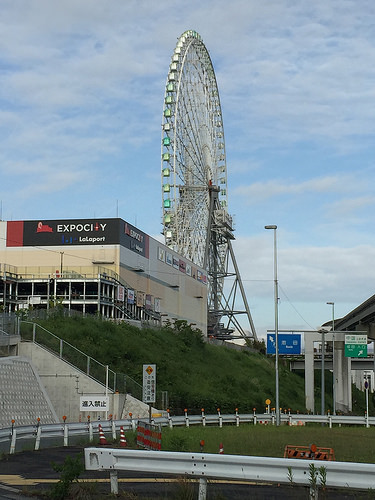
On my own bike ride this morning, I noticed that the ferris wheel at the Expo City Mall is almost complete. There is a very wide bike/running lane around the entire park and it is one of my regular bike routes. It is about 13 kilometers and can be completed in less than an hour, so it is ideal for before school or in the evening because it is safe from cars. The mall is another development that has taken part of the park away. It is hugely popular based on the weekend crowds. Combined with the new Suita City soccer stadium across the street, it is a hub of activity. Ferris wheels are quite popular in Japan and there seems to be one in every city. I don’t see the appeal to them, but maybe I am a just a grumpy, old man.
Unlike non-educators, I go to prom every year. It is much different of course as an adult chaperone rather than a teenager, but it is still fun. Nadia loves to dress up and go out, it is part of her Latin America heritage where social outings are almost mandatory. We had a nice time dancing to a few songs and trying to take pictures of friends’ children.
Our school is owned by the Kwansei Gakuin Educational Foundation which has besides us and several K-12 schools, they also run a 24,000-student university. Above is a photo I snapped before a meeting with the board of trustees. The campus looks like Stanford with the Spanish style buildings and palm trees. I enjoy cycling to the university from our campus (approx 20 kilometers) and because of traffic, it is not much longer on bike than car.
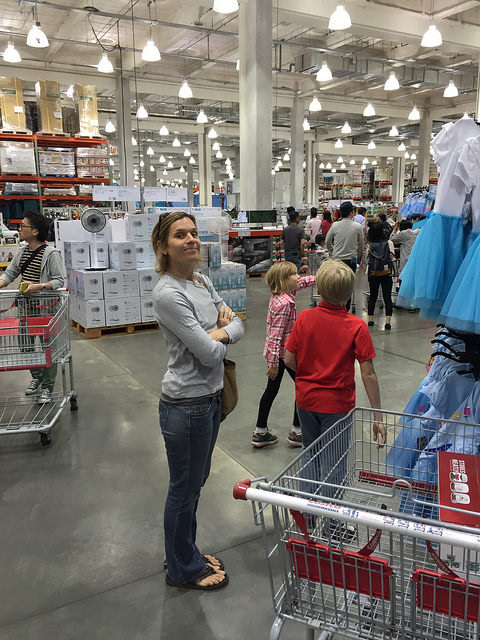
On Sunday we drove over to the Kyoto Costco for supplies. With the kids getting older and eating more, the bulk purchases make sense for our family. It is nice to have the American warehouse retail chain in Japan. We get items not usually found in Japan and there are some pretty good deals.
I just finished reading the 2010 novel by David Mitchell. He is famous for writing the book that later was a movie, Cloud Atlas. In reading a bit about Mitchell, I didn’t know that he lived in Hiroshima for 9 years and is married to a Japanese woman. The work of historical fiction is set around the turn of the 18th century in the Nagasaki Bay. This was during the time that Japan was closed to the world and the only contact with the west for 200 years, was a small, artificial island trading post managed by Dutch traders. The story’s main character Jacob, is a young clerk who falls in love with a Japanese medical student. As with Cloud Atlas, there are several plot lines that come together in the end.
As with all good historical fiction, the book gave me a strong sense of what it was like back then. Mitchell writes in the final pages that “Obscurity is Japan’s outermost defense. The country does not want to be understood.” Japan was for over 200 years blocked to the rest of world and leaving the islands or visiting the islands was punishable by death. Mitchell is right in that during a time of colonialism, Japan was not taken over by the Portuguese, Spanish, Dutch, English or other maritime powers when neighboring nations fell. Mitchell’s years in Japan served him well for this book in that he understands Japanese culture intimately. It is a decent story and I enjoyed being taken away in the evenings before falling asleep. One takeaway from that period is how slow news travelled. The Dutch traders only learned of the bankruptcy of their company a year later and with news only coming with incoming ships, they were even more isolated that other places. Today with the internet, an information-rich environment and instant transmission of news, it is hard to think how it would be to live like that. I also liked that Mitchell told the whole story in a realistic manner and we get to see what happens to each character years later.
Hopefully I’ll get the opportunity to visit the island which is now a museum and see the city where the second atomic bomb was dropped, ending World War II.
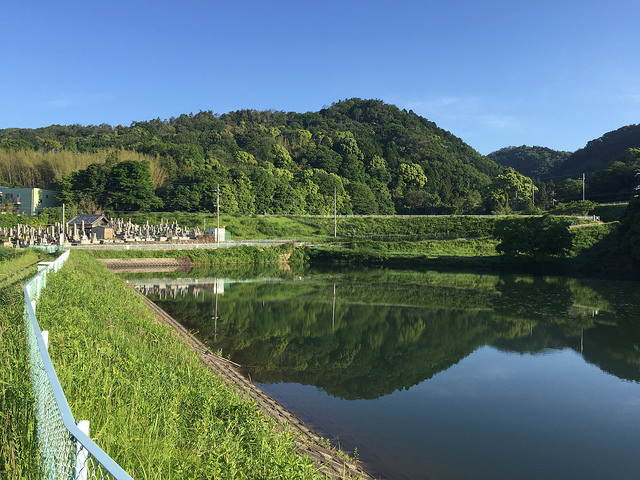
The weather in April and May in Japan is absolutely the best! On one of my morning bike rides this week, I came across the scene above, one of the many reservoirs for the rice paddies in Minoh. The fresh green leaves, blue skies, cooling breezes, dogwood flowers and bright sun just make it delightful to be outside. I love the early sun rise in Japan, it gets light before 5:00 AM and it is a perfect time to exercise for me.
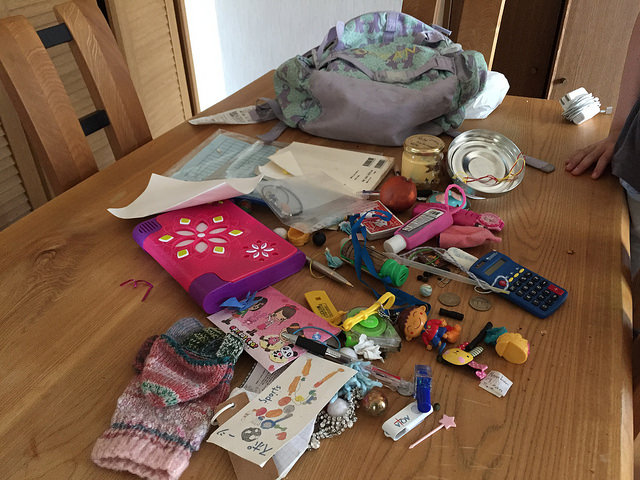
I cleaned out my daughter’s backpack and I am always amazed at the amount of stuff she collects! Her backpack is a reflection of her room. She is often making little projects with her hands like taking an aluminum container cover and converting it into a stylish hat. She also has many diaries or journals. She is a queen of clutter, but oh so creative.
\
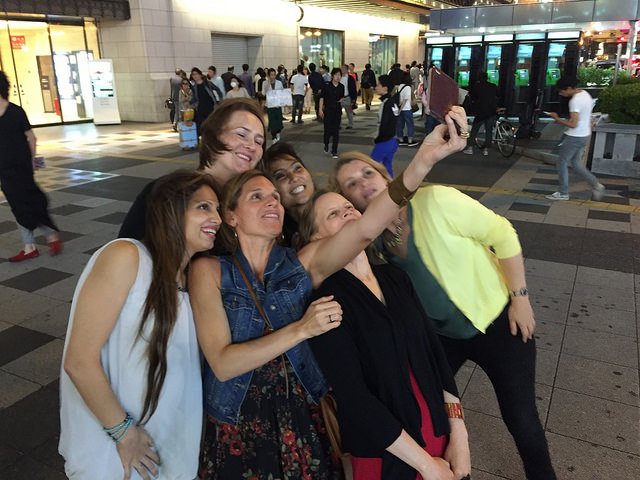
Last night we went out to dinner and dancing with friends downtown. I recommend the Absinthe Solaar which is located on the roof of the Takashimaya department store. It is a Mediterranean style restaurant. Later we visited a nightclub popular with international people. We had a lot of laughs and special thanks to Anna Y for being an awesome tour guide!
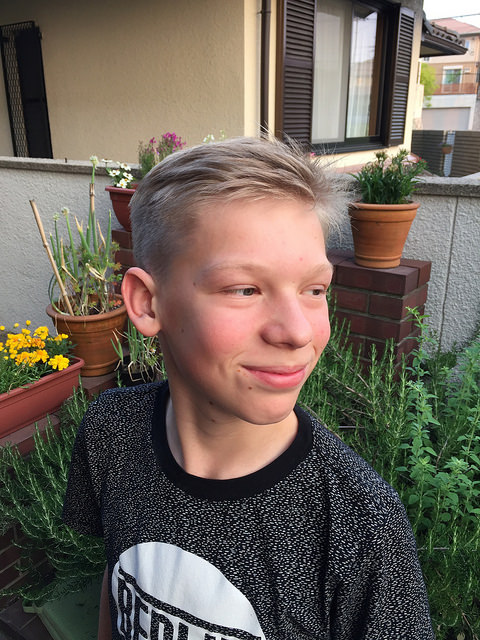
Finally, Owen was quite pleased with his haircut. His hair was getting into his eyes when he played basketball and he wanted a short cut for summer. It is really nice to have him as our in-house babysitter now. He is growing up!
Friday I attended the AISA (Association of International Schools in Asia) meeting hosted by the Yokohama International School. AISA is our high school’s athletic conference and includes international schools from Korea, Japan and Taiwan. It was my first time visiting and I wanted to give my impressions.
Gate to “China Town”
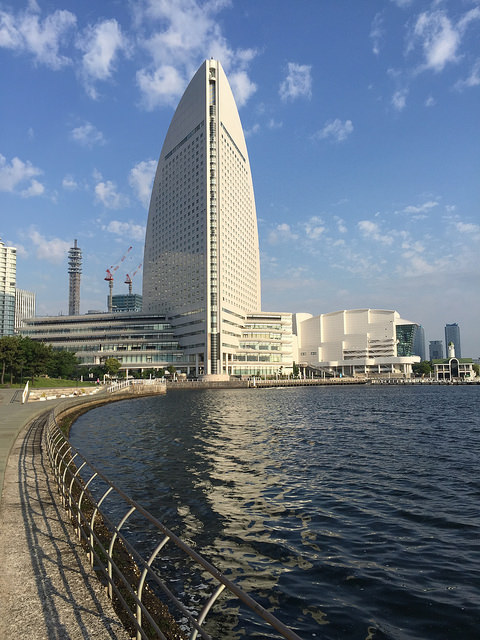
Yokohama is continuous with the Tokyo being part of the largest metropolitan area in the world, but on its own, it is a city of almost 4 million people. Thanks for US Commodore Matthew Perry landing with his “black ships” in 1853-54 just south of present day Yokohama, it went from a small fishing village to the first port and enclave that foreigners could use when Japan opened up to the world. The Tokugawas chose Yokohama because it was not too close to Tokyo. The Yamate area where the school is located, is on a bluff overlooking the bay, and it had a Mediterranean feel to it. It was still Japan, but one could notice the foreign style residences, which are much more spacious than regular Japanese housing. There are spectacular views from the park and foreign cemetery on the hill. We had lunch in the largest “chinatown” in Japan and there is a fashionable shopping district similar to Tokyo’s Ginza, called Motomachi close by also. It seemed to be a really nice place to live, although probably very expensive.
Mount Fuji can be seen from the school
The port is huge and well developed like most urban coastline in Japan. The reclaimed land holds a large warehouse converted into shops and restaurants. There are plenty of parks and a bicycle/running trail all through the bay. They were hosting a major tour event by International Triathlon Union on Saturday. It inspired me to run a bit faster to see all those young men and women in such excellent physical condition. I stayed at the Hotel New Grand, the same hotel that General MacArthur stayed after Japan’s surrender ending World War II. It was one of the few places undamaged. Large, western-style rooms, a decent Western breakfast buffet and an International Herald Tribune delivered to my room in the morning, made for a very relaxing stay. I see why MacArthur stayed here.
MacArthur leaving the New Grand Hotel – 1945
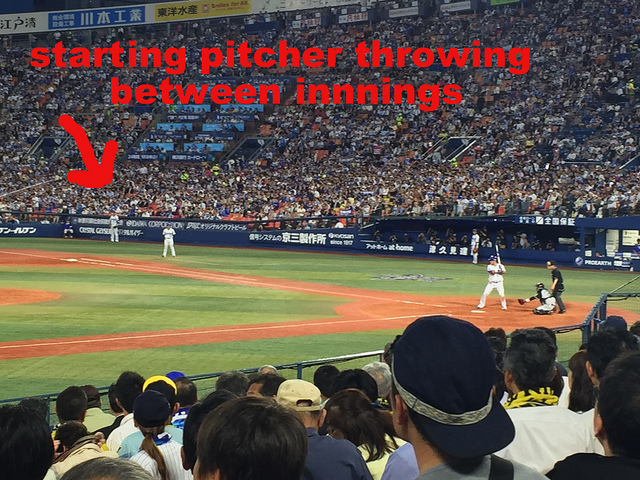
The highlight for me was the opportunity to watch the Osaka Hanshin Tigers play the Yokohama DeNA Bay Stars on Friday evening. The Nippon Professional Baseball game between the fourth and sixth place teams in the Central League was played to a capacity crowd. The stadium is much smaller than the Tiger’s Koshien stadium and there were more Tiger fans than the home fans. I finally got to see a Hanshin victory thanks to Ryota Arai hitting a ninth-inning home run to give the Tigers a 3-2 win. It is interesting to see Japan’s take on the American sport of baseball. I was shocked to see the starting pitcher for the Bay Stars pitching while his team was batting to keep loose. In the MLB, managers are restricting the number of pitches to reduce injury, and in Japan, they disregard this. He threw 112 pitches before being taken out in the 8th inning, but with his between innings throws, he probably threw over 200 pitches. The between innings throws were not game speed, but they were pretty hard. I don’t understand it. Anyway, it was an enjoyable game except for the tight seating arrangements. I was in a group of large North Americans and the seats were designed with smaller people in mind.
I really liked the feel of Yokohama, much less busy than Tokyo and I would like to bring the family up to stay sometime. It would make a good weekend get-away and has something for everyone in my family, shopping/restaurants, the historical Yamata district and lots of parks.




 Other observations: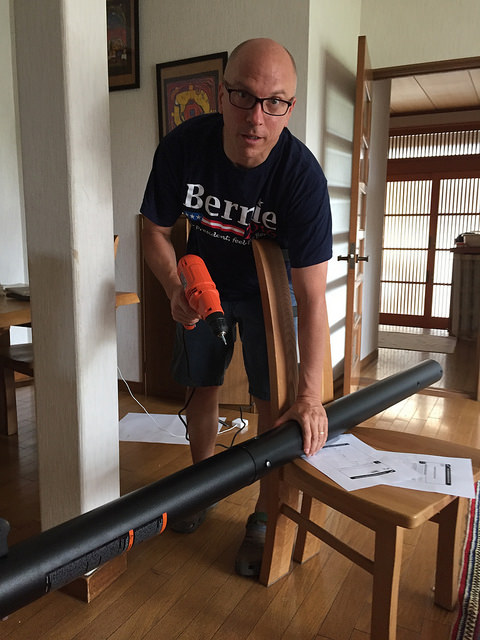







 \
\


 Bill's Blog