Waterfront Tokyo

Boats in the Shinagawa canals near Tokyo Bay

One forgets that Tokyo is on the water. The metropolitan area is massive and every trip I make I get to know a different part of it. This time I explored the area around Shinagawa station. Shinagawa is one of the major train stops in the huge spider web of train lines that makes up the network. We had dinner on one of the canals that comes in from Tokyo bay. It was odd to see big fishing boats close to big buildings. It reminded me a bit of London and the Thames River.

My morning run

Most of Shinagawa is reclaimed land and has been occupied since the Edo period. Today it is the home of hotels, embassies, office buildings and home to close to 400,000 people. You can feel the density with the many apartment buildings. It is very pleasant along the water and the best example I have seen in Japan about developing the waterfront. In the US and Europe, property along the water is looked at as desirable they are often packed with expensive housing, restaurants, bars, and usually have a walking/biking trail. Japan on the other hand, does not view waterfront property like that. Most coastline real estate is not residential. It is just not in their culture to desire living or being on the water as much as in other countries. That is odd for an island. I think it that it dates back to the Shikoku period, when for over 200 years, citizens were not allowed to leave Japan.

Shinagawa has a nice paved path that made for a pleasant run this morning. I spotted black-headed gulls, cormorants and spot-billed ducks in the pretty clean water. At least it didn’t smell or look polluted.

The view from the TY Harbor restaurant

Alas, I didn’t have enough time to explore the area more because of work, but it did give me a glimpse of another part of the biggest city in the world. I recommend a night out on the water. We had the head of school dinner at TY Harbor restaurant. The food was decent and the craft beers delicious. It also had a bustling atmosphere and different from Osaka, lots of foreigners. I hope to get back again.

Family Journal: Ollie Makes History & Earthquake!

26240572122_760500423c_c

Oliver made Kralovec family history yesterday in snagging a foul ball at a professional baseball game. He attended the Hanshin Tigers vs Hiroshima Carp NPB (Nippon Professional Baseball). Unfortunately, the Tigers lost 2-6. They are still tied for first with the Yomiuri Giants in the Central League with 8 wins, 5 losses and 1 tie (yes, there are ties in Japanese baseball). It is nice also that Hanshin shares the nickname of Tigers with our beloved Detroit Tigers!

It was a foul ball off the bat of Tiger’s outfielder, Kosuke Fukudome, former MLB Chicago Cub All Star. He was so excited, but I think me more so. Since a family trip in 1977 to Minneapolis and a three-game series between the Minnesota Twins and Detroit Tigers at the old Metropolitan Stadium, I always bring a glove to games just in case we get a chance for a foul ball. In all of the professional baseball games I have attended, including MLB, minor league games, the Venezuelan Winter Leagues and now NPB, a member of my family finally caught one! It only took 39 years! Way to go Ollie!!!!

26241273972_c71d4cd539

Either Nadia or the shaking of two earthquakes woke me up Saturday night. According to the Japan Meteorological Agency’s webpage, you can see at 1:55 AM an earthquake of magnitude 3.5, struck near us. The earlier earthquake at relatively the same spot had a magnitude of 4.0. Earthquakes between 3.5 and 4.0 are minor or light according to the Richter scale and will result in shaking and rattling noises. I certainly felt it and it made me understand what a major earthquake must feel like. I can see why people leave their homes after the first big one in fear of aftershocks.

Finally, Ocean found a 5-leaf clover at the local Matsuide Park.

26409014386_edb6ee5dcf_z

AFC Champions League

26257140576_766832d121_z

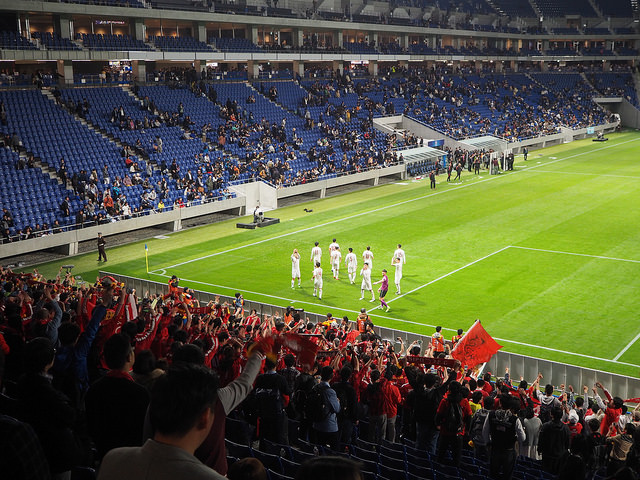
Last night my friend Josep and I took our boys to the Asian Football Confederation Champions League game between our home Gamba Osaka and Shanghai SIPG Football Club. It was our first time to the new Suita City Stadium, which is absolutely gorgeous and a great place to watch soccer. The visitors won 2-0 virtually eliminated Gamba from the competition, but we had a great time anyway.

26197449572_2a4ba238c6_z
Shanghai players acknowledge their fans after the game

The Suita Stadium is conveniently located only about a 15-minute bike ride from our house as Suita is a suburb of Osaka that borders on Minoh. The 40,000 seat stadium opened this winter and it was our initial visit. I loved the rectangular shape of the stadium, without an athletic track that puts spectators really close to the field like in many English Premier League stadiums. I was not sure about the seat location when I purchased them online. We were in the “family” section and the reasonably priced tickets (1,500 Yen for children and 2,500 Yen for adults) gave us seats a few rows from the field behind one of the goals. On the opposite side of the stadium were the fervent Gamba supporters and they provided a nice backdrop with their singing and chanting through the game, similar to the European professional leagues.

26016950100_e6cefa6df3_z
Conca with a free kick

Shanghai International Port Group FC had a much better team and game and deserved the victory. The coach is the famous ex-England coach Sven Goran Eriksson and they had a couple of high-priced stars in Conca (Argentina) and Elkeson (Brazil). They dominated play and fortunately, the two goals in the second half came on our side of the field.

26017005910_6404b18754_z
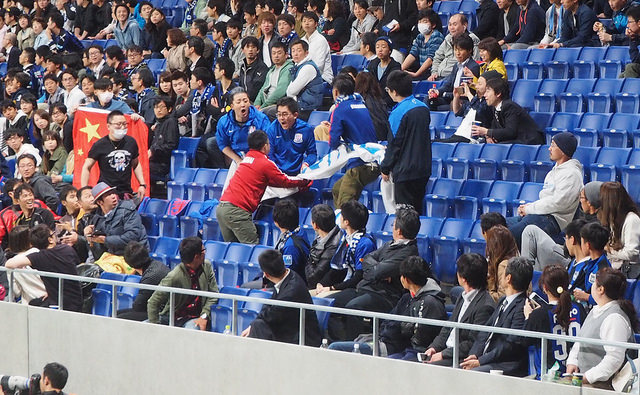
Fight between supporters of the teams

It was interesting to watch the China versus Japan dynamic played out in the stands. We were near the visiting fan section. Several Gamba supporters tried to raise a sign that I couldn’t read but it had something about Shanghai. A Chinese fan grabbed the sign and eventually threw it on the field before being escorted out by security. There is a lot of tension between the two countries, stemming back from Japanese takeover and occupation of China last century. I felt like watching the future conflict between the two countries as China is growing economically. It is the first time in a long time that both Japan and China are doing well economically and I wonder what the repercussions will be for the Asia Pacific region. I hope they can cooperate for the benefit of citizens from both countries.

26017097790_1b81bc3999_z
Go Gamba! 

We had a great night as fathers and sons bonding over sport and it was a thoroughly entertaining night. We might head to another game in the regular J1 professional league this season, although Gamba is currently in 12th place in an 18-team league after 5 games.


Aging Japan

25655229574_b7321b861e_c

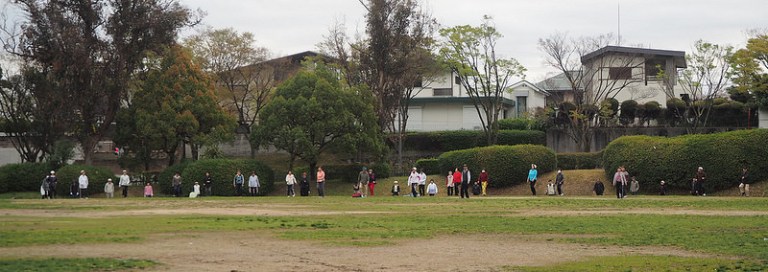
This is a common sight in morning parks throughout Japan. Groups of senior citizens perform synchronized stretching exercises. I photographed them yesterday morning during my bike ride in Senri Chuo central park. 1/3 of Japan is age 60+ and 1/4 is 65+ and this reflects a trend in people living longer and young people having less children. If it continues, in 40 years, 2060, 40% of Japan will be over 60 and the population will drop from 128 million in 2010 down to 87 million. A professor at Tohuko University continued the calculations, stating in the year 3776, Japan will be down to 1 remaining child.

In some ways this is good for Japan in that Tokyo, Osaka and other cities are overcrowded. One needs to be selective when going for holidays or excursions during breaks. Traffic and crowds are something always to be aware of. In many ways it is bad however, to have a dearth of young people, especially regarding taxes and pensions. It will force Japan to consider immigration to get more working age people here.

The exercise group is an example of the healthy living here in Japan and why people live long, productive lives. Older people eat a lot of fish and vegetables, don’t eat big portions and do a lot of walking and biking. That compares to the sedentary lifestyles and highly processed unhealthy diets of many Western cultures.

25987154430_09eefc4cc9_c

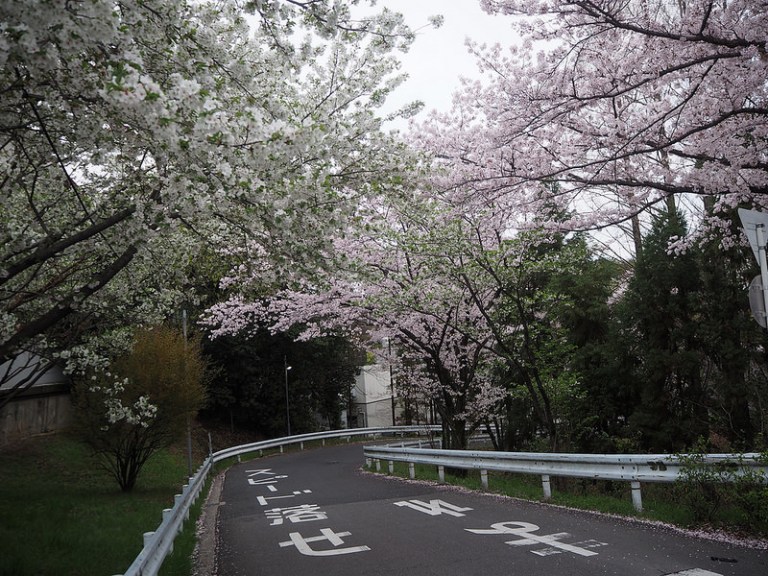
Taking my mind off Japan’s demographics, we are in the middle of sakura (cherry blossom) season and it is really stunning! There are lots of cherry trees in the city and as you can see, they are shining in color. The culture appreciates this explosion of life and the ephemeral nature of the bloom. Hanami (viewing parties and picnics) are common at this time of year.

Goodbye Guam

Goodbye Guam

26079955102_5e97b5da15_z

It is so strange that Guam is part of the USA and prides itself on “where America’s day begins.” Guam is so far away from the continental USA. The closest American state is Hawaii, which is a 7-hour flight away. From Osaka, Japan, where we live it was only about a 3 hour flight and that is one of the major reasons why the US has Guam as a colony, er, “unincorporated territory”. It was a strategic location to fight the Japanese in World War II. Today there are close to 6,000 soldiers and a naval base and air force base on the island. They have 10 times that amount stationed in Japan. I don’t see the USA leaving anytime soon as the Americans will want to keep a presence in the Pacific due to the rise of militarism in China and the unpredictable North Koreans. The locals are ambivalent towards the military, a high percentage serve in the military and the money the bases bring is needed. In speaking with an experienced military person, he mentioned that that there is some resentment for the amount of land that is reserved for the military. He feels they can get by with much less and put more in private ownership.

26172510485_9e874391df_z
Ocean overlooking Merizo

As I wrote earlier, it is a convenient location for resupplying ships and planes. It was the same for the Spanish, who arrived with Magellan in 1521 and ran the island for almost 400 years. They liked stopping to resupply ships going between the New World and Manila. The Spanish treated the local Chamorros horribly for a long time, so when America won possession of Guam after the Spanish-American war at the end of the 19th century, the people were generally happy. The Japanese took over for a 4-year period during World War II and were quite cruel to the chamorros. Today we visited the massacre site of 30 villagers from Malessa. The Japanese army, anticipating US forces retaking the island, took the 30 biggest men and executed them days before the invasion in fear that they would help the Americans. It shows you how much time has passed since WW II in that one of the biggest sources of income today for Guam is Japanese tourism. It is a short flight to a tropical country with US shopping.

25567737504_bd89f4ea90_z
Campaigning for Bernie Sanders in Hagatna

I’ve been thinking about should Guam be independent. The UN, among others view Guam as a colony and declared that there should be no more colonies. Former US president Gerald Ford gave his blessing for Guam to become a commonwealth in 1974, but it was never acted upon and some in Washington actively stopped this movement. I think the locals would vote to stay in the USA because of the development that has come to the island. I have visited several Caribbean islands that are independent countries and the scene is pretty bleak for most of the locals outside of the tourist resorts. They do have much autonomy with a democratically elected governor, a 32-representative legislative body and a supreme court. Guam also gets one representative in the US House, without voting rights, but he/she serves on committee and can participate in discussions. This is much more than they ever had with the Spanish and Japanese. However, I do feel that they should have more autonomy. I would suggest merging with the rest of the Marianas Islands and become a commonwealth, similar to that of Puerto Rico.

It somewhat feels like the USA with Kmart (no competition from Target or Walmart so it is THE place to be in Guam), Home Depot and several American fast food franchises. Most (75%) of the people are chamorro, Filipino, Asian, Pacific Islander, bicultural and only 7% white. That compares to Hawaii with a 25% white population, so it does feel like a foreign place.

26118573805_445f0e176f_z
Guam National Wildlife Refuge – Coconut Palm Grove

When I travel to places I always ask myself could I live here. I am not sure what it would be like to live on an islands 4-8 miles wide and 32 miles long. The weather and scenery is so nice, however. I don’t think I would ever get sick of those beautiful sunsets, Pacific waves, palm trees and the green hills. Sadly the introduced brown tree snake from Australia has decimated the island’s bird population and there is certainly a lack of birds here. Not many mosquitos however as well. The chamorros remind me a bit of the Venezuelans (where I lived for six years) with the cement block, flat roofed homes, cars on blocks in the yard and dark skin. Everyone here has been super friendly and I am sure we could find friends and a community here. I think I could live here with a fulfilling job and good school for my children. We will most likely be back here as it is an inexpensive flight from Japan and there are plenty of outdoors (hiking, snorkeling) for me.

It was great to decompress in a tropical paradise and enjoy a bit of the US culture.

Reaching the Top of Guam

Reaching the Top of Guam

25985522482_215c89f96f_z
Ocean is leading the way 

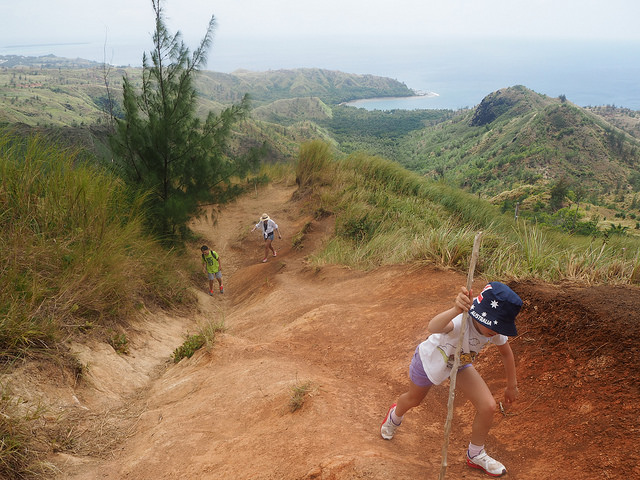
Yesterday we climbed Mount Lamlam (lightning in Chamorro) which is 1,332 feet (406 meters) above sea level. The locals look at it being actually 38,300 feet if you start measuring the elevation from the bottom of the Marianas Trench. However, the trench is 75 miles off the coast of Guam and so cannot really be considered a single geologic feature like Mauna Kea in Hawaii.

We actually did two summits, the first Mount Jumollong Manglo (1,283 feet) is where the annual Good Friday stations of the cross pilgrimage takes place. We saw the white crosses at regular intervals and the big monument cross was a short distance from the fork for Lamlam.

25804530090_0e5126c617_z
Oliver in the grove of Pandanus trees

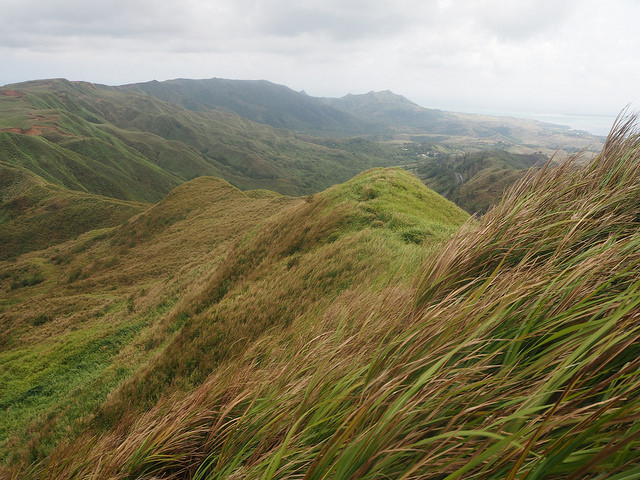
We encountered steep hillsides of sawgrass in the initial portion of the hike. It reminded me of the 1998 movie about the WWII battle for Guadalcanal, The Thin Red Line   . The sign that used to indicate which direction to the two peaks are the fork is missing. For those of you reading this before doing the hike, Jumollong is to the right and Lamlam is to the left on the smaller trail.

26077763215_e53ff880c2_z
Hills of Sawgrass

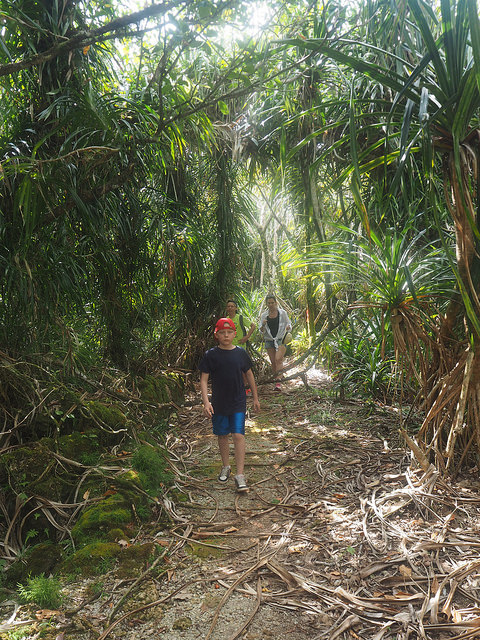
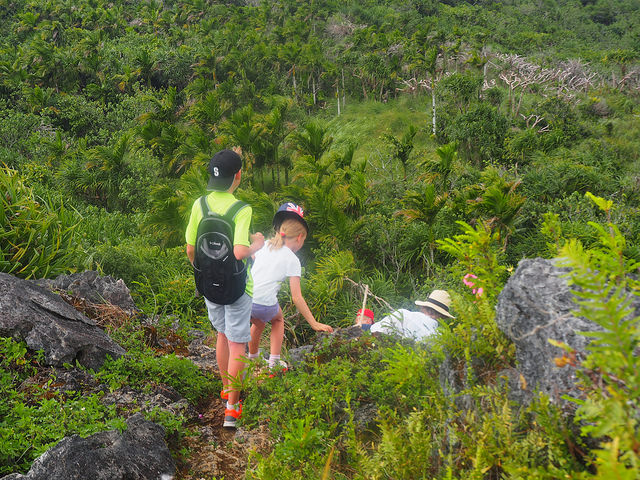
The path to Mount Lamlam goes through some incredibly beautiful Pandanus forest and limestone outcroppings. It is amazing to think that the limestone rock was once coral reef. One needs to be careful climbing on the sharp rock, especially towards the peak. It was the most pandanus trees I have ever seen! It felt like walking on the set of Jurassic Park. I am not sure which species of pandanus of the 750 total, but it is also known as the “screw pine” because the leaves are arranged spirally like a screw and the fruit looks like a massive pine cone. They kind of look like palms, but are not related. I also spotted several cycads, which are endangered in Guam. The forests surrounding Lamlam peak are the only limestone forest tracts except in the Guam National Wildlife Refuge in the far north of the island.

26077822765_30c371a022_z
A careful descent from the peak over sharp limestone

South Pacific Paradise

25441697873_9f28472e46_z

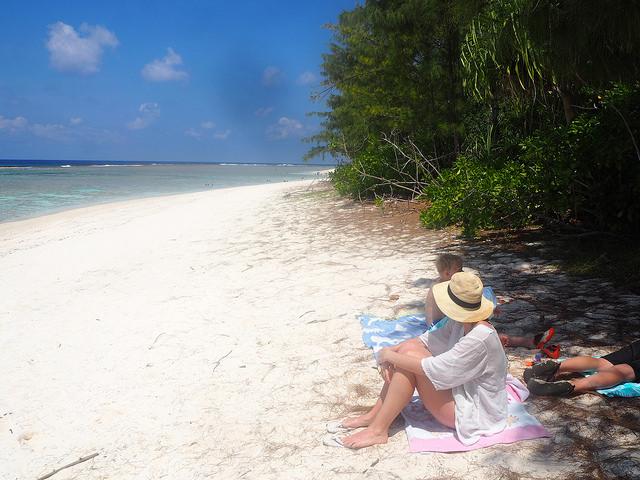
This was our view yesterday afternoon at the Guam National Wildlife Refuge. The refuge is a protected wilderness area that abuts the Anderson Air Force base. They have preserved a stretch of coastline in the far north of the island from hotels, private homes & apartments and other development. If it was up to me, no one would be able to put anything on the a body of water. That is for another blog post…

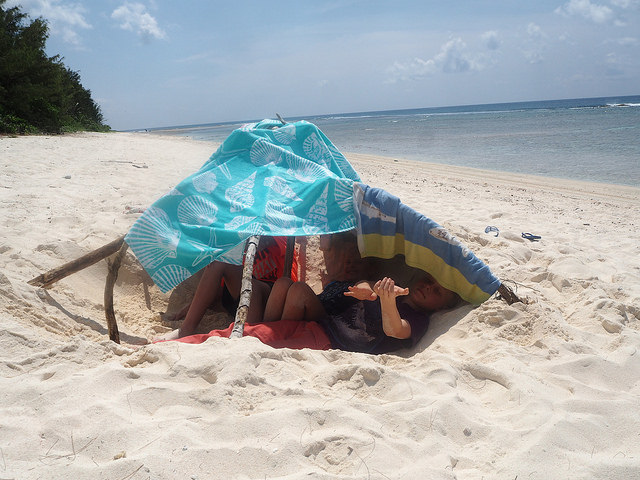
It was a Saturday afternoon and there were probably about 50-100 people in the entire 385-acre park. We had a big section to ourselves. We drove our car down a narrow two-track path to a section of forest with an opening to the beach. It provided a shady, flat area to set up our blankets and gear. There was plenty of coral for the kids to snorkel as you can see Oliver and Ocean below.

25771405640_16c8879532_z

We sadly had to leave at 4:00 PM because government officials close the refuge. We will definitely go back this week and fully explore the trails in the park.

26044210245_52672b3745_z

Initial Impressions of Guam

25373232494_5756b10262_z
Owen and I out on the kayaks. 

I have been on the island for only a few days and mostly spent in the far south of the island. Purposely I chose to stay away from the urban area Agana with its resorts and hotels.

Driving through the villages of the south, it reminds me of Venezuela. The quality of most of the homes is substandard to mainland American homes. Definitely a poorer economy for most of the islanders. This is in contrast to the military housing facilities which are suburbia USA. You can’t beat the weather however, with sunny skies, warm nights and the Pacific ocean always near by, it makes me long for living again in the tropics. I spent 13 years living in Latin America and was ready for temperate climes and the change of seasons, but there is something to be said for tropical living.

25849054092_19f4c9d318_z
Another delicious dinner by Nadia!

I basically see Guam as a roadside park. The Pacific Ocean is huge and refueling/rest stops are needed for America as they try to control shipping and air of the whole world with their military. Hence, the naval and air force bases on Guam and it is an American territory. I can see why Guam and Saipan were fought over so fiercely in World War II. Using airstrips and facilities on these islands put the USA within striking distance of mainland Japan. With China building islands in the south China Sea and apparently trying to make a sphere of influence similar to what America did in the Caribbean (read Robert Kaplan’s book, Asia’s Cauldron: The South China Sea and the End of a Stable Pacific), I don’t see the USA leaving anytime soon. Outside of the city, it doesn’t feel like America until you get in the supermarket or watch TV. Most of the people I see are dark-skinned Polynesians, who look a bit like Venezuelans. It is ironic that besides military bases, Guam relies on Japanese tourism to boost their economy. Over 1 million Japanese visit yearly. It is only an inexpensive, 3-hour direct flight from Osaka.

We are enjoying quiet family time together and soaking up the south Pacific land and sea natural beauty.

25910982261_0cc715e2c4_z
It is nice to have time to watch the sunset. 

Sella Bay Hike

25354819063_7b7223a68d_z
A view to Sella Bay from the top of the trail. 

A wonderful and challenging hike today from the Sella Bay trailhead, 500 meters above the beach. The trail led us across two small creeks and into an old coconut palm grove. The views were spectacular all the way down with some varied vegetation. When we got to the beach, we were rewarded with crossing this old Spanish bridge, over 300 years old. Amazing it has stood the test of time with erosion and typhoons, you think it would not still be standing.

25351020554_23cf8a7da3_z

The highlight of the beach time was the superb snorkeling. Owen and I went out past the reef and looked down into the abyss. Thousands of multicolored fish, coral and other creatures. Ocean and I had a great time snorkeling in the tidal pools.

25889511241_e1822aef58_z

Oliver and Ocean were troopers! Ocean is so calm and methodical in her hiking. Oliver is really in his element in wilderness. It rained a couple of times, making the trail quite slippery in many places. We made it back safe and sound.

25355775783_5c8ae27615_z

We didn’t see anyone the whole afternoon and had the beach to ourselves. I love the tropics and the smell of the sea, high humidity and tropical foliage, made for a day I won’t soon forget! My highlight was Owen’s reaction when we passed the high point of the reef. “It was like a documentary!” The snorkeling was really great and I recommend anyone doing the hike. It is located on the south side of the island, not far from where we are staying.


Sumo!

25769042202_7f581ce258_z
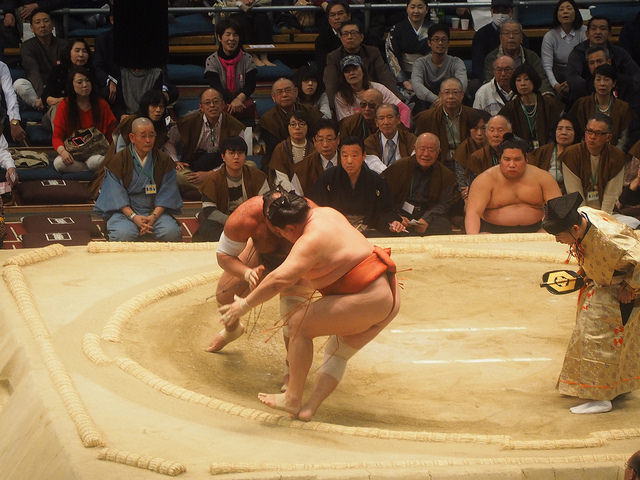
Osunaarashi tosses Asasekiryu out of the ring.

Spectacle. Bizarre. Fascinating. Wierd. Ancient. Cult. Sport. Thrill.

I absolutely loved my experience attending the 2016 Osaka Grand Sumo Tournament on Thursday. I won’t bore you with all the details of the sport. If you want to know more about sumo wrestling, check out this English guide here. There are six “grand tournies” per year, 3 in Tokyo, 1 in Nagoya, 1 in Fukuoka and in March, they come to Osaka.

It is such an unusual sport. They maintain many of the traditions and religious aspects that surrounded the sport 1,500 years ago. For example, after each tournament, they publish a banzuke, which is a ranking of all 800 professional sumo wrestlers. Instead of a straightforward list, it is printed in an ancient format. It is like the top 10 college football rankings to be written like the Declaration of Independence, with cursive letters from a quill pen. The ancient customs mean the wrestlers go through the all the rituals like throwing rice to “purify the ring”, the referees where traditional folkloric costumes, etc. The wrestlers choose ring names, like  Egyptian wrestler Abdelraham Salel’s “osunaarashi” which means sandstorm in English. He won his match against a Mongolian.

25589243790_78abf4675e_z

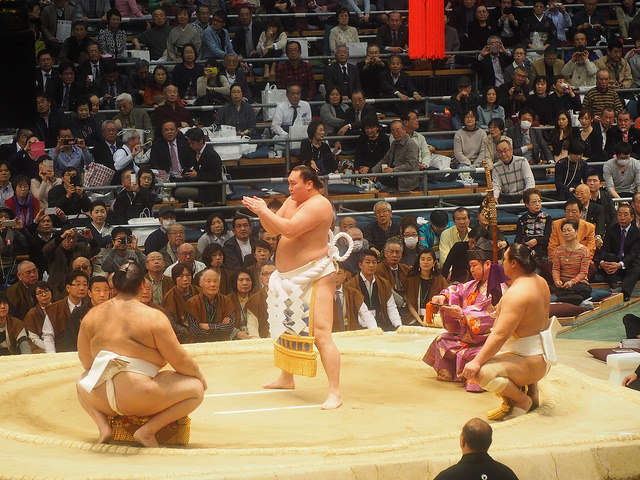
Above is the greatest wrestler in the history of sumo, Hakuho Sho, the winner of 33 grand tournaments, the most ever. He went 86-4 in two consecutive seasons. He is performing another shinto ritual before the matches begin in the final round.

I can see why the guys are so fat. The object of the sport is to push your opponent out of the ring or have a body part other than the soles of the feet touch the floor of the ring. The heavier one is, the harder it will be to move them. I wonder how professional American football players would do in this sport. The sumo guys are big and they must train really hard, but I wonder if one applied the latest techniques in strength training, nutrition, advanced statistics, film analysis, etc. I would like to know more about the different techniques used by the wrestlers.

25794944301_f0a081b1b4_z
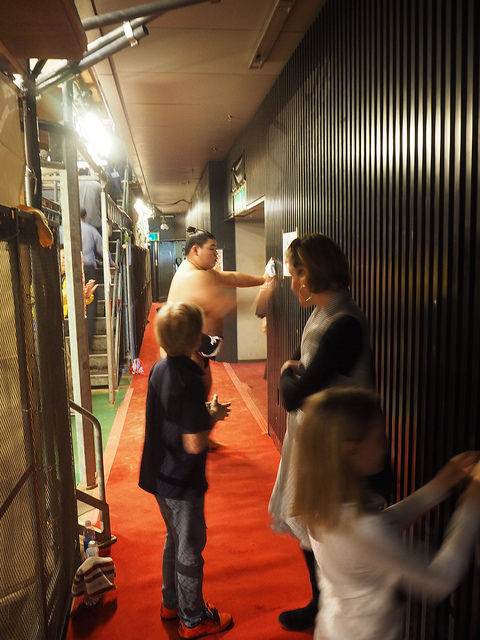
Oliver gets “up close and personal” with a sumo wrestler

The stadium in Osaka is unique in that you can get up close and personal to the wrestlers. You can stand in the hallways as they enter and leave the ring. We also saw many outside the arena, getting lunch at Family Mart or taking a taxi. Hilarious to see these big guys wearing robes and sandals walking through the streets. Their hair smells like chamomile which is another ancient ritual. I wonder if the guys really believe in shinto rituals or they do it because they have to and it is part of the sport. I think it makes the sport more appealing. The top wrestlers make a lot of money and have beautiful wives, which should not have surprised me. Beautiful women seem to come with money.

I will definitely go again, just not with the kids as they didn’t have the patience to sit through so many matches. There are bouts occurring all day, with the lower rounds starting in the morning, culminating with the masters in the late afternoon. It is a 15-day tourney and the wrestlers fight daily in round-robin style. The best record wins.

I will end this post with a portion of Hakuho’s pre-match ritual. He is the greatest off all time!