This morning I asked my father-in-law, Hermes, what he remembered about his paternal grandparents. They are the maternal great, great, grandparents of my children.
The father of the father of Hermes was Pedro Pablo Chavez Balzan, who died around 1920 at age 60. (born approximately 1860). He was one of the original settlers of Santa Cruz. Hermes only remembers some of what his father told him about his grandfather because he died before Hermes was born. When Pedro Pablo Chavez arrived to the area, there were no owners of much of the land surrounding Santa Cruz so he went out and marked 2,000 hectares and made his claim with the provincial government. In those days, one went to the plaza in Montero (a nearby city) to find permanent workers (peones) to clear and work the land. 2,500 hectares is about 20 square kilometers which about 1/3 the size of Manhattan. That is a lot of land! All for free, which is amazing to think of today. Ah, to be the “first” European to get to a place. There are hardships that come with that, but those opportunities only come once in generations of families. The estancia was called La Redonda de Higerones (Around the Ficus Trees).
He also had a house in the center of Santa Cruz. He had five children with two different women. Pedro Pablo is pictured above with Etelvina Justiniano de Chavez, the mother of Hermes’s father. (more on her in a later post) For now, all they said was my wife Nadia has her eyes. Justiniano and Chavez are both common names today in Santa Cruz. I have not seen the Bazan surname, but it is of Spanish/Basque origin.
Their children are as follows:
Luis Chavez – He was a cattle trader who fell out with brother, when Pedro Pablo Chavez died, he sold part of his inheritance to a priest – the house downtown, which caused a rift between the brothers.
Severiano Chavez – The great grandfather of my children and the father of Hermes. I previously blogged about him here, and I will be adding another blog post later
Alicia – ended up blind and living in Brazil;
BernardoChavez– also a cattle trader;
MarianoChavez– lived in the Beni; not sure what he did for a living or anything else about his life;
This morning Nadia, Owen and I ran in a 6.5 kilometer race here in Santa Cruz. It was a charity event to raise money for the Santa Cruz Special Olympics delegation. The Special Olympics are taking place later this month in Los Angeles and the funds generated from this run will help defray the transportation costs for the athletes.
The run was very well organized! It started on time, there was an aerobics warm up, police were out in force to stop traffic, several water stops placed on the route and the race finished with a folkloric performance. Many of the special olympic athletes were at the race and it was a touching moment when one awarded Nadia her finishing medal and gave her a big hug. The race start and finish was in the southern part of the city, in the Plaza Blacutt. With a cool breeze and temperatures in the mid to high 70s, conditions were excellent.
It was rewarding to run with my son Owen and we finished the race in about 31 minutes. I’ll have to check the times online to get the exact timing. Nadia finished a couple minutes after us.
Distance running is new in Santa Cruz and it has become somewhat popular, especially with the upper class. There are events almost every weekend and I am sorry we won’t be here for the SC Marathon taking place in September.
Participating in the World Special Olympics will be a wonderful experience for them and I wish them best of luck!
Coming from ultra clean and organized Japan, it has been a shock to see large amounts of litter, garbage and rubble everywhere in the city. I forgot how dirty Bolivia can be and with the high winds the past couple of days, there is a constant flow of debris. It is nice to vacation in a place so different than what we are used to.
The street in front of the barbershop today.
The city continues to grow. I haven’t been across the Pirai River to the section called Urubo yet where most of the growth is occurring, but in the north part of the city where my father-in-law lives, there is lots of growth. New apartment buildings, malls, paved roads, etc everywhere! It is one of the fastest growing cities in the world. The metro area is now over 2 million people, which feels small compared to Osaka. 🙂
Enjoying spending time with Lulu, our family dog.
I forgot how cheap services are here and how time consuming it is to run errands. We have been improving the house for my father-in-law to make him more comfortable. Buying plants, getting the couches and chairs reupholstered, painting walls, fixing leaks, etc. We hope to be able to take out the bathtub and give him a walk-in shower so there is less risk of a fall.
Owen getting his haircut at El Tiluchi barber in the 7 Calles neighborhood of Santa Cruz.
Despite the growth, the city still has its small town charms. We took the kids down to the main plaza, 24 de Septiembre yesterday. The first revolt against the Spanish colonial government occurred on September 24, 1810. As with many Spanish cities, there is a central plaza and it was full of people. We have many memories of hanging out there going to the Victory Cafe. There used to be sloths in the trees in the plaza but they have been taken away.
Santa Cruz is the economic powerhouse of Bolivia
I haven’t heard much of autonomy movement on this visit. The president Evo Morales is firmly in control and has quashed much of the dissent of his rule. Santa Cruz is the economic capital of the country and the Cruceños have a different culture than the Andinos of La Paz and have resented the internal immigration to the city and tax money flowing out to La Paz. He has imposed harsh discrimination laws and jailed one of the alleged leaders of the breakaway movement. I think and I have wrote this before, that Santa Cruz is more like Asuncion than La Paz and should be a part of Paraguay. Being part of Bolivia brings some benefits and diversity, but it really is a Chaco/Guarani city. Too late now…
People moving from the Bolivian Andes seeking economic opportunities has caused divisions within the country.
There is a lot of poverty here and the lack of education in the majority of the citizens is quite evident. The lives of most Bolivians is stultifying boring, sitting in a market selling cloth, fruit, parking cars, etc. It is a sad fact that there is a lot of lost potential, especially in a country with many young people with energy and ideas.
A tough way to make a living- parking attendant on the streets of 7 Calles.
The weather is absolutely delicious the first week with cool, cloudy weather the beginning of the week and sunny skies with temperatures in the 80s this weekend. The climate and soils make growing stuff here very easy. It could be a tropical paradise with a bit of care. There are many nice parks near our house and the kids have been enjoying playing in many of them.
With Pope Francis (Papa Francisco) visiting Santa Cruz this week, I have been thinking about the Catholic church and his work in the church. I was raised in a devout Catholic family so know much about the church. I read the perfect book to coincide with his visit. “Pope Francis: From the End of the Earth to Rome” by the staff of the Wall Street Journal. The electronic book was about 200 pages, more than a cover story in the paper, but less than an exhaustive biography. It gave me the perfect amount of information I wanted about his life, his beliefs, how he became pope and the future of the Catholic church. I highly recommend it.
The citizens of Santa Cruz went a bit crazy for the pope’s visit. I think in part because the city is up and coming and someone of his stature coming to visit here was a novelty, in part the strength of the catholic church in Latin America and finally, Pope Francis is a charismatic leader who champions the cause of the poor and is from neighboring Argentina. The president declared a national holiday yesterday in honor of his visit.
Mario Bergoglio is from Buenos Aires Argentina, the son of Italian immigrants. Like many immigrants to the Americas from Europe, his family was fleeing poverty in between the wars of Europe. The thing that impresses me most about his career in the church as a priest and bishop, is his dedication to the poor. He is a Jesuit, the largest order of over 17,000 priests, and they are known as the “foot soldiers” of the church, going out into the community. Father Bergoglio worked in the worst neighborhoods of Buenos Aires, helping single mothers, drug addicts, gang members, etc. For someone to devote their life to the service of others, especially the most downtrodden in our society, is something to be admired. It makes me inspired to do more for the poor. It is also essential for humanity to be focused on income inequality. I certainly saw it in Los Angeles and it is even more dramatic here in Santa Cruz.
When he became pope, he has continued faithful to his beliefs, getting rid of the ceremony and emperor-like trappings of being the pope. He lives in a simple apartment, dresses simply and takes public transport often. The Vatican has the economy of a mid-sized European country ($7.8 billion in assets).
I liked also that he was the rector of Colegio Maximo, Argentina’s top Jesuit school. Some of the priests complained that he brought in lay professors who were generally more conservative than many of the progressive Jesuits wanted. It is tough to be the head of school. I like his management style, personally being involved in many aspects of the church, tackling tough issues and dealing with the big problems of the church today and being accessible to all. This is what the catholics need in a leader. He also has many interests and is well-read and thoughtful.
The book discussed the future of the catholic church. In Europe and the USA, it is dying because of people are more secular due to high economic status and in my opinion, a more informed life with the rise of the internet. The catholic heartland is Latin America, where most everybody is catholic. The evangelical protestant churches, like the Seventh Day Adventists, the Mormons and others have made inroads here in Latin America, because they are more like the Jesuits. They deal with everyday lives and are out meeting people. This has gained them a following and several of Nadia’s friends are no longer Catholic, but have become evangelical.
I have a hard time believing in the dogma of the bible as an educated person, but I do believe in humanity and want to see social justice and the church can help in this area. I am much more liberal in thought than Pope Francis, who is center-right conservative, but we are in agreement to call for “health, food, education, housing and work guaranteed for all” and to fight rising income inequality. I think the church can grow and do a lot of good in this area.
It was interesting to read about his time as a priest during the Argentina military dictatorships of the 1970s. He is criticized for his lack of action towards the leaders, but it was a tough time and I am not sure how much he could have done. I would like to read more about this time in Argentina’s history. The book also touched on the child abuse scandals of the church, and it didn’t put him in a good light in his handling of these situations. I don’t know enough about it to comment.
The new vocabulary I learned in reading the book, or words I want to use more often follow:
rector – the head of certain universities, colleges and schools
raconteur – a person who tells anecdotes in a skillful way
catechism – a series of fixed questions, answers or precepts used for instruction in other situations
anathema – something or someone that one extremely dislikes; a formal curse denouncing a movement or excommunicating someone
ombudsman – person who investigates citizens’ complaints against a government/administration/organization
Pope Francis cruising by me tonight in Santa Cruz!
We had quite a thrill briefly seeing Pope Francis tonight! A big thank you to Ximena, Gaby and Ines for taking us along. We were not planning to go after watching the crowd reaction in La Paz earlier today, but when Gaby called, we decided to check it out. We drove over a few blocks to the Avenida Alemana (Germany Avenue) here in the north part of Santa Cruz to wait for him to come by. The pope landed at the Viru Viru airport and was escorted to a cardinal’s home where he will be spending the evening.
My blurry photo of the pope.
All Latin Americans I know are Catholic and so having the pope come to Bolivia has created a lot of excitement and anticipation in the city. It was kind of like seeing God, with his lighted pick up truck come by. We were probably 10 feet away from him and I could see him quite clearly. He looked healthy and vibrant, this despite spending the day at 3,500 meters in La Paz and a flight to Santa Cruz, and at 78 years old, it must be tough for him.
We all were thrilled with seeing Pope Francis so close to us!
Earlier today I took the dog Lulu for a run down to where Pope Francis will be saying mass tomorrow morning. The security was out in force and they made the area near the big Christ statue look pretty good. People were sleeping on the street to get a good seat tomorrow. They were setting up big screens so if people are far from the altar, they can still see the mass. The altar was done in a style like the Jesuit missions here in eastern Santa Cruz department.
The city has caught Pope Francisco fever and it is fun to have his visit happen while we are here. I am reading a Wall Street e-book on his life and how he became pope and might post some more.
The nuns from Universidad Catolica de Bolivia are looking forward to his visit.
An end to a perfect day at the Santa Monica beaches.
I am writing this on the plane leaving LA after a relaxing and enjoyable 4 days stay. Our host, my uncle Jack, was the ideal host and gave us the royal treatment. He showed us the best of LA and we had a worry-free visit. Thank you!
We spent the morning playing in a park at the Hollywood sign.
Getting to know new places is one of my favorite things to do, more so when I can do it with my family. Los Angeles is one of the great world cities and LA and California are distinctive parts of American culture and could easily be a country of its own. I think we saw a lot and did many of the southern California activities, from swimming in Santa Monica to hiking in Griffith Park, to cruising through Beverly Hills, to give our family a good understanding of the city.
Below are my impressions:
• Southern California is the desert. They are also in the midst of a multi-year drought and residents have been asked to reduce their water use by 25%. I read a lot about the aqueducts that bring water to the city. Most of California’s water however, is used for agriculture and there are no reductions in that use yet. California is one of the most prolific fruit, nut and vegetable growing areas in the world, due much in part irrigation schemes. They will have to come up with ways to use water more efficiently. We felt the drought more outside the city and our hike through the Hollywood hills was quite dusty.
• There are a lot of free spirits and “riffraff” in LA. We saw many characters and scruffy, unkempt people. After being in Japan, it was a bit shocking to see the individuality and diversity of people.
• As in most cities throughout the world, if you are wealthy they are great, but if you are middle class, it is better to live in a smaller city or town in my opinion. The real estate prices were super high. Beverly Hills reminded me of our neighborhood of Dedenje in Belgrade. As soon as we crossed the line, ivy covered walls and tall palm trees gave it a peaceful look. There were many really large homes and Rodeo Drive is the main shopping district for the them. There is a lot of money in LA, but it is obviously not distributed evenly and I feel sorry for the underclass and lower middle class trying to make ends meet. We stayed in the suburb of Studio City, which is upper middle class and really didn’t see any of the poorer areas.
The view from the rooftop of CBS Studios – Studio City, California
• Sitting on top parking lot of CBS Studios, listening to the Beach Boys and watching the fire works was a very California experience. The many billboards advertising new television shows was another sign that the main industry of LA is television and movies. LA has been a driving force of spreading American culture over the world. We didn’t run into any actors or celebrities.
• We went to two beaches (Ventura and Santa Monica) and both times the water was cold. The currents off California come down from Alaska and the water does not warm up until August.
• The Mediterranean climate is the best overall weather. The bright sunny days with that extraordinary light, the cool nights, and mild, rainy winters are nice to live in. The winters are fresh and not too cold and the summer days are hot but not humid. Los Angelinos were complaining about the humidity our first couple of days there, but we didn’t feel it coming from humid Japan. I lived in Perth, Australia for two years with the same climate and loved it. The hills, pines and yellow sands and rocks reminded me of Spain and Cyprus. It is my ideal climate to live in.
The main dome of the beautifully designed Griffith Observatory.
• The Griffith Observatory is definitely worth visiting! We attended the planetarium show and it was truly inspiring. It made me want to study astronomy and to look up at the night sky. I really do love science and hope I can pass my passion to my children. There were many exhibits in the museum and despite the crowds, it was informative and one could have a good experience. I would like to go back again.
Owen above the Griffith Observatory with LA in the background.
The best thing about the observatory is its location. After looking at the exhibits, we went for a long hike up the mountain. The views over Los Angeles were spectacular. The kids and Nadia were good natured to go with Jack and I. You could really feel the drought on the walk. The trails were extremely dusty. We didn’t see much wildlife and I didn’t take time to identify any of the local trees. During our visit however, we did see many eucalypts, California palms, date palms,
• I didn’t know that Scientology started in Hollywood. We drove by the world headquarters.
Ocean’s hands are a bit smaller than George Clooney’s
• Nadia was excited to see the hand and foot prints of the movie stars at the Chinese Theatre. We went to the epicenter of movies, Hollywood Boulevard. It had the feel of Times Square with the crowds of people. The area was a bit seedy with bars, hustlers and other assorted characters.
• In experiencing the crazy amount of traffic and large highways, it gave me a feeling of sadness. To have so much time wasted and everyone in their own little isolated capsule, wanting to be somewhere else while stuck in line…Although Los Angeles has its pleasures and attractions, unless I was loaded with money, there are better places to live. The stark contrast between rich and poor is disturbing to see. I do want to come back and visit again. I really want to see some other parts of the state like Death Valley, Palm Springs, Yosemite, and small town northern California.
After a day of shopping at an outlet mall, we spent a couple of hours on Ventura Beach, located in the city of Ventura. It is located just northwest of the Los Angeles metropolitan area. We enjoyed a bit a swimming and playing on the beach. The water was quite cool and the cold breeze kept most people away so we had lots of space to run around.
Ventura is famous for its agriculture because two rivers empty to the sea nearby and it created super fertile soil. It is still today one of the biggest citrus growing regions in the world. We saw some of the migrant workers in the fields as we headed from Caramillo to Ventura. It is far enough out of LA to feel a bit like the desert west and had a much different feel than the city.
It was nice to get a taste of California surfing beach culture. Traffic also was not too bad on the way home, something that is always a concern in LA.
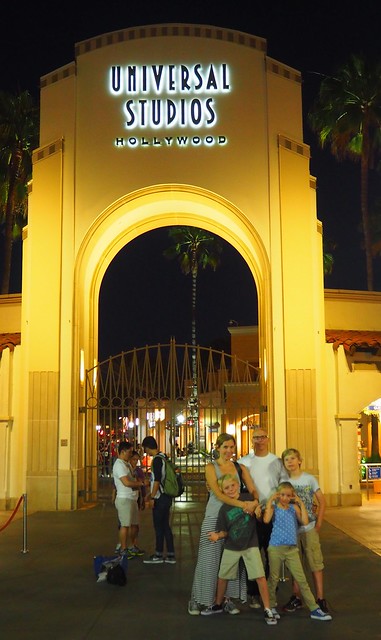
Posing in front of the Universal Studios Hollywood gate
After a long flight over the Pacific, we arrived at LAX on a hot sunny Tuesday afternoon. We are staying in the San Fernando Valley suburb of Studio City in greater Los Angeles for a couple of days before heading to Bolivia. My uncle lives near Universal Studios, so in trying to stay awake we went out to dinner and soaked up some of the atmosphere. As you may have read in a previous blog post, I had horrible experience at Universal Studios Japan because of the immense crowds. It was nice to see the original theme park in Hollywood. We didn’t go inside, and at $100 per person, I don’t think it is worth it. Since Comcast bought NBCUniversal, the park has turned its finances around with 6.1 million visitors in 2013 and over 1.3 billion dollars in revenue at the Florida/California parks.
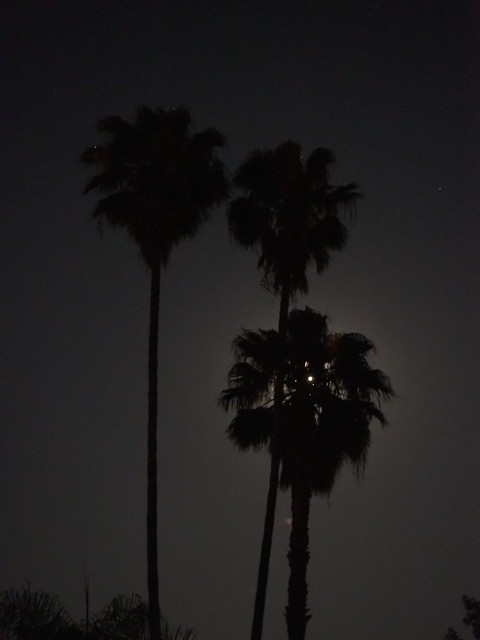
California reminds of Spain and Cyprus, a typical Mediterranean climate. The state is going through a multi-year drought and it did look very dry from the airplane. Water rationing is in full force for the people of LA, and we needed to take short showers and not rinse dishes before putting them into the dishwasher. Big fees are given to heavy water users and all consumers were asked to cut their water use by 25%. California agriculture however, uses most of the water and the “world’s garden” may need to come to terms to using so much water. Above is a photo I took tonight of the moon behind some palm trees. LA is known for its palms, but there is only 1 species of palm native to here.
We are looking forward to exploring one of the world’s great cities some more in the next few days.
I received the school photos yesterday that were taken last month. I am glad schools still do this in the digital age. There is something about opening the envelope and seeing your children in a formal school photo. You notice how they change from year-to-year. Owen still looks like a boy, but is on the verge of becoming teenager. Oliver, below is such a typical “Dennis the Menace” mischievous little guy with a heart of gold.
Oliver – Grade 3
Finally, my angel-princess Ocean (below), the best of the Kralovecs, is so beautiful! I know I am biased, but I appreciate her intelligence and calm demeanor more and more everyday. Nadia and I are so fortunate to have three children. I feel so lucky!
I had a really nice day Father’s day with the kids. The only negative was Nadia was traveling today and couldn’t be there with us. I did go to the airport with her in the morning and see her off. She is chaperoning the World Scholar’s Cup team that is competing this week in Kuala Lumpur, Malaysia.
I spent father’s day exactly how I wanted to, with my children. We played basketball in the school gym and then went to Starbuck’s for a light brunch.
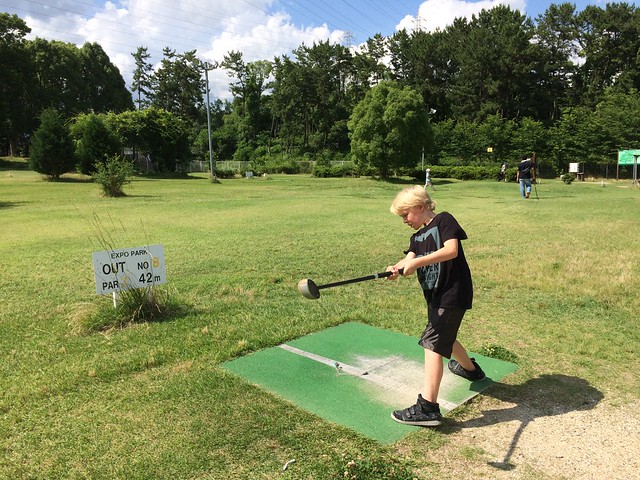
After a nap, the kids and I rode our bikes to Park Golf, a “mini-golf” course in Expo ’70 Park. I have never seen a course like it before. Each hole is around 40-60 meters in length. We used sticks resembling wooden drivers and the ball was similar to a croquet ball. The par 66 course is a total of almost a kilometer. The kids loved it because a variety of skill levels can enjoy the course. For serious golfers, one can work on the short putting game and for kids, they can just whack the ball as many times as they want.
I shot a 71, Owen a 78, Oliver a “110” and Ocean a 139. To play is costs 400 yen ($3.20) for kids and a 200 yen to rent a ball. You can play for as long as you want. The course was not crowded either. It is a nice thing to do for a morning or afternoon for a family.
We finished the day off with dinner and a couple of episodes of Modern Family. The kids are being nice and pretending the pasta I prepared was delicious. It was just a super nice day – what a privilege it is to be a father!
A final thought – I miss my father – here is a photo from 2007 with all of the Kralovec men!


 Owen getting his haircut at El Tiluchi barber in the 7 Calles neighborhood of Santa Cruz.
 People moving from the Bolivian Andes seeking economic opportunities has caused divisions within the country.

 Pope Francis cruising by me tonight in Santa Cruz!
 My blurry photo of the pope.


 A street scene in Beverly Hills





 Bill's Blog