New Belgrade Flea Market

New Belgrade Flea Market, originally uploaded by bill kralovec.

Update: August 31, 2009  Here is an article about the possible move of IKEA to Belgrade. (courtesy of the Balkan Insight)

My son Oliver is above checking out bathroom fixtures at the New Belgrade Flea Market (Buvljak – in Serbian). I needed a new plug on an extension cord I use to mow the lawn with my electric lawnmower. I found the plug and the guy connected it to my cord for 300 RSD ($4.50).I also saw some small soccer goals I’m thinking of purchasing for the school.

The place has everything, literally everything. From Nike shoes, to fans, from pirated DVDs to ladders. It is a huge open market with narrow stalls. The flea market is located in New Belgrade, just down from the Delta City mall. It is always busy and there is a variety of people there. Everyone is pretty friendly and we’ve never had a problem there. Nadia found a booth selling IKEA products. IKEA is one of her favorite stores and the nearest outlet is in Budapest, 5 hours away.

In front of the flea market is an unofficial flea market. It is filled with gypsies selling junk they find in the dumpsters around the city. I’ll take some photos there the next time we go.

Support Staff Dinner

Last week we gathered together to say thanks to our support staff. These are the secretaries, administrative assistants, receptionists, and others, that help the school run smoothly. I am pictured below with my administrative assistant, Bojana Borovic. I’ll do a post on her later. She is from Montenegro, and has a Montenegrin father and Serbian mother. Bojana works with me and our curriculum coordinators in the high school.

I am pictured saying thank you to the lovely Bojana.

It is a nice tradition to recognize the people who handle much of the daily activities that happen in the school. We dined at the Zaplet Restaurant located downtown. The Belgrade Eye describes the restaurant as follows:

Zaplet – Belgrade Restaurant

Address: Kajmakcalanska 2, 11000 Belgrade
Location: Center – Vracar – find this restaurant on Belgrade map
Telephone: (+381 11) 240 4142

Our Rating:

Restaurant Description

Very nice and cozy restaurant in Vracar municipality – and one of the favorite places for many Belgraders. This Belgrade restaurant offers wide rage of meals from Serbian specialties all the way to asian cuisine. The place is always packed so advance reservation is a must here. The place offers intimacy, modern interior, great ventilation, and as such it is ideal for relaxing and feeling the benefits of really professional service. The menu includes: classic food, salads and starters, risottos and pastas, soups, national meals, main courses, fish and sea fruit. The specialty of restaurant is one of the most comprehensive wine list where you will find all sorts of domestic and imported wines. Besides this the restaurant offers 15 different kinds of deserts and one of the finest coffees we have tried in Belgrade.

Belgrade versus Seattle Appetites?

I highly recommend the restaurant. I’ll definitely take Nadia back there sometime soon. The Independent of the UK ranked it as the best restaurant in the city.

Leaded Gasoline In Serbia

Types of Gasoline In Serbia, originally uploaded by bill kralovec.

There are many little challenges in living in a country other than your own. When we bought a car this year, we needed to fill it up with gasoline. I pull up to a gas station and see these choices of fuel. Which one is for my car?

I immediately eliminated the two choices with “dizel” which is a cognate of diesel. My car is a 1996 Honda Odyssey and requires unleaded gasoline. So what is the difference between the two premium choices? I usually trusted the attendant, as in Serbia, there is no self-service.

I did a bit a research on line and found out that the “BMB” is unleaded fuel and “MB” is leaded fuel. I am surprised that Serbia still uses leaded gasoline. This was phased out in the US in the 1970’s and across much of the world. Leaded gasoline is still used in less developed nations like Afghanistan, Fiji, Iraq, etc. There are three of the former Yugoslavia nations (Bosnia, Macedonia, and Serbia) still using leaded fuel.

Expats to Serbia always complain about people smoking, but rarely do I hear them complain about leaded gasoline. I wonder what the health effects are, especially with my children. We live in relatively traffic free area, but we must still be exposed to lead in the air.

I’ll definitely do some more research on the topic. If any readers of my blog have any thing to add to the discussion, please do so.

I must remember then, to put “BMB” in my car as that is the Unleaded Gasoline. A mnemonic to use is “un” is one extra syllable and “B” is one extra letter. “B” is good, no “B” bad.

This from the “United Nations Partnership for Clean Fuels and Vehicles” report.

Serbia – deadline of 2015 – 2020

The Clearing-House together with the REC country office supported a one-day national round table
discussion 8 May 2006 that included the phase-out of leaded gasoline. The Clearing-House plans to carry out an
awareness campaign that will include blood lead level testing, in cooperation with REC and the Institute of
Public Health of Belgrade.  A ban for phase-out is not clearly defined; according to the National Environmental
Action Program, an optimistic forecast is given as 2015, whereas a ‘business as usual’ deadline would be 2020.
As of 2006, 58% of fuel used was leaded, with no price difference between leaded and unleaded.  Serbia is in the
process of privatizing its refineries, and there is currently no political interest in improving fuel quality in the
country.  The PCFV Clearing-House, together with the US EPA and the REC, plans to participate in the
upcoming UNECE Environment for Europe ministerial conference, Belgrade October 2007 to bring more
attention to the issue.

Visit to the Belgrade Museum of Aviation: April 25, 2009

Yesterday we toured the Museum of Aviation located on the grounds of the Nikola Tesla International Airport in Belgrade. The kids loved it and we spent an entertaining two hours in the museum. I highly recommend a visit to anyone with a interest in flight, military history, and with children.

Ollie and Owen are shown above in a cockpit of one of the planes. They were impressed with being able to move the tail and wings with the controls. The building is very cool and upon entering, is like going back into a time warp of the early 70’s. I told Owen, “This is what it was like when I was a kid.” They still had that 70’s fake wood paneling, credit card stickers from long ago, and the funky desks and furniture from the era. They had an impressive amount of planes with many having English descriptions. On display was also a tail of an US F-16 that was shot down during the NATO bombing (the pilot ejected and was rescued) and a British unexploded bomb found in Kosovo, also from the NATO bombing. Here is a link about the history of the building.

The Museum of Aviation

All eras of flight are on display including the World War I fighters, World War II, Communist Yugoslavian Air Force, and the history of JAT Airlines. As I said, a very impressive and complete collection! The boys were totally punped and were running around outside on the planes and helicopters, pretending to be James Bond.

The F-16 Tail
The F-16 Tail
Ocean next to the Mig-20

I think the visit will generate an interest in aviation for the boys. We may buy a model plane and put it together for them. We also have to watch the ultimate in fighter jet movies, Top Gun with the boys.

Military Medical Academy

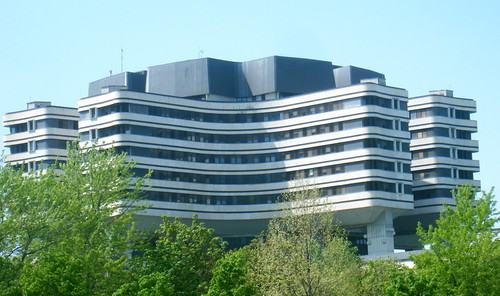
We were driving from the Partizan Club Pool in the neighborhood of Banjica when we saw this funky building below.

After doing a bit of research, I learned that it is the Miliary Medical Academy (Војномедицинска академија – Vojnomedicinska Akademija in Serb.) This is the largest hospital in Serbia and was constructed in 1982. It is like a VA hospital in the USA, but it also serves civilians also. We drove around the parking lot a bit and there were lots of cars and people. It was designed by the award-winning architects, Colonel Josip Osojnik and Slobodon Nikolic.

For more information you can visit the hospital’s web site in English or see this 3-D model on this architecture web site.

Am I rich? Serbian Hyperinflation of the 1990’s


With all of the talk of the global economy and media buzz about the global recession, I was very curious to learn more this denomination of Yugoslavian currency I bought at a market in Belgrade.

The bank note is real and it was issued in 1993 at the height of the hyperinflation during the chaotic times of the breakup of Yugoslavia. It was the largest denomination of the ex-Yugoslavia and nominally worth 500 billion (US terms) dinara. At the time, it was virtually worthless by the time it was printed and released to the public.

I thought I had lived through tough economic times the past 6 years in Venezuela under the economy destroying policies of President Chavez. But the 30+% annual inflation and currency exchange controls pale in comparison to the craziness of 1990’s Belgrade. A bit of background…

When Yugoslavia was breaking up into the separate nations of Croatia, Slovenia, Macedonia, and Serbia, it not only generated political chaos, but economic chaos. The economic output of Yugoslavia dropped 70% from 1990 to 1994. The government tried to compensate by printing more money and passing laws making it illegal for businesses to lay off employees. On top of this were the war and UN sanctions making it more difficult manage the economy. The result was an inflation rate that peaked at 313,563,558 % per month which comes to 851 with 78 zeros behind it. Amazingly, this was not the highest inflation ever! In neighboring Hungary during WWII, they had an inflationary rate of 4.16 trillion per month and they also had the largest bank note. Serbia does have the record for the longest sustained hyper inflation. 

As you might have guessed, this made people’s lives very difficult during this time. People survived through a variety of creative measures. Thankfully, Serbia has rich soils and most people have relatives living in the countryside to feed their extended families. Eventually, the Dinar died as a currency and was replaced by the German Deutschmark. Today, Serbia has an inflation rate of around 10% and a stable Dinar currency. Tim Judah, in his book “The Serbs: History, Myth & Destruction of Yugoslavia” has an excellent detailed description of this time in Serbian history. 

Pictured on the front of the note is the Serbian poet, Jovan Jovanović. He lived in the late 1800’s – early 1900’s and was born in Novi Sad. He is famous for his children’s poetry. Below is an example of one his poems,

DARKNESS

You could think that darkness 
is so scary strong, 
powerful and dreadful, 
and–you would be wrong.

Fortunately, it is 
not at all this way: 
You just light a candle 
and it runs away.

Jovan Jovanović Zmaj 
Translation: Dragana Konstantinović

Another translated poem can be found on Dragana’s website. On the reverse side, pictured below, is the Serbian National Library. The library is still open today and is located next to Saint Sava’s Cathedral in downtown Belgrade. 

Gypsies in Belgrade

Above is a photo I took last weekend. We were on the way to an open market in New Belgrade. We stopped at the traffic light, and these three gypsies were asking for handouts from cars waiting in line. At the major intersections downtown and in New Belgrade, it is common to have gypsy beggars or window washers. It has been a source of fascination for our family since our arrival. This is my second post (for my first post, click here) on the gypsies and I intend to do more while I am living here.

I recently finished reading Isabel Fonseca’s excellent book, “Bury Me Standing: The Gypsies and Their Journey” in which she writes of her experiences of living with the Romany people of several Eastern European countries for 4 years.

There are over 100,000 gypsies living in Belgrade. They are an on-going social problem in the city. They get little support from the government and have difficulty integrating themselves into modern, Serbian society. The latest news was the government moving (bulldozing) of a settlement in New Belgrade. It seems that no one wants them to live in their neighborhood. There are gypsies that are successful, but most are extremely poor and outside of normal society. Beside hustling for money at intersections, they are also seen collecting cardboard and other recyclable materials or selling junk at markets in New Belgrade.

They remind me of the Aboriginal people of Australia. They have their completely separate culture and lifestyle living right next to a majority “Western” culture. They are closer to the North American Indians, and are more integrated than the Aboriginals, but the same view applies. Like the Slavs, the migrated to Serbia from the east. Researchers discovered they originally came from India, leaving about 16-20 generations ago (approximately 12th century). They stopped in central Asia (Armenia) and reached Serbia and eastern Europe in the 14th and 15th centuries. Their official name possibly dates back to their original caste in India. Fragments of their Indian origin are maintained today in many words in their language and their Hindu-like customs of cleanliness and superstition.

Their original nomadic lifestyle has ended in modern times.  Today they are mostly poor, illiterate, living on the edges of cities and towns. There are an estimated 6 -11 million gypsies world wide with most in Eastern Europe. The biggest population is in Romania. Fonseca reasons they were used as slaves in historical Romania and that explains the high numbers there. They have been persecuted since their arrival to Europe. They are the forgotten part of the Holocaust.

The girl above is probably the mother of the baby in her arms. Gypsies have their own cultural norms and one of them is to become a mother as soon as physically possible. What is amazing is many are illiterate with no concept of history, time, and Western cultural literacy.

Ocean is up and I need to attend to her. I’ll be writing more in the near future…

Below are some excerpts from the Rom News Network a website based in Germany that produces news items about the Romany people. I took the excerpts from an article by Olga Nikolic, called, “Life on the Margins of Society” from 2001.

“Romanies form the youngest portion of the population in Serbia – over a half, 62 per cent of them, are under the age of 25, while only 4,1 per cent of them are over 60 years-old. The said age structure is accounted for by experts as the result of high birth and death rates and a low average life expectancy. According to some statistics, the average Romany life span is 10 per cent shorter than is the case when all other citizens of Serbia

Dragoljub Atanackovic, the president of the Romany Congressional Party, claims that 90 per cent of Romanies live in extremely insanitary conditions and that in Belgrade itself there are 60 enclaves with over 90 thousand Romanies living in wretched circumstances. “The social position of Romanies is exceptionally difficult. But three per cent of the population of working age are employed, only 31 per cent have primary school education, the rest are half-illiterate or illiterate. We do not have a single newspaper in our mother tongue or a radio and TV program financed by the government.

According to statistics, the rate of unemployment among Romanies is four times higher than is the case with the country’s majority nation and in the past ten years the negative ratio has doubled. Every fifth Romany of working age is illiterate and every third has merely primary education. A fifth of all Romany families have no earnings whatsoever, while the majority barely survive by doing odd jobs in the black market sector, such as selling contraband cigarettes and similar smuggled goods or by collecting secondary materials.”
Sad Anniversary in Belgrade Today

UPDATE: The Serbian government asked everyone to observe a minute of silence at 12:00 noon yesterday. At the school, we paused before starting our afternoon classes and listened to the air raid sirens throughout the city. In Senjak, where the school was located, we heard at least three different sirens, although they were not that loud.

I also want to note that the Serbs separate governments from citizens and I have never felt any animosity towards me or my family. They are extremely kind towards foreigners and we feel very much at home in Belgrade!

Several long time expatriate teachers and Serb colleagues were meeting last night to commemorate the anniversary. They lived through the 78 days of the bombing and wanted to share their memories of that time. I might interview one of them to get their story of the school during the bombing.

Serbians will be recognizing the 1o year anniversary of the 1999 NATO bombing today. NATO (North Atlantic Treaty Organization) began a bombing campaign of 38,000 missions in Serbia in the spring of 1999, from March 24th to June 11th. The bombing campaign was in response to the Serbian government’s involvement in the then Serbian province of Kosovo.

The Former Yugoslav Ministry of Defense (B. Woodruff Photo December 2008)

Reminders of the bombing are present still today in Belgrade. On one of its busiest streets, the Knez Miloševa are two buildings that have not been repaired or replaced since the bombing. It is quite a shock to newcomers to the city. I remember seeing these on my first taxi ride downtown upon my arrival to Belgrade. It is a sad and tragic reminder of the Yugoslav Wars of the 1990’s. I am not sure why nothing has been done to these buildings. Perhaps it is lack of money, or perhaps Belgraders don’t want to forget. If any of my blog readers can enlighten me on this, please do so. The photo above was taken by a friend visiting us over the Christmas holidays. I took the photo below in April of 2009.

Different View of the Building - B. Kralovec Photo April 2009

The building above is the former Yugoslav Ministry of Defense which was bombed on May 7th, 1999. It was built in 1963 and it was designed by Serbian architect, Nikola Dobrovic. The building is divided by Nemajina Street and the design of the building is meant to resemble a canyon with the street as a river divided the two sides. There is an excellent blog by a Swiss architect married to a Serb which discusses many of the buildings in Belgrade and it also has an indepth description of the NATO bombing campaign.

The Yugoslav Ministry of Defense Building In Its Prime

The anniversary will be marked by air raid sirens, church bells, and ceremonial gatherings. Around 500 civilians were killed in the bombings and many Belgraders are resentful at the NATO bombing. The BBC has an article about the anniversary here.

Serbian Birthday Parties

We get invited to many birthday parties from the classmates of our children. We rarely go because with our hectic schedules, when we get some time away from school, we prefer to be alone as a family.

We made an exception Sunday as you can see above. The Serbs really know how to throw a party! Serbia is a south Slavic nation and has more in common with southern Europe lifestyles, than northern Europe lifestyles. They emphasize good times and family and there is more disorganization like Spain and Italy, than say Austria or Switzerland. That is a big generalization and it is not a comment on the entire population, but that is the trend I have observed.

The party was at a place called “The Jungle” and there are many childrens’ birthday party places in Belgrade. The children above are watching a magician on stage. See if you can spot Owen!

The hosts care as much as the comfort of the adults as children. There were probably 60 adults at the party and about 50 children. As you can see above, there is a nice cafe/banquet style seating for adults behind the children. The hosts had a really nice buffet and an open bar. The building was large, with separate rooms for a disco and play land.

Jungle Employees Entertain the Children in the Disco

The Jungle provided supervision for the children in the playland and did music activities with them in the disco. Quite an operation, that makes it easy for parents to hold a party. The downside I imagine would be cost, as I saw plenty of bottles of wine and food being consumed. Overall we had a nice time. We have a lot in common with the other school families with young children.

Belgrade is known for its night life. This is about as close as I get to the partying scene!

Family Journal: Sunday March 1, 2009

We had a fantastic day yesterday. The weather was in the high 50’s and the snow was melting fast. It was the end of the Ski Week holiday. Reflecting on the break, the best thing about it is reconnecting with my children and wife. I really noticed today as I came home from school, how excited the kids were to see me. I missed them today as I was working at the high school. They are shown above playing on a car in the shopping mall of the supermarket, Super Vero. We did grocery shopping Saturday morning.

Below, Owen is seen looking over the park of Kalemegdan. Kalemegdan is a Turkish word for “battle ground – fortress” and it is one of my favorite placeds in Belgrade. The city began here, within the walls of the fort and the history just oozes out of every brick and turret. The fort was originally built by the Romans and throughout history, has changed hands from the Byzantines, Hungarians, Turks, Serbs, etc. As you can see in the photo, the fort is strategically placed overlooking the confluence of the Sava and Danube (Dunav in Serbian) rivers. Legend has it that Attila the Hun is buried at this meeting of the two rivers. Belgrade has always been at the border between various empires and the fort holds the memories of these conflicts between competitors.

Owen looks to the outline of the wall leading to the Sava and Danube Rivers

Today there is also a huge park surrounding the fort. Many Belgraders hang out there, playing chess, walking, talking, and many children are running around the playgrounds. The fort also has tennis courts, basketball courts, and a cool military museum display with about 10 tanks and cannons kids can climb on. Owen and Oliver below are shown on a battering ram with the fort in the background. The kids love eating “kokice” (popcorn in Serbian).

I read of the catacombs, canals, and tunnels that are largely unexplored under the fort. The Serbs really have not restored the fort or done enough excavation and research on the place which is unusual. It is part of the charm I guess, that it is not totally done up for tourists, although it is a must see for anyone coming to the city for the views. I also like the fact that the locals uses the place and it is still a vital part of the daily life of many Belgraders and not just a museum.