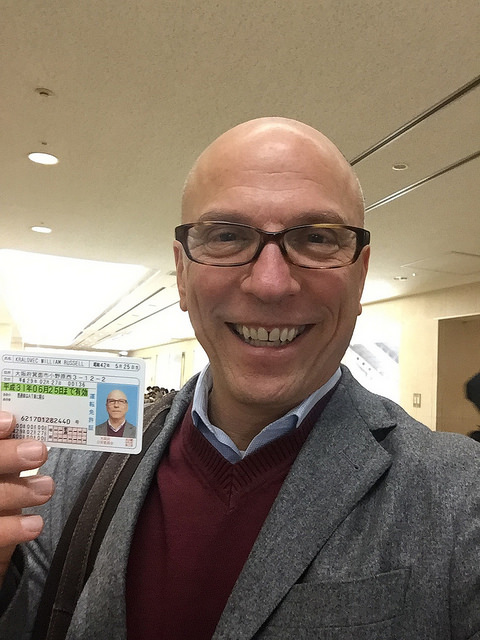
I’m Street Legal!

33055703411_61aeff1b23_z

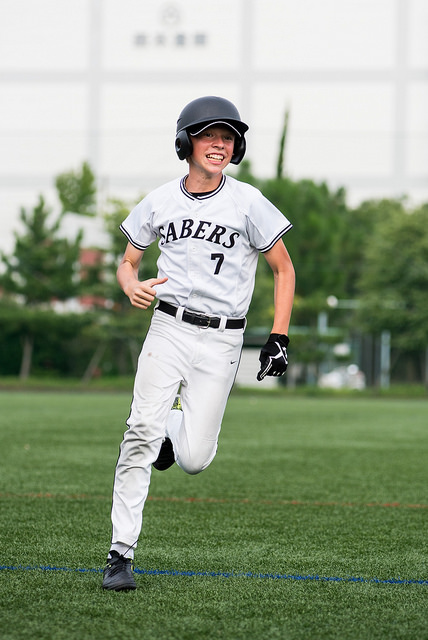
The size of my smile is in direct correlation to the amount of time and stress that went into obtaining my Japan driver license! It was quite the ordeal. In all the countries I lived in, it was always some simple paperwork or an international driving permit would suffice. In Japan, after one year, residents need to obtain a Japanese license.

My first challenge was paperwork. I renewed my Michigan license 46 days before arriving to Japan. The rule states I need to prove I drove 90 days as a licensed driver in the USA. I had to send for my complete driving record from the State of Michigan Secretary of State, showing I received my first license on June 6, 1983, one week after my 16th birthday. I also needed to supply original diplomas of university as evidence I lived in the USA for at least 90 days after June 6, 1983.

The second challenge was the eye test and written test. This was pretty straight forward process and after reading through the Japan Automobile Association book, I scored 8 of 10 on the quiz, needing 7 of 10 to pass. The forms and all information is kindly translated to English, which is nice of the driving center.
33055701291_391eeb8a5c_c
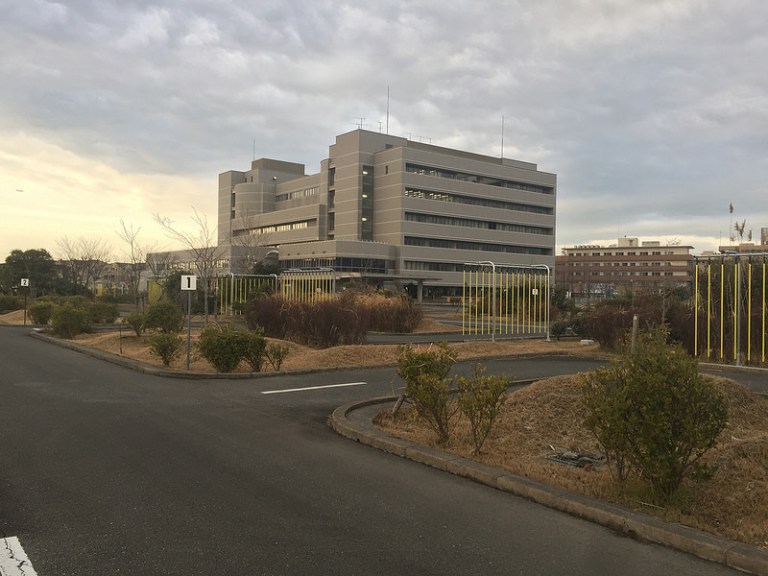
The course!

The final part is the driving test. The driving center for northern Osaka is located in the suburb of Kadoma, which is about an hour away by public transport from our part of Osaka. This is an industrial area close to the Panasonic plant and headquarters.  There is a large administrative building and driving course as you can see in the photo above. The test is only about 5 minutes long, but one needs to do everything right. Things like checking under the car before entering the car, checking mirrors, pumping the brakes, looking both ways, etc. One tiny mistake can result in failure. The average amount of attempts it takes to pass the test is 2.7 according to informal research conducted by the English teachers association of Japan. It is hilarious that adults are treated like beginners and actually fail a simple driving test. I rented out the course for an hour on a Saturday to practice so I felt confident, but I was extremely nervous.

I failed the first time. I think the instructor wanted to pass me but the bumper of the car hit one of the yellow poles you see in the photo. It was in the “crank turn” section of the course, almost near the end. The other driver in the car with me also failed by driving over a curb on the “s-curve” portion so I didn’t feel so bad. On the second attempt, I passed! I did have to stop and back up twice in the turning sections. The instructor only criticized my hands while turning, they needed to stay on the wheel more.

In reflecting upon the experience, I think the experience made me more aware of pedestrians and cyclists which is good. There are lots of people in the streets in Japan and as a cyclist myself, want drivers to be aware of us. Still over 400 cyclists/pedestrians are killed by getting hit by cars in Japan. That is a tragedy that people and the media do not talk about much. Self-driving cars can’t come fast enough in my opinion! I was annoyed at the silliness of the paperwork, especially providing evidence that a 49 year old man drove for 90 days in the country of his passport. The Kadoma driving center is such an odd place. It is a doctoral study in sociology waiting to happen. Japanese drivers face the same amount of testing and paperwork as foreigners. The culture here dictates complicated forms and procedures for just about anything, from purchasing a cell phone to exchanging money.

Obtaining a local driving license is a rite of passage for expatriates here. I would like to thank my wife for urging (not nagging) me to get this done. I am also thankful for the support of Ritsu and Art. They spent their time on me and gave me many helpful suggestions. I will be forever grateful! I am proud of my accomplishment and feel so relieved to be a legal driver again! I am looking forward to getting out to the best parts of Kansai and Japan.

Quirky Japan: Parking & Taxis

31564044366_9f1d59eae2_z

Japan is the approximately the same size as California, but with three times as many people. Space is an issue in cities of Japan. In my neighborhood of Onoharanishi, which is one of the more expensive suburbs in Osaka where people have more space than the average Japanese dweller, space is still at a premium. This family solved the “we have two cars but only one parking spot” problem. Rotary parking systems are common in cities, especially the big parking garages downtown. They are so much more efficient use of space. I wanted to wait at this house until the owner wanted to drive the silver car to find out how it works. I think you would have to take out the bottom car and then lower the silver car.

Taxis here have automatic doors as you can see in this video. This is a good idea because it prevents people from having to open the door when carrying lots of bags or children. It also prevents damage to the door if clients slam the doors too hard. I also noticed it is only the left side door that opens automatically, which in Japan where people drive on the left side of the road, it is a safety measure. People cannot open the door into the street and must exit the taxi curbside.

Happy Health and Sports Day!

29623624154_af7ea330b7_z

One of my favorite holidays in Japan is the national “health and sports” day. It commemorates the opening day of the 1964 Tokyo Olympics . Two years later is was made a national holiday and is celebrated on the second Monday in October. The purpose of the day is to promote an active, healthy lifestyle. What a great idea! Every country should have a day like this. Most businesses are closed and the weather in mid-October is usually really nice which is conducive to doing something active outdoors.

29623623944_c9eeeb07e4_z

Schools in Japan hold a sort of sports carnival on this day or a weekend close to it. As you can see in the photos in this post, Ocean and Oliver enjoyed our school’s sports day. They played water polo in the morning and field / athletic events in the afternoon. Owen participated in the middle school events, including winning the obstacle course. The day was marked by dance performances, picnics and music.

30023571556_c9a377e990_z
Owen rounds third in a recent baseball game

Thanks to Steve Lewis for the photos of my children being active!

An interesting side note, the 1964 Tokyo Olympics were held in October to avoid the rainy season and humid summers that are typical of the islands of Japan. The 2020 Olympics do not do this, starting July 24 and running until August 9.


Owen stars in Sabers win

28813717353_22e1121f8a_z
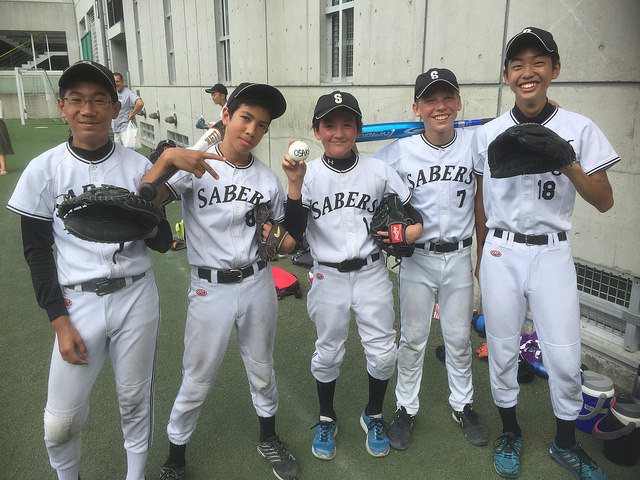
Owen with some of his teammates

The Senri & Osaka International School’s middle school baseball team defeated Sons of Light IS 3-0 yesterday afternoon in their second game of the day. Earlier they defeated Kansai University International Academy 14-4. They are now 3-0 this season and on top of the Western Japan Athletic Association. Euan L. went the distance, pitching a shutout and Owen had a clutch 2-RBI double in the fourth to break open the pitcher’s duel. Owen played first base in the second game, and pitched for 3 innings in the first game.

The Sons of Light threatened to score twice in the game. In the fifth inning, the first two batters got on base, but then Euan struck out the next two batters and a groundout ended the inning. In the last inning, a runner was put out at third after a perfect throw by right fielder Rintaro.


After a game there are distinctive Japanese practices of showing respect towards others. The video shows the final out and the post-game team bows towards the opponents, coaches and umpires. It is a nice tradition and manner of ending games, reinforcing sportsmanship. American sports should integrate something similar.

28813717663_ed5e957f4f_z
Owen on third base

Quirky Japan: Eating Daggertooth Pike Conger

27787149301_553bb41658_z

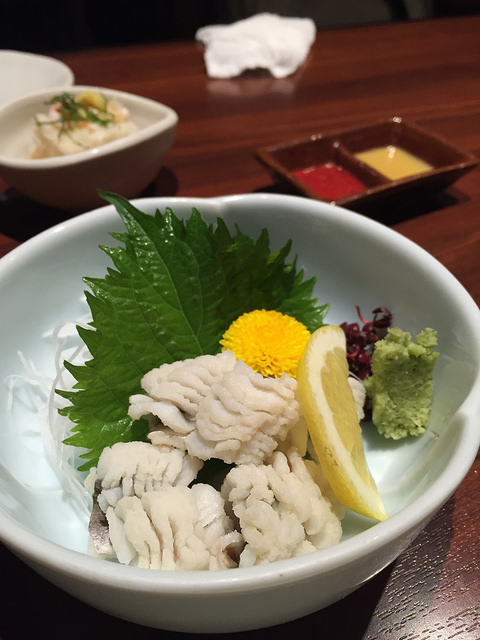
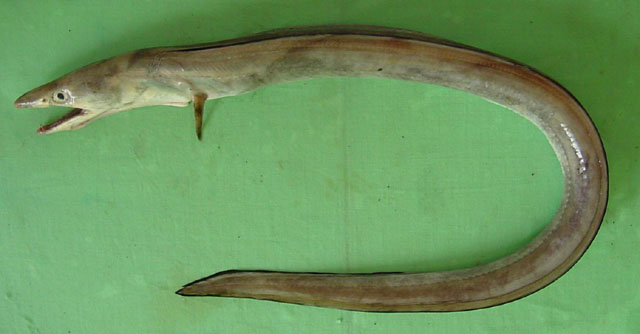
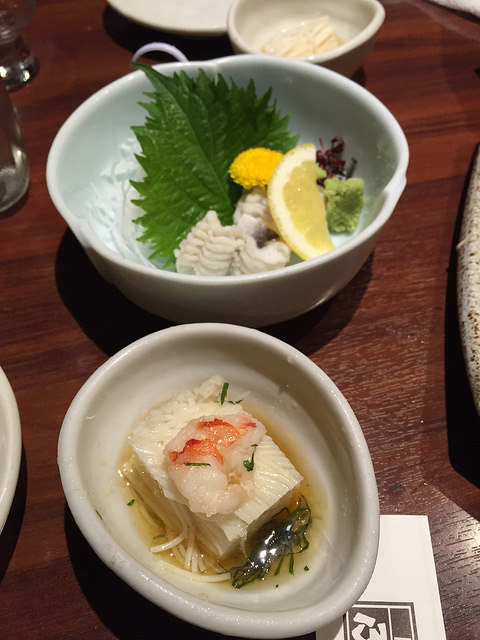
Japan has a “foodie” culture and presentation and delicate tastes are very important at restaurants. They also eat everything that comes from the sea including the summertime Kansai (name for the western region of Japan where we live in Osaka) dish, hamo. It is in the foreground in the photo above and served with beefsteak leaf, wasabi paste and either a spicy red sauce or mustard. It was delicious but when I looked up the English name for hamo, I found it was dagger-tooth pike conger (Muraenesox cinereus) a type of eel. It lives on the sandy bottoms of oceans up to 100 meters deep.

mubag_u2

Hamo is best in the summer and I love the seasonality of seafood. Fish are best to eat at certain times of the year and each season brings with it new fish and other creatures to try. I am trying to learn all of the different seasonal fish and also learning how to prepare them. I never grew up eating much seafood, but really like it and I know that it is very healthy for me. One of the starters was the summer noodle, somen, which is in the foreground in the photo below. It is served cold. I had these dishes at Fujiya a restaurant close to the kitaguchi-nishinomiya station.

27251103664_f431ac1ab4_z

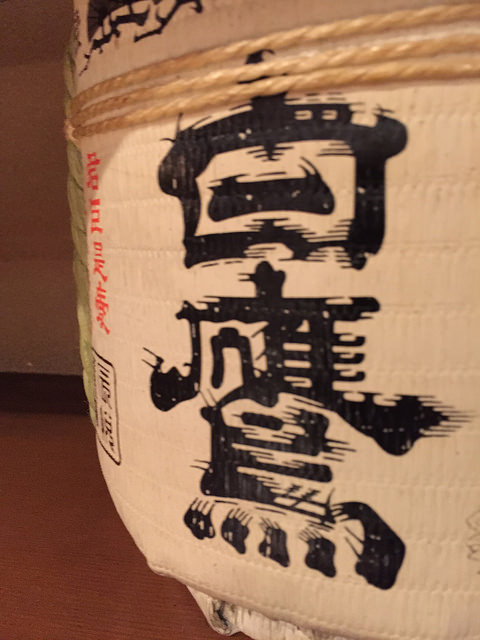
People like to socialize and drink over meals in Japan. Restaurants rather than bars and dance clubs are less popular than restaurants. Meals last a long time and are many courses. It must be the Japanese metabolism that keeps people thin here because when they go out, they eat a lot. Below was my kanji lesson for the night. The top part is the kanji for white and the bottom has a portion for bird and go forward, which signifies “white hawk” and it is a type of sake. I would like to learn more about how sake is made and the different types of sake.

27251103954_2f5751e237_z


Aging Japan

25655229574_b7321b861e_c

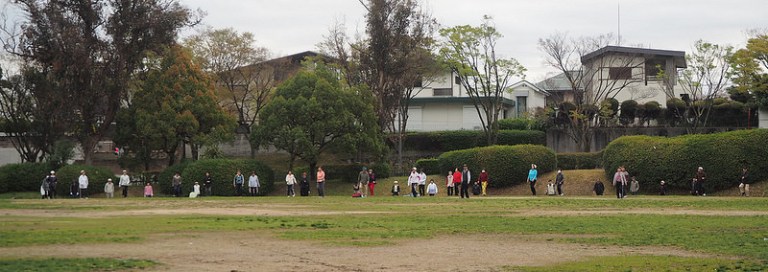
This is a common sight in morning parks throughout Japan. Groups of senior citizens perform synchronized stretching exercises. I photographed them yesterday morning during my bike ride in Senri Chuo central park. 1/3 of Japan is age 60+ and 1/4 is 65+ and this reflects a trend in people living longer and young people having less children. If it continues, in 40 years, 2060, 40% of Japan will be over 60 and the population will drop from 128 million in 2010 down to 87 million. A professor at Tohuko University continued the calculations, stating in the year 3776, Japan will be down to 1 remaining child.

In some ways this is good for Japan in that Tokyo, Osaka and other cities are overcrowded. One needs to be selective when going for holidays or excursions during breaks. Traffic and crowds are something always to be aware of. In many ways it is bad however, to have a dearth of young people, especially regarding taxes and pensions. It will force Japan to consider immigration to get more working age people here.

The exercise group is an example of the healthy living here in Japan and why people live long, productive lives. Older people eat a lot of fish and vegetables, don’t eat big portions and do a lot of walking and biking. That compares to the sedentary lifestyles and highly processed unhealthy diets of many Western cultures.

25987154430_09eefc4cc9_c

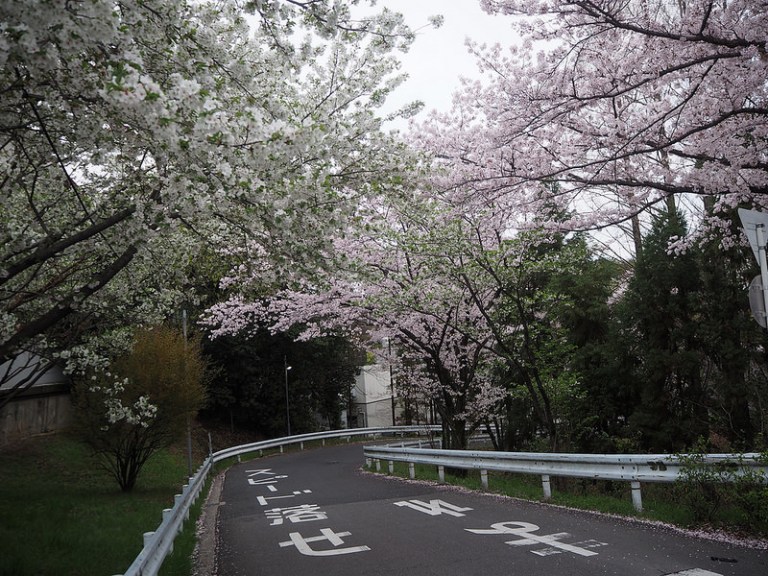
Taking my mind off Japan’s demographics, we are in the middle of sakura (cherry blossom) season and it is really stunning! There are lots of cherry trees in the city and as you can see, they are shining in color. The culture appreciates this explosion of life and the ephemeral nature of the bloom. Hanami (viewing parties and picnics) are common at this time of year.

Geocaching on the Yodo River

25059878942_44573586c1_z

Sunday afternoon we took the kids down to the Yodo River, one of the big rivers running through Osaka into the bay. There are over 300 geocaches along the shores of the river and people come from all over to see how many they can get in a day. We did a loop around both banks of the river and got a bunch, but not close to 300. The sun was out and despite the cold winds, it was quite pleasant to be outside. The Japanese love baseball and play all year round as you can see by the photo above. I also like to see the large number of bikes at the park. That is one of the reasons the Japanese are so healthy is that they get a lot of exercise, which is a suggestion for Americans to improve their health.

24547445424_fb4d4a94f9_z

As I have previously written, geocaching is a great excuse to get outdoors, spend time together as a family and explore new areas. The river banks are for public use in Japan and one finds sports fields, golf courses, bike paths, fishing spots, etc. We are passing over the Nagara bridge, just outside the central business district (photo above)

24551304903_84dbbf830f_z

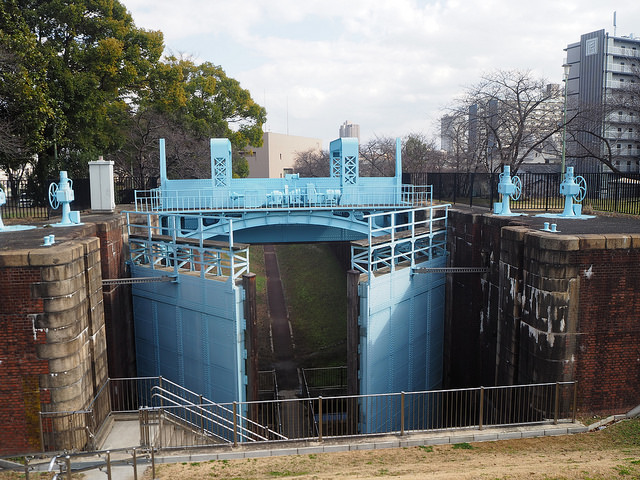
Above are the old locks that carried boats between the Okawa and Yodo rivers. Because of dams and levees to prevent flooding, the two rivers had a large difference in elevation. They are no longer used and city officials have turned them into a sort of outdoor museum.

24810443969_8b3a1e7775_z

A highlight for me was crossing this train bridge. The tracks are under construction so no trains are crossing, but Oliver was really frightened to cross, thinking a train would come. There is space on the side and it is safe, so it was a managed risk situation. We made it across with no problems.

Thanks to Josep for driving and Pico and Bernie for helping us find so many geocaches!


Viewing the White Egret

23308468911_54dfb2e4a9_z

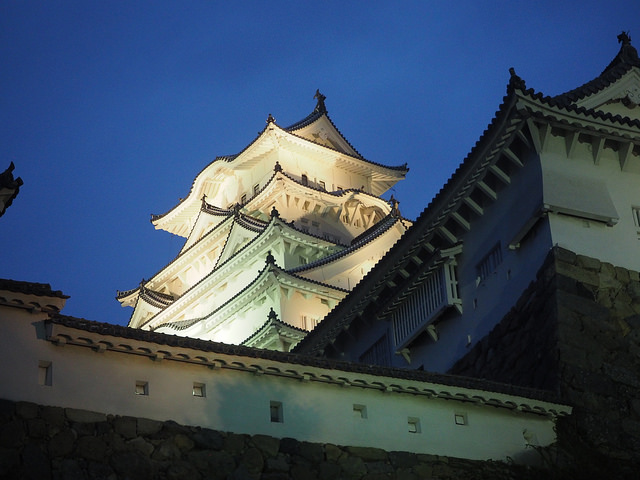
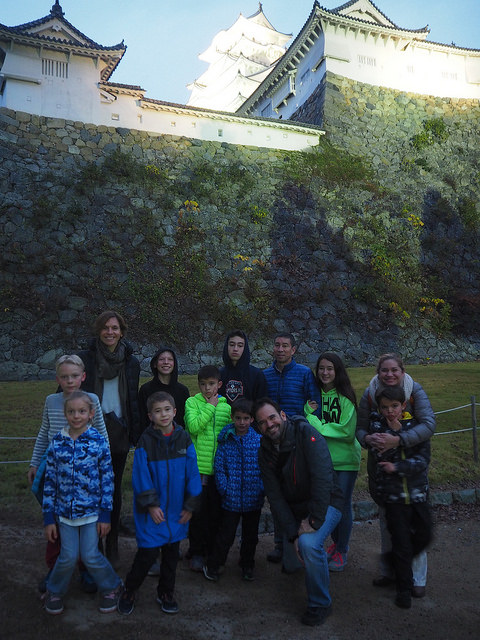
On the way home from Tottori we stopped at the famous Himeji Castle in the Hyogo prefecture. It is an UNESCO world heritage site and the finest example of the classic Japanese feudal period architecture. We arrived too late in the day to enter, but we did admire it from the substantial grounds surrounding it. It is called the “white heron” or “white egret” because with the roof gables give it the appearance of the white bird taking off in flight.

Castles are always funny to me in that people don’t realize all the awful things that took place on the site. They are usually the sites of great battles where men died and if the raid successful, the women and children enslaved. Because it happened so long ago however, people look at them for the architecture and history, but not the tragic human story. Himeji is no exception to this rule and since it was originally built in the 1300s, probably many people died fighting for control of the castle and the town. It is built on a hill and dominates the city.

It is remarkable that it is still standing. During World War II, a bomb landed on the roof but failed to detonate, meanwhile the entire city was destroyed by the allies. It survived the Great Hanshin earthquake of 1995, while once again, many buildings in the city were destroyed. Earlier, it was almost demolished and developed by the locals, but the expense of tearing it down, prevented various parties throughout history from doing so.

I am glad that it remained standing and perhaps if we are in the area, we will return to go inside. We found several geocaches around the castle and despite the rainy night, it was a good time. I want to thank the Tsubaki and Marce families for coming with us!

22762668424_9f5f861d13_z


Temples of Japan

After our hike we drove across town just before closing time to walk the grounds of the Temple of the Golden Pavilion in Kyoto (photo above). This is another former villa of a rich shogun which upon his death, was turned into a Zen Buddhist temple. From the photos of the temple, it always looked like it is out in the countryside, but a busy street is in front of the grounds and property is in an urban zone. Arriving 5 minutes before the front gate to the complex closing was excellent timing for photos and lack of crowds. It is a thin coating of gold foil, not made of solid gold. The shoguns loved their ponds and gardens, which made for a stunning reflection in the setting sun.

Temples in Japan are similar to the monasteries in Serbia for me. They are usually located in bucolic settings, which is the attraction, as I don’t seek spiritual things. It is also an insight into the culture of a country and there is always a bit of history. They make for a good destination for a day out and a reason to get out of the house.

The biggest temple in Minoh is the Katsuo-ji  (in Japanese, “ji” means temple) which I’ve blogged about before. It is a nice hike we can do from our house and takes about 4 hours round trip. On my brother’s first day in Japan, we went up through the Minoh quasi national park forest to the temple. Despite the rain, it was a relaxing hike and as you can see from the photo above, the clouds made it even more mystical.

Temples also have attractions for kids. They love to feed the koi, or as I call them, colorful carp. There is also incense and candles to light and reflect on family members, both living and dead. Most have a gong or bell that can be rung and the kids can also get a fortune paper and tie it to the string. At katsuoji, you can also get the Japanese dolls, daruma. We have darumas representing our family under the biggest cedar tree on the property.

Harvesting Rice

Owen operating the Mitsubishi VMS 11 rice harvester

On a perfect autumn morning we got to harvest rice in the nearby Shukonoso neighborhood. Our suburb of Minoh is dotted with paddies and rice is such a central part to the Japanese culture and diet, I always wanted to help out in the harvest. Our CAS coordinator arranged the opportunity through one of her neighbors, Kubo-san. His family have been harvesting rice for the past 800 years, so to say it is a family tradition, is an understatement. Osaka, like many metropolitan areas through the world, has grown immensely to overtake what was once a quiet village, Shukonoso is now part of the city. The families of Shukonoso continue to harvest rice, although, it is not a necessity today. Kubo-san is an expert garden and landscape designer, and told me his family does not make much money from their paddies, but they do it more for tradition than anything. Japan is not a big exporter of rice and the government subsidizes its production. Japanese prefer the short grain, glutinous rice that is good for sushi and chopsticks. My children prefer the this short grain rice, especially when we add the rice vinegar. I prefer the long grain jasmine variety, produced in Thailand.

Kubo-san shows us how to cut the rice bundles.

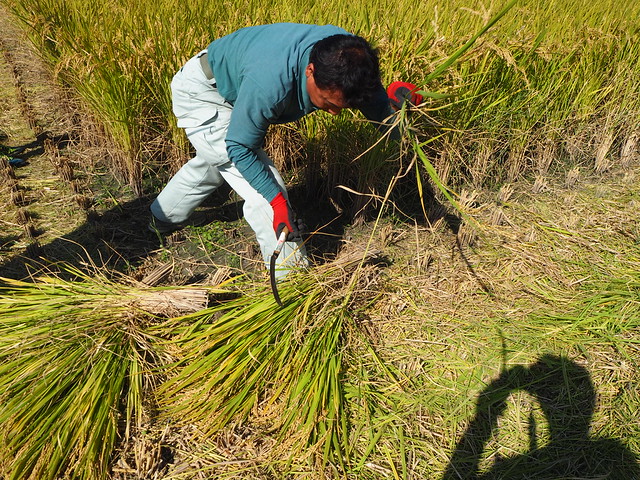
Kubo was very kind to put up with us wanting to “help”. He showed us how to harvest in the traditional manner, with a sickle. Rice seedlings are planted in bundles and 3-5 bundles are cut and laid on the field at a time. They would then be hung and dried before the grains are pulled. Instead, we fed the rice stalks into the harvester. Kubo then allowed us to drive the harvester along the rows. It was like mowing lawns, slowly going down the rows.

Spending time in the field also gave me the chance to look at the irrigation system. There is an intricate system of reservoirs, damns and canals like a spider web going from the Minoh hills down through the city to the Osaka bay. It makes it easier for the rice seedlings to combat pests and weeds to have them grow in a few inches of water. That system must have been developed over the centuries. I am not sure how it works, but everyone must work together to get the water where it needs to go to at the proper time.

We counted between 44 to 62 seeds per stalk.

The experience gave me a better appreciation of rice and brought me closer to Japan. Thanks to Lyn and Kubo san for allowing Owen and I to participate.

It is funny to me that I eat so much rice now. Growing up in 1970s  rural Michigan in the pre-globalization era, my mother never served rice and we didn’t eat at ethnic restaurants. I really didn’t eat much rice until university and my first international posting in Colombia. Rice is as popular in South America as Asia. We were strictly a “meat and potato” family growing up. We eat rice on an almost daily basis and the staples of my youth, bread/butter and potatoes are rare at the dinner table for the Kralovecs.