Growing Rice

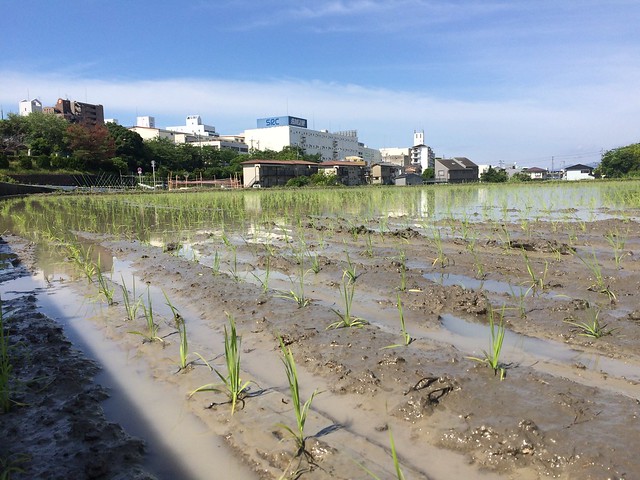
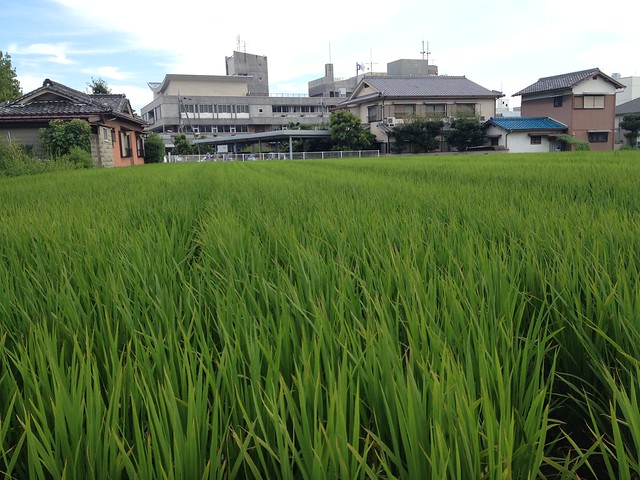
Our suburb of Minoh is full of rice paddies and gardens. You can find them scattered between residential and business districts. Often there are several fields together. The method of rice cultivation here requires standing water and so coming from the hills of the Minoh quasi national park down into the city, there is a system of  irrigation canals and reservoirs for capturing rainwater and storing and directing it towards the fields. The field above, as you can see in the another photo below of the field, has an reservoir right next to it. The reservoirs are a great place to see and hear wildlife. I’ve taken many photographs of ducks and herons.
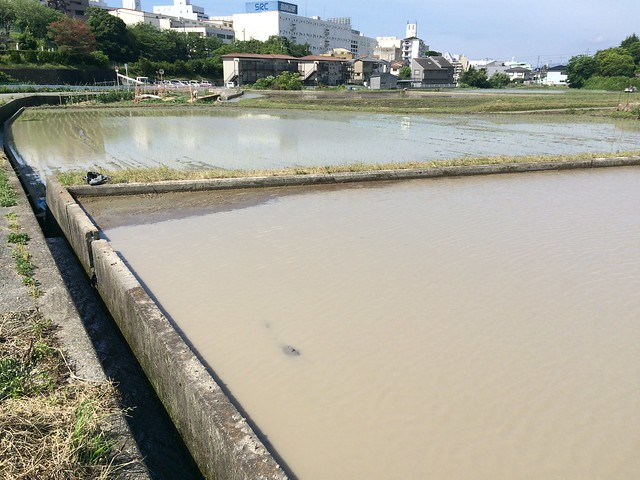
There are canals everywhere, mostly on the sides of roads. In a safety conscious country like Japan, this is unexpected because they are easy to fall into on a bicycle or car.

The rice paddies are mostly tended to by older people, which there are a lot of in Japan. The government subsidizes the production of rice in the name of national culture. Small, private  farms are not economical, but it is nice to see agriculture everyday and the Japanese practicing this facet of their culture. I wonder if the younger generation will continue this practice? I also would like to know how much the government spends on this.
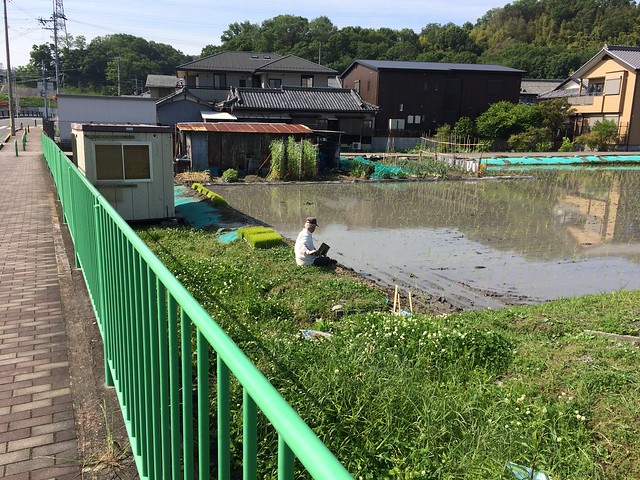
The last week in May and first week in June is when rice if first planted. The seedlings are started indoors and then brought out to the fields. You can see the seedlings in the photo above, they are next to the man.  Most of the planting I saw was by a machine that looked a little bigger than a riding lawnmower. The Minoh city office organized a community planting for families and they did it by hand. The fields are then flooded and farmers watch to make sure the water levels remain static. The water blocks out other weeds from outcompeting the rice.

When I get back from summer holiday and August, the rice will look as it does below. The rice is harvested in mid to late September and I hope to participate in a harvest this year. It would be interesting to see how it goes from field to the store. I have no idea.
Our First Professional Japanese Baseball Game

Tiger left field Matt Murton at Bat

On Monday we went to see the Hanshin Tigers to host the Chunichi Dragons. The Dragons won 9-2, and the 44 year old player-coach for the Dragons, was 4-4 with a home run and double to lead them to victory. Both teams are around the .500 mark, being fourth and fifth in the standings respectively.

It was a fascinating afternoon to experience the differences between baseball in Japan compared to the USA, especially the stadium experience.In the USA, most people go to baseball games for day or night out and many times the game is secondary to the food, the music, the attractions at the park, the in-between inning entertainment etc. The crowd is also much more subdued in the USA. In Japan, I think people go to let off steam and shout and sing. There is much more noise and group singing here in the games. It is a tradition in many Japanese games to have spectators release balloons during the seventh inning stretch and it is as enjoyable for kids as singing “Take Me Out to the Ball Game”.

Koshien Stadium is the most famous ball park in Japan. It is 80 years old this year and is one of the few outdoor stadiums, as most of the teams play in domes. It rains a lot in Japan so I see why they do this. Koshien also has a totally dirt infield and real grass in the outfield, rare for Japan as well. It also hosts the high school baseball national championship tournament, which is almost as popular as the professional league, every August.

The Tigers are the second most popular team in the league, behind the Yomiuri Giants from Tokyo. They are owned by the same company, Hankyu, that started the school I am working at. The Tigers however, have only won the league only 9 times compared to the Giants 45 titles and they have been compared to the Boston Red Sox while the Giants are the New York Yankees. The Chunichi Dragons, from Nagoya, also have won 9 titles, and with the Hiroshima Carp, are one of the strongest organizations. All of these teams play in the six-team central league. It is a shame that there is only a two week window in June that the central league teams play with the pacific league teams.

My favorite part of the experience were the songs the best players had. The Tigers have an official song writer and when a player comes up to bat, the crowd sings a particular song written just for that player. Only the veteran or best players have personalized songs. They are catchy tunes and the fans know all the words. My favorite was the song for Tsuyoshi Nishioka’s song. I would have loved to have a song written for me, although it must get tiring to hear it during every at bat.

The Hanshin Tigers are one of the big national teams. There is a second team in Kansai, the Orix Buffaloes, who play in the Osaka Dome. Koshien stadium is halfway between Kobe and Osaka and is about the same distance away as the Osaka Dome, which is just south of downtown Osaka, from our home in Minoh. I hope to go to a Buffaloes game, and get a chance to see some of the other Pacific league teams. The Tigers get about 1 million more fans yearly at their games than the Buffaloes.

I would like to thank our friend Kenta for inviting us to the game! We are going again Sunday with him to see the Tigers take on the Carp.

Life in Japan: School Uniforms

Boys leaving the train station in their school uniforms.

Last Saturday upon dropping off Owen at the train station for his trip to Kobe for soccer, I ran into a large group of students. They were on their way to school. Many Japanese students do go to school for a half day on Saturdays. This may be to do some special test preparation for university or high school entrance exams or special lessons in civics or community service that are not covered during the regular school week.

Prussian military officer in uniform circa 1912 (courtesy of Worldwar1.com)

The boys’ school uniforms are distinct. They are called ga-ku-ra-n, which translates to “gaku-school/student” and “ran-Netherlands”. Historically in Japan, the “west” or all Europeans, were referred to coming from the Netherlands because at the time, they were the most common traders in the few ports that were opened to foreigners. The school uniforms first were designed in the late 1800s and modeled after western military styles. I read where uniforms for boys were modeled after either French or Prussian soldiers. I wonder why they haven’t changed since? Is it the Japanese respect for tradition and uncomfortableness with change for certain things?

I think it is a good look, however, in putting myself in a young person’s shoes, it must be a bit uncomfortable to where these to school, especially the hats and buttoned jackets. As you can see from the photo above, they do look like soldiers or policemen directing traffic.

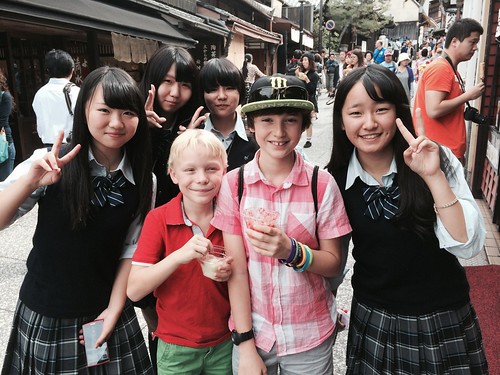
Girls uniforms are modeled after naval uniforms. I’ll get some photos later. Some uniforms are more in the British style classic school girl uniform with plaid skirt, tie, and vest. You can see this in the photo below. The girls wanted a photo with my son Oliver and nephew Seby when we were visiting Kyoto this fall.

At the private international school I teach at, uniforms are not required. Some girls however, where the British school girl outfit as a fashion statement. Some want us to adopt them as the school uniform, I think because they have been featured in pop culture in television, movies and graphic novels.

Christmas in Japan

We had a funny experience earlier this week when we tried to buy a Christmas tree. We heard that Ikea sold real trees so on the last day of our rental car, we drove south to the store. Ikea is located on reclaimed land in the Osaka Bay, close to the mouth of the Yodo River. The waterfront in Osaka is not developed as a tourist destination, but instead is very industrial with a large port and factories.  My guess is that land was cheap and it was easy to receive imported goods so Ikea put their store there. The store is not near public transport so Ikea runs their own shuttle bus from the Namba station.

After about a 45 minute drive we got to the parking lot and there was a frenzy of activity near the entrance. They were selling “trees” around the corner from the entrance and when Nadia asked a salesperson how to buy a tree, she tells us that they are quickly selling out and to hurry to buy a ticket for a tree and stand before they run out. Nadia left for the sales desk and I went out to select a tree. When I got there however, I saw that the “trees” were just large branches. The locals were presenting their tickets and wrapping their branches in newspaper and were carrying them to the cars like babies. Hilarious! They were very happy with their branches. I guess it is all relative and in thinking about the size  of most Japanese apartments, a large tree would not fit. I quickly called Nadia and told her not to spend the 2,000 yen on a branch. Being from northern Michigan and having spent several years shaping Christmas trees at Hanson’s Tree Farm in my home town, I couldn’t get myself to buy a branch. It was a full branch, but it would have been worse than a Charlie Brown Christmas tree.

Instead we ended up getting an artificial tree. The main point was the kids, especially Ocean, loved trimming the tree and we infused some Christmas spirit into our house. We decided to put up the tree early this year because we are traveling to Australia for the holiday and want to enjoy the tree for a longer time.

The view from the Ikea parking lot back towards Osaka

I didn’t want to take any photos of people, so we sent Oliver to snap a photo of the branches to give you an idea of what they looked like. He took the photo that led this post, this branch sitting on a pallet, waiting for pickup from some happy customer.

I find it interesting as well that the Japanese love Christmas! There are decorations everywhere and Christmas carols playing in the stores. Nadia bought some ornaments and decorations at the local Ikea version, Nitori. Halloween was big here as well.

The view from the Midosuji Highway – downtown Osaka

Inner City Night Patrol

I got to see another side of Osaka last weekend when I accompanied the students from our school on a community service activity. We went to the Sanno Childrens Center in the poorest ward of Osaka, Nishinari-ku. The ward is infamous in Japan for its crime rates, red light district and homeless. Now this being Japan, a country with one of the lowest violent crime rates in the world, I felt quite safe and yes it did seem a bit run down and not as new and tidy as other parts of the city, but compared to disadvantaged districts in cities in other parts of the world, it is extremely safe.

The Childrens (Kodomo) Center was founded in the 1960s by German missionaries. To this day, it continues to provide after school care and other services for children from the ward. As you can see from the photo above, one of the children the center cares for was fascinated with my European, bald, head. One of the initiatives of the center is a monthly yomoguri or night patrol. Volunteers led by the pugnacious director of the center Mami, lead groups into the streets to deliver food (onigiri – spheres of rice wrapped in seaweed) and blankets to the homeless men sleeping in the streets of the shopping arcades in the district. I was filled with a sense of goodness seeing how grateful and kind the men were in talking with the students, including my 7 year old daughter.

Mami gives us instructions for the patrols and you can see Ocean leaning over the middle of the table.

Within Nishinari-ku is a neighborhood called Kamagasaki. This area is home to many male day laborers, who through a variety of circumstances (gambling, alcohol, mental illness) are homeless. The government forbids the official use of the name and they try to hide media from portraying issues in the area. A recent NHK documentary about the Sanno Childrens Center featured one of the orphans the center cares  for and it has brought increased donations to them. It was sad to see them laying on newspaper with cardboard boxes around them as their only protection against the elements. It gets cold at night in Osaka in November. There are several organizations helping them, including a center to organize them finding short-term manual labor, free or reduced price shelters, etc.

We also walked through Tobita Shinchi, another neighborhood within the ward. Tobita Shinchi is infamous for its red light district. As in Amsterdam, the women are displayed for street view, although here, it is open air and the architecture is old Japan style. They were only protected by an elderly woman minder that sat to the side of them. She yelled at me when I tried to take the photo (see below). The police tolerate prostitution, but again, I felt sorry for the girls, as it is a tough way to make a living.

I was so inspired to help and want to make it a regular part of our experience while we are here. I would like to thank Lyn and Hannah for assisting me and Ocean and introducing us to the center.