Shinsaibashi

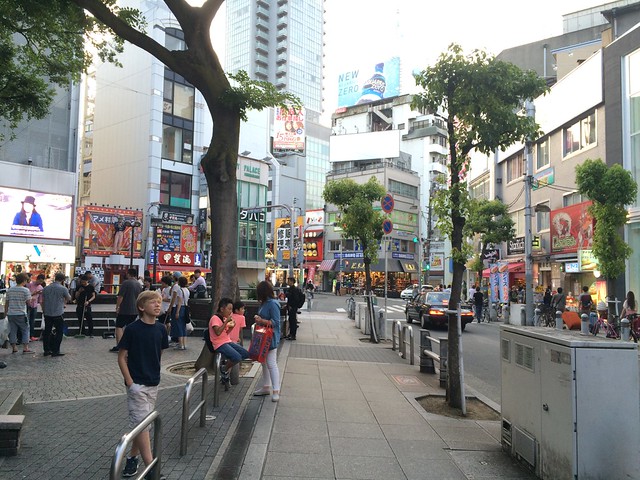
Last night we ventured downtown Osaka to the neighborhood of Shinsaibashi. The goal was to pick up money sent by Nadia’s father (thank you Popa!) through Western Union. He likes to send money to his grandchildren occasionally.

Shinsaibashi is one of the main shopping areas in Osaka. The word bashi means “bridge” and it is named after a bridge over one of the many canals in the city. It was the first western-style stone bridge built in 1909 and it became an icon of the city. In 1964 the canal was reclaimed and turned into a road due to increasing traffic and some of its parts were used in the construction of a pedestrian overpass.

Lots of high-end shopping to be had in Shinsaibashi

We walked around the streets for a bit, soaking up some of the vibrant urban scene and then had a nice dinner at Brooklyn Parlor . It is easy to get to by taking the Midosuji train line from Senri Chuo to the Shinsaibashi stop.

Unusual columns in front of a hotel in Dotonbori.


Why Japanese Kids Can Walk to School Alone & My Lost Wallet Was Returned

A couple of weeks ago I lost my wallet. It fell out of my pocket/bag on a ride home one evening. I realized it the same night and searched the entire route from the store to my home in my neighborhood, but could not find it. It caused much angst in our family because if I didn’t get it back, it would mean hours of obtaining new identification cards, a driver license, credit card, etc.

A few days later, it turned up on the bench outside my front door with a note stuck inside. All the money, credit cards and identification cards were inside as well, untouched. On a gum wrapper the person who found my wallet wrote, “Today I picked up this. To KRALOVEC 9/23” and he left an email address. I contacted him and thanked him profusely and asked where he found it. He apologized for looking up my address (on my Japanese residence card, my home address is written on the back) on Google maps to find my home.

This is typical of Japanese society. Everyone has a responsibility to help out each other and they are always concerned about others’ feelings and they do not want to disturb others. Now there are good people everywhere, but I would guess here in Japan, there is a higher chance of my intact wallet getting back to me than in other countries.

There is a downside to this mentality, but in most ways it is quite good. It is one of the best things about living here, especially with children. They will be safe and looked after. Single women are not cat-called or harassed by men (except on trains occasionally by drunk salarymen). The elderly are respected.

This article appeared in the Atlantic recently. It is hilarious to see very young children, some that don’t look more than 8 years old, taking public transport and walking to school alone. There are several reasons they can do this.

The first is overall, Japan is one of the safest countries in the world, and this bears out in the crime statistics.  Japan ranks at the bottom (in a good way) in every category of crime. Here is how it compares to the USA and other OECD countries. (all categories are per 100,000 people)

  • Homocide – Mexico 18 / USA 5.0 / Japan 0.5
  • Rape – Sweden 58.6 / USA 28.6 / Japan 1.1
  • Robbery – Spain 1,180 / USA 133 / Japan 4
  • Assault – Germany 630 / USA 262 / Japan 44
  • Burglary – Australia 1,017 / USA 715 / Japan 117
  • Vehicle Theft – France 333 / USA 258 / Japan 85

Second, public transport is safe and is the preferred mode of transport over private cars. In my city of Osaka, 24% of all trips are by bicycle, 24% walking, and 36% by rail. Private transport is only 15% . Compared to Chicago (63% private), New York (33% private) and Sydney (63%), this shows that Japanese society has a reliable system of public transport, used by most people, not just the poor or urban population. It helps to be in a high population density environment. As in other European countries, government policies make it more difficult and expensive to use private transport.

Third, and the most important in my opinion, is what the Atlantic article describes,

What accounts for this unusual degree of independence? Not self-sufficiency, in fact, but “group reliance,” according to Dwayne Dixon, a cultural anthropologist who wrote his doctoral dissertation on Japanese youth. “[Japanese] kids learn early on that, ideally, any member of the community can be called on to serve or help others,” he says

People care about and trust others! That is so refreshing to live here and know that everyone is looking to help others. I don’t see this level of caring or trust in any other society I have lived in.
The Tigers are in a Pennant Race!

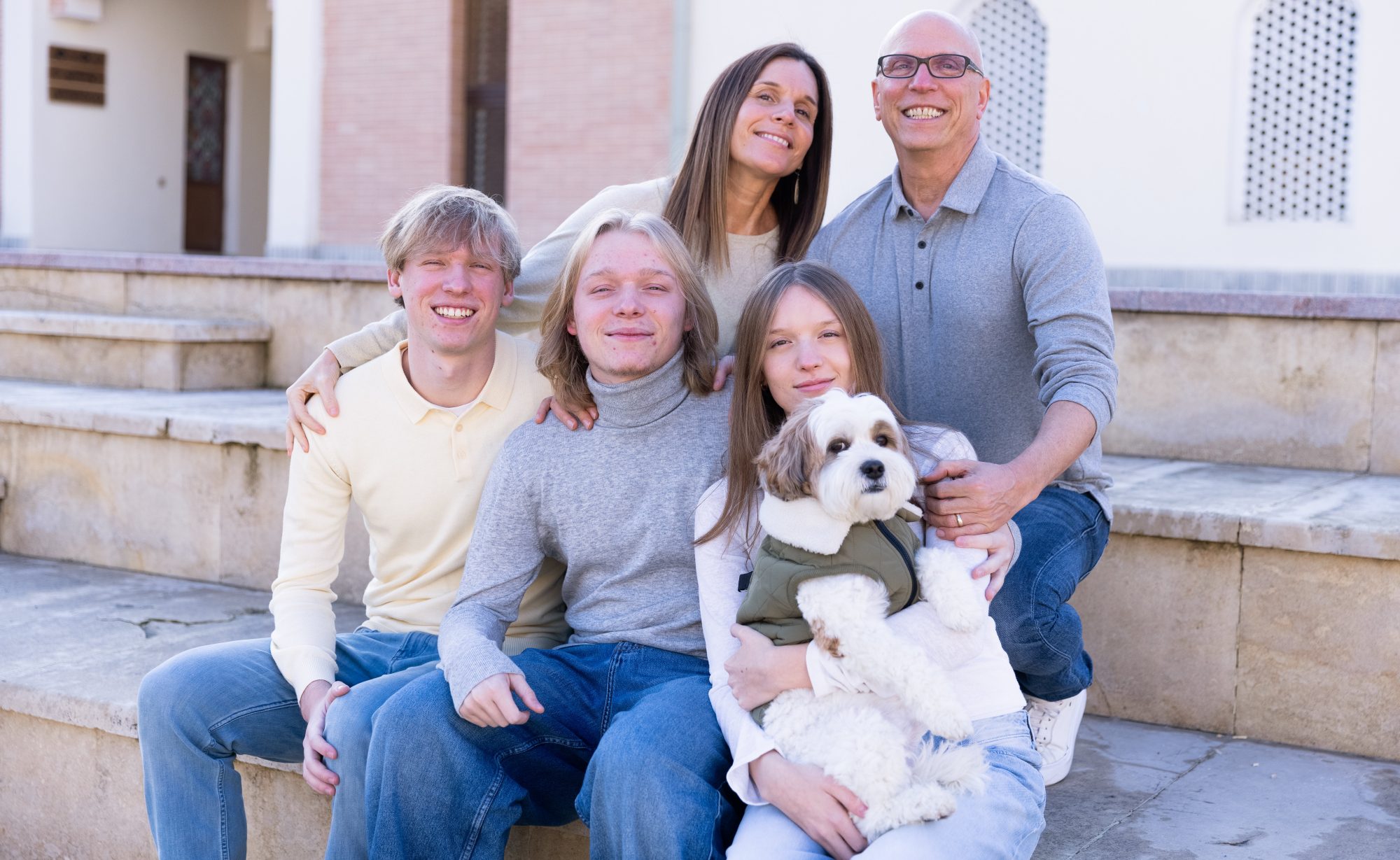
The boys are watching batting practice at yesterday’s Nippon Professional Baseball League game. The Hiroshima Carp defeated the Hanshin Tigers, 3-0 behind the stellar pitching of Kenta Maeda and an early home run by Brad Eldred. Despite the loss, we enjoyed the day at Koshien Stadium. Eldred, the left fielder for the Carp is one of those “4A” players, which means he was a star for several triple A MLB teams, but every call up to the big league team, resulted in poor results and a demotion. He seemed to be too good for the AAA, but not quite good enough for the  majors, although, he never had an extended opportunity to find his place at the big league level.

For many years the Detroit Tigers have won the Central League division and/or been in a race for the playoffs. Finally, this year they are in last place, but my baseball season was saved by moving to Japan and cheering for the other Tigers, the Hanshin Tigers. They are in first place and it is good once again to have meaningful September games.

The stadium was full to watch the first place Tigers, in the midst of a tight pennant race. With 17 games to go, Hanshin is tied for first place in the Central League with the Yakult Swallows, with the Yomiuri Giants a 1/2 game behind and the Carp 3 games behind. The top three teams make the playoffs and the first and second place teams get a game advantage in their playoff series. It is a big advantage to finish first and a good advantage to finish second.

Baseball offers a chance for the usually reserved Japanese to let off some steam. They will sing and cheer the entire game, even when there is not much action going on. Many fans also sport these baggy pants (above) and colorful jerseys. I had to buy a pair!

$7 for the Matt Murton Pork/Crab on rice!

I love the quirkiness of the Japan and it shines through in the fan experience at the stadium. I had a delicious “Murton Katsu Don x Crab” lunch. The bentos and entrees are named after players with some of the bentos shaped like a baseball diamond. A regular rotation of Asahi beer/snack girls tempted Oliver with junk food throughout the game. The girls carry beer kegs on their backs or heavy boxes of refreshments in front. It must be a long day as they are constantly moving. They must have a set circuit they take in order to evenly offer beer, sweet and salty snacks at regular intervals. I walked out to the deep left field line to video the release of balloons during the seventh-inning stretch, a tradition in many Nippon league stadiums.

Former Chicago Cub Kosuke Fukodome is having an excellent year with the Tigers (.281 – 19 HR)

The game was well played. The Carp outfielders made several spectacular catches, robbing the Tigers of extra base hits and possible runs. Maeda made Tiger hitters look weak in the first half of the game. It was nice to see that they still have the relief pitcher car here, as it was phased out in the MLB years ago. I think there is too much bunting here. In the MLB, advanced stats have shown that a bunt used to advance the runner one base is not as valuable as giving up one of the 27 outs a team has per game.

Owen, Oliver and Kenta were star struck watching infield practice. It is nice that Matt Murton acknowledged their shouts. They also got a close up view of how fast and accurate the players can throw the ball. We will be following the pennant race down the stretch and hopefully come October, we will be celebrating a Tiger’s series win!

Fiesta Mexicana Osaka 2015

Last night we ventured downtown to the plaza underneath the Umeda Sky Building for the Fiesta Mexicana Osaka 2015The city holds many ethnic festivals during the year. It was a lot of fun, with tacos, Mexican beer and of course, lots of music and dancing. There was a mariachi band and then they opened up the stage and a DJ played Latin music. It was so nice to in a Latino party atmosphere again! Besides seeing many Latinos and other foreigners, it was good to see the Japanese cut loose a bit and laugh and dance and have a good time. I was surprised to see they were selling glass bottles of Corona, Tecate and other beers. This would only happen in Japan – selling glass bottles at a large public gathering. Of course everyone respectfully deposited the glasses in the recycling bin and there were no fights, etc.

Ocean loves to dance and insisted that I take her up on the stage. Our friend Josep was teaching her some basic salsa steps. She takes after her mother! We laughed a lot and were sweating profusely in the humid, late summer evening. Thank you to the Marce family for inviting us to come down.

River Hiking in Shiga Prefecture

Owen, Oliver and Harry are ready to shoot down stream.

We had a fantastic day in the outdoors yesterday hiking/swimming up and down the Aichi River. We were quite sleepy as we drove north on the Meishin Expressway heading up to the Shiga prefecture early Saturday. Shiga is the state that surrounds Lake Biwa and we were headed to a river that feeds into the lake. We stopped at the dam before completing the journey to our entry point on the 421 highway.

The best part of the day for me was watching the kids learning how to maneuver in the fast flowing river. Especially Oliver, who does not have a passion for swimming, get over his fear and by the end of the day, begging us to stay as we jumped into the current and let it carry him down river. I think he learned to give new experiences a try and with effort and courage, he can accomplish something he didn’t think was possible at first. An important lesson for him and hopefully he will carry into future challenges he will face.

Ready to jump!

The hike up the river was hilarious. It was a non-technical scramble along the banks and over the big and small boulders in the river. The water was very clear and the water was fast, but not dangerously fast. It sounded and looked more risky than it actually was. I couldn’t stop laughing seeing that my wife Nadia, a true city girl, was put in the middle of a white water rapids.  Trying to get her over the rocks and to get into the river was funny. She got over her fears as well and she did remarkably well on the walk back down to our camping spot for the day.

The scenery was spectacular as well. The walls of green foliage contrasted with the turquoise water and white rocks. We only saw a few people the whole day and it felt like we had the river to ourselves. It reminded me of Horserace Rapids in my home county in Michigan. I am so glad my family got to experience a river like I used to.

I would like to thank our friends Naoki and Tara for inviting us to come along and helping with the logistics that go into preparing kids for a day of water adventure! ありがとお!

Airports in Japan

The family outside of the Narita Airport

It is confusing for foreigners flying into Osaka and Tokyo. Both cities have two airports. Here in Osaka, we have the Itami airport, which is about a 15 minute taxi ride away from our house. The other airport is Kansai International Airport or as it is known by its code, KIX. KIX is an elegantly designed airport, (Italian architect Renzo Piano – yes, his real name) but is inconvenient for almost everyone in Kansai to get to! I would guess there was some politics or corruption that occurred to put the airport on an artificial island, 30-40 miles south of the population centers of Kobe, Osaka and Kyoto. For me to get to KIX, I have to take a “limousine bus” for and hour and 10 minutes to Itami airport and then the 15 minute taxi from there. For people in Kobe, they can take a ferry across the bay, but both the Kobe and Itami airports are so much more convenient.

It was exciting to watch the planes land

Our flight was delayed coming out of Los Angeles and we were forced to spend the night at the Narita airport north of Tokyo. A very strange airport in that once you exit the airport, you are in the middle of rice paddies and forests. Great if you have a layover and have a day to kill, horrible if you need to do business in Tokyo. This is another case of a bad selection of placement of the airport. The other airport in Tokyo, Haneda, is closer to the center of Tokyo, but is limited by size. Narita airport officials have been fighting local residents with departure and arrival times, which are limited and the number of flights.

All four airports have been passed by the competition in other Asian cities to serve as a hub for east Asia. Japan’s airports have the highest landing fees in the world, discouraging airlines from scheduling more flights in the airports. Narita and KIX are both inconveniently located for passengers wanting to go to Osaka or Tokyo and there are less options with flights. The restaurants also only keep regular open hours, thus many times in the evening or morning, one cannot get something to eat or a coffee. Internally, they get competition from the shinkansen or “bullet” train, which in many ways is more convenient.

I am not sure how one solves a bad location, without closing and moving the airport to a more logical location. That is an expensive solution, but it might be the only one. Japan is also  probably losing out in international tourist or travelers to Seoul and Hong Kong, which are more convenient hubs to the major cities of China and SE Asia. I personally am annoyed every time I need to take a taxi and bus and 3 hours of my time to fly in/out of KIX. I will do a blog post about my next experience of using KIX.

Rice is almost ready for harvest.

Problems aside, I highly recommend an overnight and full day layover at Narita. We went for a hike in the woods near the airport with the kids. They loved watching the planes roaring into the airport directly overhead. There were also many walking and running trails in the countryside. We met an American Airlines pilot from a small town near mine in Michigan’s Upper Peninsula as well for a bonus! In the afternoon we went swimming in the hotel pool. It felt like an extra day of holidays and a great way to end our summer before the onslaught of work and school.

Growing Rice

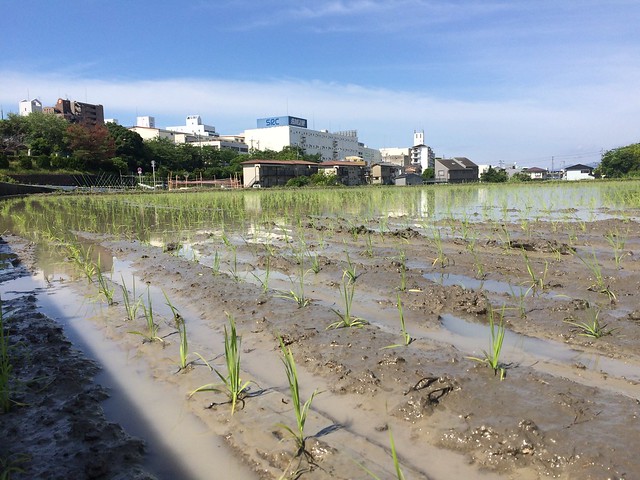
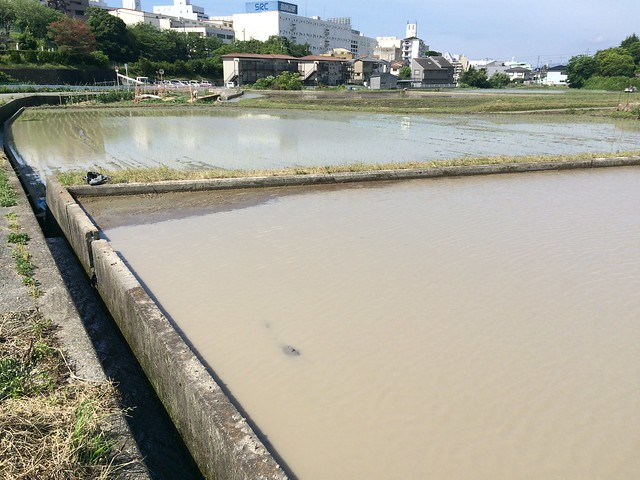
Our suburb of Minoh is full of rice paddies and gardens. You can find them scattered between residential and business districts. Often there are several fields together. The method of rice cultivation here requires standing water and so coming from the hills of the Minoh quasi national park down into the city, there is a system of  irrigation canals and reservoirs for capturing rainwater and storing and directing it towards the fields. The field above, as you can see in the another photo below of the field, has an reservoir right next to it. The reservoirs are a great place to see and hear wildlife. I’ve taken many photographs of ducks and herons.

There are canals everywhere, mostly on the sides of roads. In a safety conscious country like Japan, this is unexpected because they are easy to fall into on a bicycle or car.

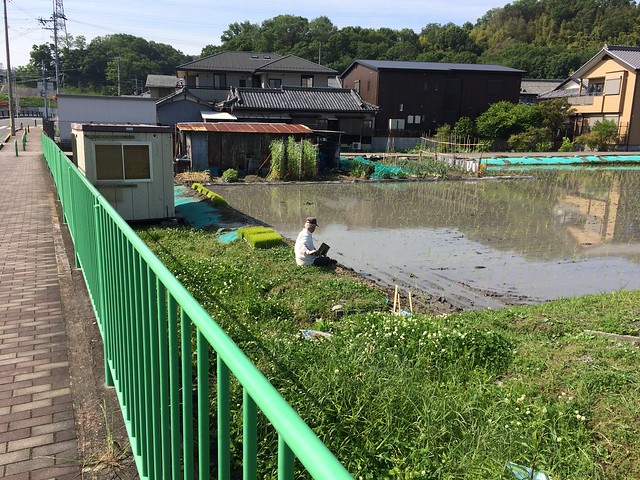
The rice paddies are mostly tended to by older people, which there are a lot of in Japan. The government subsidizes the production of rice in the name of national culture. Small, private  farms are not economical, but it is nice to see agriculture everyday and the Japanese practicing this facet of their culture. I wonder if the younger generation will continue this practice? I also would like to know how much the government spends on this.

The last week in May and first week in June is when rice if first planted. The seedlings are started indoors and then brought out to the fields. You can see the seedlings in the photo above, they are next to the man.  Most of the planting I saw was by a machine that looked a little bigger than a riding lawnmower. The Minoh city office organized a community planting for families and they did it by hand. The fields are then flooded and farmers watch to make sure the water levels remain static. The water blocks out other weeds from outcompeting the rice.

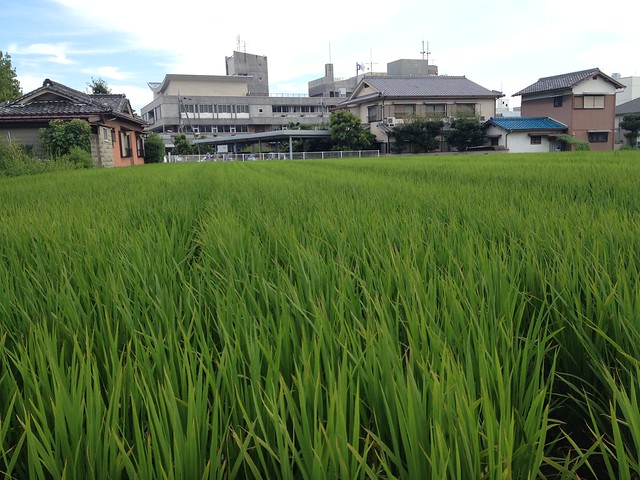
When I get back from summer holiday and August, the rice will look as it does below. The rice is harvested in mid to late September and I hope to participate in a harvest this year. It would be interesting to see how it goes from field to the store. I have no idea.

Shirahama Beach

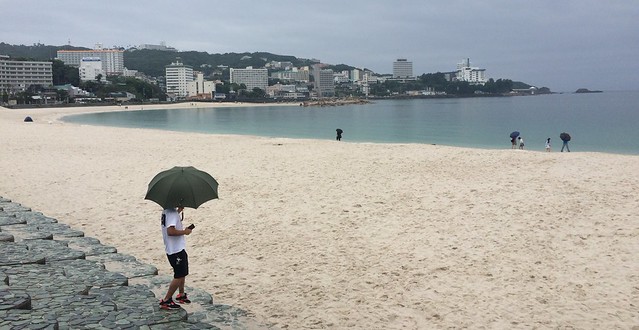
Yesterday we got out of the city and headed south of Osaka, towards the end of the Kii Peninsula. Our destination was the beach resort town of Shirahama (white beach). The city of 23,000 people, is a popular summer destination for people from Kansai. I can see why because the beach was beautiful and there is lots to do in the area. We will definitely go again.

We stopped at the Tore Tore Ichiba, which is a large market. It was the best fish market I have ever seen. The Japanese know seafood and do it right, and it was amazing that the place did not smell like fish in the least bit. Other seafood markets I have been to around the world have that strong smell of fish, but this one, nothing. That tells me the it is fresh! We had an interesting “tour” of the market and the workers were quite friendly, answering our questions the best they could with limited English. We bought some fresh Red Sea Bream for tonight. I also bought a whale steak. I was surprised at the large section of whale meat and I will blog on that experience in a later post. The kids enjoyed the spectacle of the live aquariums. I recommend a visit and it was quite popular with tourists.

It was an overcast, rainy day but that did not stop us from enjoying the beach. The white sands are imported from Australia and the water was clean and cool, but not cold. In Japan, people only swim in the ocean from July to August, so outside of those times, the beaches are pretty much empty. There were three people swimming and two other families/couples on the beach. The coastline is supposed to be beautifully rugged with lots of cliffs, rocks and small beaches. We are looking forward to exploring more when we get back in August.

It is about a 2 and 1/2 hour drive from Minoh. Most of the way is four-lane expressway and the tolls are expensive (4,000 Yen one way) but it is a smooth pleasant drive.

Finding a kanji for Kralovec

This is another post in the series about life in Japan. The longer I am here, the more I am liking it.

Most of the homes in our neighborhood have name plates near their front door or gate. Most of them are in both English and kanji, the Chinese characters borrowed by the Japanese. We wanted to make our rented place a bit more like home, so we made our nameplate. At the local hardware store, Konan, we needed to make a design. My surname Kralovec, is Czech, and there is not a kanji associated with it. Foreign words and names are written in another Japanese script, katakana, which is used for those words that have been adapted into Japanese. Kralovec becomes クラロヴェツク- phonetically it is KU-RA-RO-V-E-KU. The “L” and “R” are not differentiated in Japanese and a source of constant confusion for newcomers and for Japanese pronouncing English words. I didn’t want to have katakana on our name plate because I wanted to fit in with others in the neighborhood and I like the stories and history behind the kanji symbols. I instead came up with kanji characters that I felt best symbolized our name.

Kral in the Czech language means “king” hence the first kanji character (pronounced oh-uu) means king. The second character means “love” (pronounced “ah ii” and the spelling our name has the word love in the middle, kraLOVEc. A portion of the love kanji has the radical, or building block heart, kokoro, in the center of the symbol. So we are the King Love family. I like to think we have a lot of love in our family. It always gets a confused look and then a big laugh when people encounter it. A good way to enter a home!

America-mura (American Village)

Last week we ventured downtown to Shinsaibashi, one of the neighborhoods in the center of Osaka. Bashi means bridge and it is one of the famous bridges over the Nagahori River. Nadia needed to fix her iPhone and the most convenient Apple store is in this area. After getting the phone repaired, we stumbled onto the America-mura the American-themed shopping and entertainment district that is the center of popular youth culture in Osaka. There was an air of excitement and energy, especially around the triangle park (Sankaku koen). There was also a lot of interesting fashion choices, with all sorts of hairstyles and clothes with an urban edge. We walked around a bit and took the kids to Burger King. I would certainly like to go back and explore the area a bit more without the children in tow. There are some live music venues we would like to check out.

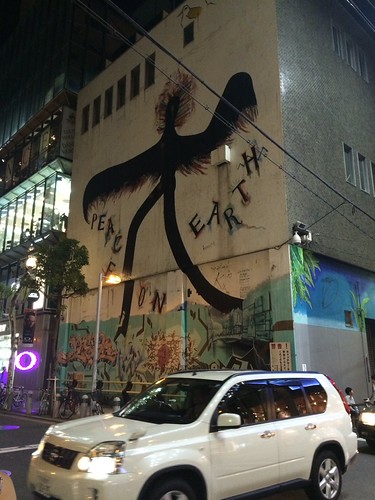
“Peace On Earth” by local artist Seitaro Kuroda (1983)

To get to America-mura, it is a side street off the main Midosuji road and subway line that runs north and south, bisecting Osaka. You can disembark at Namba or Shinsaibashi station. The area has always been an attraction for young people. I also liked the robot/human shaped light posts.

It is nice to live out in the suburbs but be very close to the inner city. America-mura is so different from Minoh and it makes for an invigorating night out.