Osaka Castle

Trying on the shogun era garb in the museum.

It was a beautiful spring day on Sunday and so we wanted to get outdoors and enjoy the day. We went to see the Osaka Castle, one of the famous landmarks of the city. There is a large park around the castle and makes for a nice afternoon. We strolled along the moat and the kids played under the trees in the forests in the park. The green areas and massive moats and walls surrounding the castle are impressive. It reminded me a bit of the Kalemegdan Fortress in Belgrade.

City officials have made a museum inside the castle. Admission is free for kids and 1,200 for adults. There are 8 floors of displays, which include videos describing the history of the castle, art work, models, etc. Much of the information is in English. The views from the top are also nice. The castle is located in the south central part of the city.

We were fascinated with a video explaining a huge tapestry depicting the summer war of 1615. The castle was the scene of many intertribal battles and the biggest was the Tokugawa clan, the group that unified Japan and then closed it off for over 200 years, defeated the Toyotomi clan. Back in the day, being routed was not pleasant. The tapestry depicted beheadings, rapes, and women and children fleeing across the moats. The poor civilians upon reaching “safety” were set upon by robbers and had everything taken from them. The tapestry ends with the the survivors crawling to Kyoto on the old road. I can see why the Japanese at the time welcomed the Tokugawa peace. Having to constantly be worried about attack from various clans must have been a tough way to live. The castle was destroyed a couple of times after lightning strikes and finally in 1868, during the Meiji Restoration and the end of the feudal era, the fort was destroyed during the civil conflicts of the time.

The view from the top

I recommend a day out at the castle. The city also organizes lighting shows are certain times of the year in the evenings. I will definitely go back after I learn a bit more about Japanese history.

It is strange that 400 years later the scene of so much violence and death is a tourist attraction.

Our First Professional Japanese Baseball Game

Tiger left field Matt Murton at Bat

On Monday we went to see the Hanshin Tigers to host the Chunichi Dragons. The Dragons won 9-2, and the 44 year old player-coach for the Dragons, was 4-4 with a home run and double to lead them to victory. Both teams are around the .500 mark, being fourth and fifth in the standings respectively.

It was a fascinating afternoon to experience the differences between baseball in Japan compared to the USA, especially the stadium experience.In the USA, most people go to baseball games for day or night out and many times the game is secondary to the food, the music, the attractions at the park, the in-between inning entertainment etc. The crowd is also much more subdued in the USA. In Japan, I think people go to let off steam and shout and sing. There is much more noise and group singing here in the games. It is a tradition in many Japanese games to have spectators release balloons during the seventh inning stretch and it is as enjoyable for kids as singing “Take Me Out to the Ball Game”.

Koshien Stadium is the most famous ball park in Japan. It is 80 years old this year and is one of the few outdoor stadiums, as most of the teams play in domes. It rains a lot in Japan so I see why they do this. Koshien also has a totally dirt infield and real grass in the outfield, rare for Japan as well. It also hosts the high school baseball national championship tournament, which is almost as popular as the professional league, every August.

The Tigers are the second most popular team in the league, behind the Yomiuri Giants from Tokyo. They are owned by the same company, Hankyu, that started the school I am working at. The Tigers however, have only won the league only 9 times compared to the Giants 45 titles and they have been compared to the Boston Red Sox while the Giants are the New York Yankees. The Chunichi Dragons, from Nagoya, also have won 9 titles, and with the Hiroshima Carp, are one of the strongest organizations. All of these teams play in the six-team central league. It is a shame that there is only a two week window in June that the central league teams play with the pacific league teams.

My favorite part of the experience were the songs the best players had. The Tigers have an official song writer and when a player comes up to bat, the crowd sings a particular song written just for that player. Only the veteran or best players have personalized songs. They are catchy tunes and the fans know all the words. My favorite was the song for Tsuyoshi Nishioka’s song. I would have loved to have a song written for me, although it must get tiring to hear it during every at bat.

The Hanshin Tigers are one of the big national teams. There is a second team in Kansai, the Orix Buffaloes, who play in the Osaka Dome. Koshien stadium is halfway between Kobe and Osaka and is about the same distance away as the Osaka Dome, which is just south of downtown Osaka, from our home in Minoh. I hope to go to a Buffaloes game, and get a chance to see some of the other Pacific league teams. The Tigers get about 1 million more fans yearly at their games than the Buffaloes.

I would like to thank our friend Kenta for inviting us to the game! We are going again Sunday with him to see the Tigers take on the Carp.

Hike Through Rokku Gaaden

It was a glorious early spring day yesterday, so we took advantage of the perfect weather and hiked through Rokku Gaaden (Rock Garden in English) in the hills above Kobe. The 5 kilometer hike goes through the sandstone “badlands” to the summit called Fubukiiwaato (447 meters). The views of Osaka Bay and the Koshien metropolitan area were quite nice. I can’t get over how close the dense urban population is so close to the quiet, forested hills. It is much like Avila Park outside of Caracas, Venezuela.

Nadia was a bit nervous climbing through the rocky bits, but seeing local senior citizens moving down the rocky paths, inspired her to power through. The kids loved scrambling over the rocks on the way up to the top. There were not that many people on the trail, considering it being a beautiful Saturday. It is a great hike to do close to Osaka/Kobe and can be reached by public transport.

We were disappointed not to see any of the famous wild boar, but it provided entertainment through the hike when one of us would snort like a pig to fool the others that boar were in the area. I did see the pygmy woodpecker for the first time and we discovered the source of a foul odor we have been smelling during this holiday. A bush that I think may be a Boxwood (Buxus sp.) has flowers that give an odor with a hint of small, rotting animal. We’ve been wondering what they were the past couple of days in our runs around Minoh and our visit to Kyoto earlier this week. I’ll have to look more into it and identify it.

The view from the top

I found a description of the hike in the Lonely Planet’s “Hiking in Japan” which I highly recommend for residents and tourists wanting to get out and explore a bit of the countryside. There are 70 detailed hike descriptions including maps.

We finished the day with a meal down at the Kobe Port waterfront. All and all, an excellent day with my family.

The Business of Baseball in Japan

Matt Murton, a great baseball player and engaging speaker.

Last night I went to the other side of the bay to Kobe to attend the American Chamber of Commerce in Japan sponsored talk, “The Business of Baseball” featuring author Robert Whiting and Hanshin Tiger player, Matt Murton.

Whiting is a long-time commentator on culture and baseball in Japan. His most famous book is “You Gotta Have Wa” which I read recently. It should be required reading for anyone working in Japan! Whiting tells the story of baseball in Japan and the clash of cultures when foreign players, mostly American, come over to play. The book has relates to life outside baseball, and will give useful insight to people in any field, including business and education.

One of my interesting takeaways was learning why Major League Baseball has grown to $9 billion in revenue while the Nippon Baseball League has stayed around $1 billion. The reasons are many, but basically, MLB teams run their teams professionally specific to baseball. All front office people are trained and experienced in sports business and they have successfully monetized the sport. From getting taxpayers to fund stadiums, to subscriptions on MLB.com, the league exploits every possible avenue to gain money. MLB teams also work closer together to create a competitive balance and negotiate broadcast contracts together to get more money for all the teams. In contrast, Japanese teams are owned by corporation and are thought of as a division of the company, not a money-making entity in the entertainment business.

Front office people are assigned by the CEO or board to run the teams and they may not have the interest or expertise in sports marketing. The league also is run by the top two teams, Hanshin Tigers and Yomiuri Giants, to the detriment of the other teams and the league as a whole. Also, the players do not have much power and hence there is not much incentive for team executives to try to maximize profits to pay high salaries.

As a counter point, I get tired of the high cost of professional sports in the USA. To go to a game with my family, although it is a really great night out, is prohibitively expensive to do it too often. American sports business tries to get every last dollar from the consumers, whether it be through $150 jerseys to a 2% hotel room tax in Green Bay Wisconsin to pay for the renovations to the Packer’s football stadium. They do get the stadium experience right, even in the minor leagues as we experienced this summer.

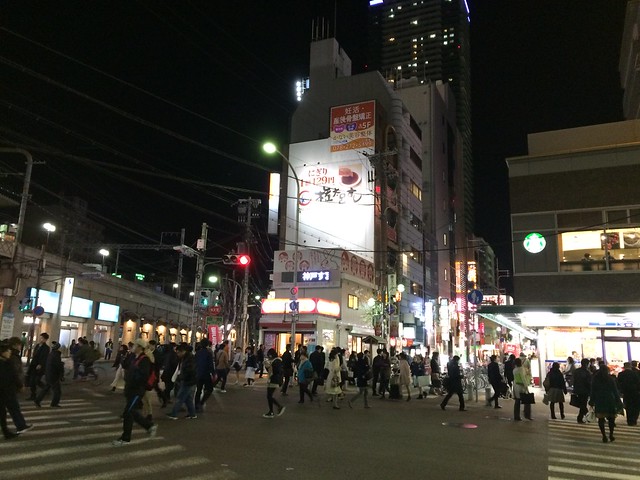
The vibrant street life of downtown Kobe – Sannomiya

The other takeway is how different the Japanese approach the sport to Americans. The amount of training, practice and preparation is many times more in Japan than in the USA. It is basically a year-round sport, with spring training starting a full month prior to the US. “Thunder” Matt Murton, as he is known, gave the example of batting practice. In the US, batters will take 5-8 swings in the cage and then rest. In Japan, there are 3 cages and he batted for 4 minutes three times and then went in doors to swing some more.

I asked Robert about US managers in Japan and the parallels to a business or education professional working in Japan. He said it was a balancing act and one needs to appreciate and learn as much as possible about the culture and language, but always keep in mind that you were hired for what you bring from the outside world to Japan. He also recommended to leave Japan to decompress a couple of times a year.

I would like to thank the American Chamber of Commerce in Japan for organizing the talk!

Life in Japan: Innovative Design

I am constantly running into really well thought out design of products and objects here in Japan. This post is just about two of the hundreds of differently designed things that makes like easier in subtle ways.

Bicycles are quite popular here. Drivers are respectful and it is pretty safe to ride bikes, even in a big city like Osaka. Because so many people ride bicycles, there are many bicycle garages. In the Q’s Mall near our house, we put them into these holders that are easy to use and hold the bikes up strongly. To save space, a slightly higher rack is interspersed with the lower rack.

Another space saver in this populous country is the gas pump that comes down from the ceiling (below). This allows for maximum amount of use of surface for cars to line up and to come from any angle. Many gas stations have pumps on the ground and cars need to align themselves in the direction of the islands. This would restrict the number of pumps one could have.

Hokkaido Winter

The best thing about holidays is reconnecting with my family. I take so much pleasure in watching my wife and children enjoy themselves and experience new things. I get more pleasure out of their joy than my own. I guess that is where an adult wants to be in middle age and in the middle of raising a family. It has changed me profoundly, thinking of others before myself. It makes life better.

Oliver came down with a fever and stomach problems while we were here, but managed to recover enough yesterday afternoon to enjoy some time in the snow. Nadia, Ollie and I went for a snowshoe hike on the hill behind the hotel. I can’t get over the amount of snow here, especially in this time of global warming and ski resorts around the world suffering from a lack of snow. The snow pack in the woods was a good 250 centimeters. The guide showed us how trees give off enough heat to melt the snow at their base, resulting in little snow caves. These allow one of the see the depth of snow. The little guy Oliver was non-stop talking and he really had a good time. Nadia doesn’t like downhill skiing and the resort doesn’t have cross-country skiing, so this was a good alternative. The fresh winter air and quiet of the woods caused by the heavy snow reminds me of my winters in Michigan. Something to be said for experiencing the change of seasons.

Owen, Ocean and I had a great final day of skiing. There was hardly anybody on the slopes, as spring break doesn’t start for the Japanese until next week and it being a Monday. The snow conditions were perfect and slashing down the groomed runs was a bit of heaven. It was the best day of skiing I ever had. Owen is getting good and was taking jumps and going off the course (they call runs, courses in Japan) and into deeper snow. If downhill skiing could be like this all the time, I would do it more often. The lines, hassle of equipment, and people all over the place, deter me from truly enjoying downhill skiing. But yesterday, with two of my kids and I spending a day outdoors challenging ourselves physically, was a bit of heaven!

I highly recommend the Kiroro Resort for a family ski destination. It has many different intermediate runs which provide the average skier variety of experiences. Kiroro comes from the Ainu words, Kiroru meaning a wide-walking path and Kiroro-an meaning resilient or healthy. The Ainu are the indigenous people of that region, but today they have mostly been bred out of existence in Japan with intermarriage with Japanese. The resort is owned by the Yamaha group and consists of two hotels in this mountain valley. There is no town or city close by.

I usually like the most wildest part of any country, like the Tara River valley of Serbia, and Hokkaido fits the bill. I hope to explore more of this beautiful island in my time in Japan.

Japan’s College Football Championship Game

KG in blue on offense against Nihon in red

Owen and I attended the 69th Koshien Bowl yesterday. This is Japan’s equivalent to the NCAA Football Championship Game. This is North American football, not soccer for my international readers. The bowl began in 1945, probably due to the American occupation after World War II. I happen to be working for the “Alabama Crimson Tide” of Japan’s college football scene, the Kwansei Gakuin University “Fighters”. They are known as “KG” to us. They defeated Nihon University 55-10 to win their fourth consecutive championship and their 27th in the history of the game, the most of any university. The game is named after Koshien stadium, the famed baseball stadium of the Hanshin Tigers professional baseball team. The game pits the east champ (Tokyo/Nagoya) versus the west champ (Osaka/Hiroshima). KG represented the west region.

The view from the field

It was a great atmosphere on a sunny, chilly, December afternoon in the stadium, located near Kobe, about an hour’s train ride from our home in Minoh. There were marching bands, cheerleaders, probably about 30-40,000 fans and most importantly,  some excellent football. Both teams were well coached, especially the KG Fighters (blue uniforms). The Phoenix of Nihon University (red uniforms) didn’t stand a chance however against the mighty fighters. KG controlled the line of scrimmage and had many long drives. I was surprised at the technical skill of the players, it looked like a very well played high school game in the USA, much like the Arctic Blast, a semi-professional team from my part of Michigan. They were not as athletic as American teams, but totally organized and fundamentally sound. There were screens, traps, misdirection, read option, KG even tried a flea flicker play. The field goal kickers were excellent as well, one being from 40 yards.

The Fighters now go on to play in the Rice Bowl next month. The winner of the collegiate championship plays the winner of the corporate league in a game called the Rice Bowl. No doubt this was made up by Americans. The corporate league are teams sponsored by companies, some with only employees of that company or teams that hold tryouts. They usually have an older and better quality of player. The college guys have not won since 2004, but KG should have a pretty good shot this year. The past three years they have lost to the Obic Seagulls, once only by 5 points. As you can see in the video below, the action was quite good in the game.

https://www.flickr.com/photos/billkralovec/15403871604/

https://www.flickr.com/photos/billkralovec/15403871604/

I enjoyed the day more just because it was father and son time. Nadia took the two little ones to Universal Studios Japan, while Owen and I had a great day at the stadium. We played basketball in the morning at the gym, rode our bikes to the train stationand ended the day with a stop at Owen’s favorite restaurant, Subway. It is a day that I would happily relive over.

The best part of the day was spending it with my son!

Nadia Excels in First 10km in Japan

Nadia ran a 55:02 10 kilometer race on Sunday in the Suita Bampaku Marathon race. This was her first competitive race here in Japan. The race took place in the Expo ’70 Park in the nearby suburb of Suita. Our school’s biathlon team participated and Nadia joined several of the faculty. We all had a fun day with an exceptionally beautiful autumn sunshine and fall colors.

The race differed from others she ran in that the crowd was very quiet and the only people cheering loudly were the family support for our us. Usually in Europe or America, strangers cheer on the runners to give them support.

She was a bit nervous because of her back, but it did not give her problems. Nadia wanted to be under an hour so she completed her goal.

We would like to thank Marcella, Dawn, and Tara for inviting us to run with them. We are planning to all run as a family in January for our next race.

Christmas in Japan

We had a funny experience earlier this week when we tried to buy a Christmas tree. We heard that Ikea sold real trees so on the last day of our rental car, we drove south to the store. Ikea is located on reclaimed land in the Osaka Bay, close to the mouth of the Yodo River. The waterfront in Osaka is not developed as a tourist destination, but instead is very industrial with a large port and factories.  My guess is that land was cheap and it was easy to receive imported goods so Ikea put their store there. The store is not near public transport so Ikea runs their own shuttle bus from the Namba station.

After about a 45 minute drive we got to the parking lot and there was a frenzy of activity near the entrance. They were selling “trees” around the corner from the entrance and when Nadia asked a salesperson how to buy a tree, she tells us that they are quickly selling out and to hurry to buy a ticket for a tree and stand before they run out. Nadia left for the sales desk and I went out to select a tree. When I got there however, I saw that the “trees” were just large branches. The locals were presenting their tickets and wrapping their branches in newspaper and were carrying them to the cars like babies. Hilarious! They were very happy with their branches. I guess it is all relative and in thinking about the size  of most Japanese apartments, a large tree would not fit. I quickly called Nadia and told her not to spend the 2,000 yen on a branch. Being from northern Michigan and having spent several years shaping Christmas trees at Hanson’s Tree Farm in my home town, I couldn’t get myself to buy a branch. It was a full branch, but it would have been worse than a Charlie Brown Christmas tree.

Instead we ended up getting an artificial tree. The main point was the kids, especially Ocean, loved trimming the tree and we infused some Christmas spirit into our house. We decided to put up the tree early this year because we are traveling to Australia for the holiday and want to enjoy the tree for a longer time.

The view from the Ikea parking lot back towards Osaka

I didn’t want to take any photos of people, so we sent Oliver to snap a photo of the branches to give you an idea of what they looked like. He took the photo that led this post, this branch sitting on a pallet, waiting for pickup from some happy customer.

I find it interesting as well that the Japanese love Christmas! There are decorations everywhere and Christmas carols playing in the stores. Nadia bought some ornaments and decorations at the local Ikea version, Nitori. Halloween was big here as well.

The view from the Midosuji Highway – downtown Osaka

Daisen National Park

Our first view of the Mountain

I can see why ancient people worshipped volcanoes. There is a sense of awe at the force of nature of something that big coming out of the earth. Above is our first view of Mount Daisen, located on the Sea of Japan coast of the main island of Honshu.

During this fall break from school, we rented a car and drove to the Daisen-Oki National Park.  We had a fantastic stay, enjoying the peace and serenity of the forests and mountains of the park, gourmet meals at a cozy bed and breakfast, and some quality family time. It was a holiday I won’t forget soon.

We only began to explore the park as it includes a large mountain range and even several islands. My highlight was the hike we took to Misen Peak. The trail goes through the Daisen-ji, a Buddhist temple dating from the eighth century. We are getting into the Buddhist and Shinto traditions of washing away the negativity in one’s life and ringing the gong to awaken our ancestors. The kids were pretty good and we made it to the snow line, which is over 1,100 meters. The peak is about 1,700 meters, but I don’t think Nadia was ready to go all the way. There were plenty of old growth trees and spectacular views of the snow-capped peaks. It was great to get away from the crowds of urban Japan as there were only a handful of people on the trail. The mountain is called a “mini-Mount Fuji” and is so far our favorite place in Japan. The fall colors were also out in full force and the drive through the forests reminded me of my home in Michigan.

The trail leading from the back of the temple.

I am really interested in the geology of Japan as it is one of the most seismically active places on earth. Daisen last erupted about 10,000 years ago, but an earthquake in 2000, made one of its flanks unstable. The pre-Buddhist sect, Shugeno, a group of acsetic monks, used to call it the mountain of the great god. The god may awake again someday. Another interesting thing about the mountain chain is their proximity to the Sea of Japan, which you can see from mountains.

We will definitely be back to explore more of the park and maybe even for some skiing this winter.

Safe and sound back in the Daisen village