Growing Rice

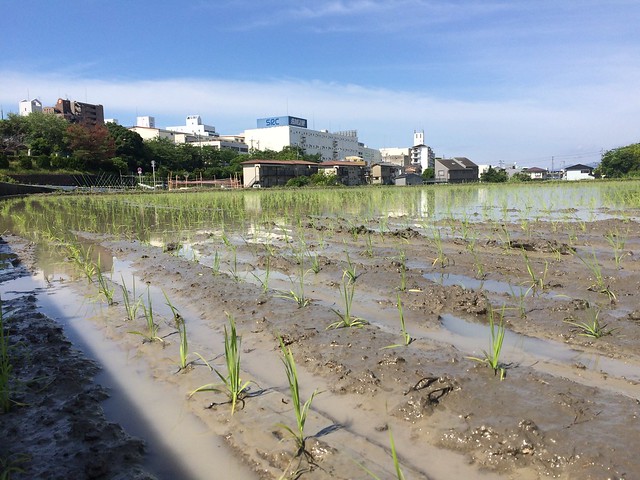
Our suburb of Minoh is full of rice paddies and gardens. You can find them scattered between residential and business districts. Often there are several fields together. The method of rice cultivation here requires standing water and so coming from the hills of the Minoh quasi national park down into the city, there is a system of  irrigation canals and reservoirs for capturing rainwater and storing and directing it towards the fields. The field above, as you can see in the another photo below of the field, has an reservoir right next to it. The reservoirs are a great place to see and hear wildlife. I’ve taken many photographs of ducks and herons.
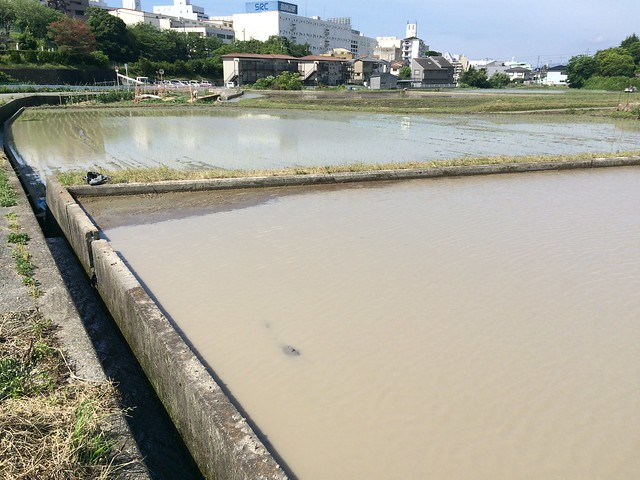
There are canals everywhere, mostly on the sides of roads. In a safety conscious country like Japan, this is unexpected because they are easy to fall into on a bicycle or car.

The rice paddies are mostly tended to by older people, which there are a lot of in Japan. The government subsidizes the production of rice in the name of national culture. Small, private  farms are not economical, but it is nice to see agriculture everyday and the Japanese practicing this facet of their culture. I wonder if the younger generation will continue this practice? I also would like to know how much the government spends on this.
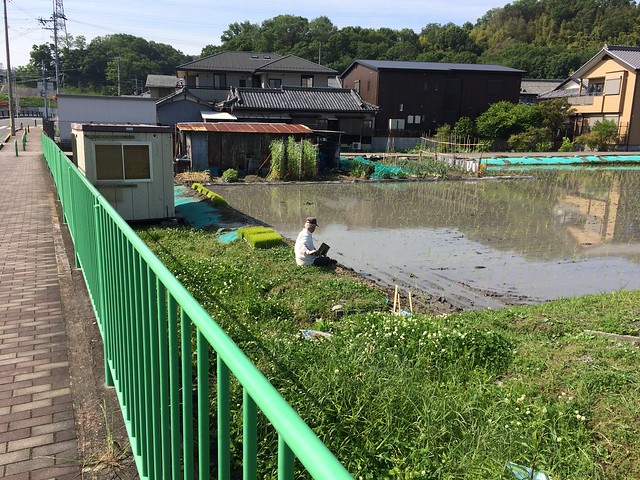
The last week in May and first week in June is when rice if first planted. The seedlings are started indoors and then brought out to the fields. You can see the seedlings in the photo above, they are next to the man.  Most of the planting I saw was by a machine that looked a little bigger than a riding lawnmower. The Minoh city office organized a community planting for families and they did it by hand. The fields are then flooded and farmers watch to make sure the water levels remain static. The water blocks out other weeds from outcompeting the rice.

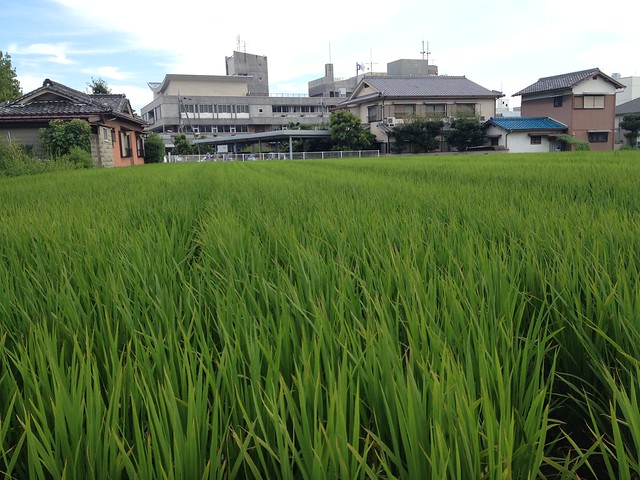
When I get back from summer holiday and August, the rice will look as it does below. The rice is harvested in mid to late September and I hope to participate in a harvest this year. It would be interesting to see how it goes from field to the store. I have no idea.
Shirahama Beach

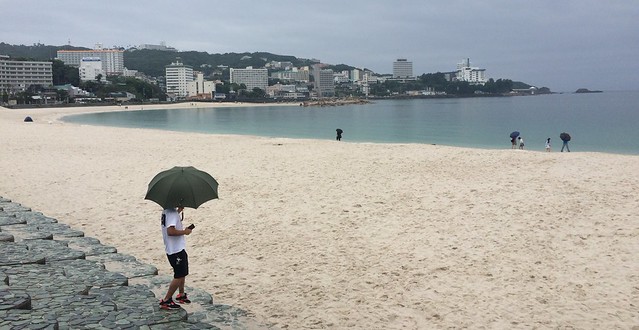
Yesterday we got out of the city and headed south of Osaka, towards the end of the Kii Peninsula. Our destination was the beach resort town of Shirahama (white beach). The city of 23,000 people, is a popular summer destination for people from Kansai. I can see why because the beach was beautiful and there is lots to do in the area. We will definitely go again.

We stopped at the Tore Tore Ichiba, which is a large market. It was the best fish market I have ever seen. The Japanese know seafood and do it right, and it was amazing that the place did not smell like fish in the least bit. Other seafood markets I have been to around the world have that strong smell of fish, but this one, nothing. That tells me the it is fresh! We had an interesting “tour” of the market and the workers were quite friendly, answering our questions the best they could with limited English. We bought some fresh Red Sea Bream for tonight. I also bought a whale steak. I was surprised at the large section of whale meat and I will blog on that experience in a later post. The kids enjoyed the spectacle of the live aquariums. I recommend a visit and it was quite popular with tourists.

It was an overcast, rainy day but that did not stop us from enjoying the beach. The white sands are imported from Australia and the water was clean and cool, but not cold. In Japan, people only swim in the ocean from July to August, so outside of those times, the beaches are pretty much empty. There were three people swimming and two other families/couples on the beach. The coastline is supposed to be beautifully rugged with lots of cliffs, rocks and small beaches. We are looking forward to exploring more when we get back in August.

It is about a 2 and 1/2 hour drive from Minoh. Most of the way is four-lane expressway and the tolls are expensive (4,000 Yen one way) but it is a smooth pleasant drive.

Owen’s Band Concert

I have been pleased with Owen learning the trumpet this year. The school has a quality instrumental music program and all students either learn a wind or string instrument or sing in the choir. Owen chose the trumpet and last week, he performed in the middle school band concert. This was his first concert with a full band and I am happy that he is getting this experience. Currently, he is in the beginning band, but next year he will move up to the concert band. I would like to thank his music teacher, Mr. Mark Elshout for his work with Owen!  We will have to take him to the home of the greatest trumpet players, New Orleans someday!


Finding a kanji for Kralovec

This is another post in the series about life in Japan. The longer I am here, the more I am liking it.

Most of the homes in our neighborhood have name plates near their front door or gate. Most of them are in both English and kanji, the Chinese characters borrowed by the Japanese. We wanted to make our rented place a bit more like home, so we made our nameplate. At the local hardware store, Konan, we needed to make a design. My surname Kralovec, is Czech, and there is not a kanji associated with it. Foreign words and names are written in another Japanese script, katakana, which is used for those words that have been adapted into Japanese. Kralovec becomes クラロヴェツク- phonetically it is KU-RA-RO-V-E-KU. The “L” and “R” are not differentiated in Japanese and a source of constant confusion for newcomers and for Japanese pronouncing English words. I didn’t want to have katakana on our name plate because I wanted to fit in with others in the neighborhood and I like the stories and history behind the kanji symbols. I instead came up with kanji characters that I felt best symbolized our name.

Kral in the Czech language means “king” hence the first kanji character (pronounced oh-uu) means king. The second character means “love” (pronounced “ah ii” and the spelling our name has the word love in the middle, kraLOVEc. A portion of the love kanji has the radical, or building block heart, kokoro, in the center of the symbol. So we are the King Love family. I like to think we have a lot of love in our family. It always gets a confused look and then a big laugh when people encounter it. A good way to enter a home!

America-mura (American Village)

Last week we ventured downtown to Shinsaibashi, one of the neighborhoods in the center of Osaka. Bashi means bridge and it is one of the famous bridges over the Nagahori River. Nadia needed to fix her iPhone and the most convenient Apple store is in this area. After getting the phone repaired, we stumbled onto the America-mura the American-themed shopping and entertainment district that is the center of popular youth culture in Osaka. There was an air of excitement and energy, especially around the triangle park (Sankaku koen). There was also a lot of interesting fashion choices, with all sorts of hairstyles and clothes with an urban edge. We walked around a bit and took the kids to Burger King. I would certainly like to go back and explore the area a bit more without the children in tow. There are some live music venues we would like to check out.

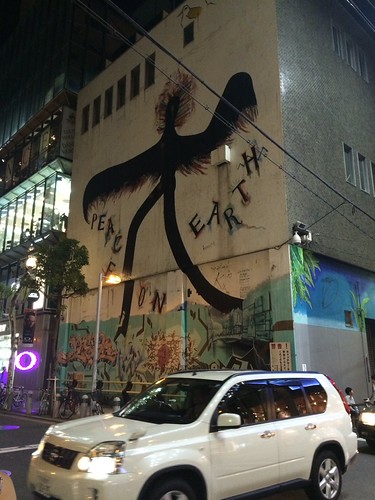
“Peace On Earth” by local artist Seitaro Kuroda (1983)

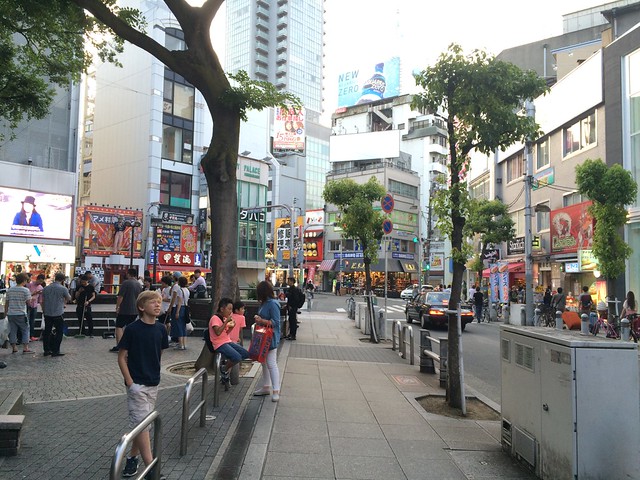
To get to America-mura, it is a side street off the main Midosuji road and subway line that runs north and south, bisecting Osaka. You can disembark at Namba or Shinsaibashi station. The area has always been an attraction for young people. I also liked the robot/human shaped light posts.

It is nice to live out in the suburbs but be very close to the inner city. America-mura is so different from Minoh and it makes for an invigorating night out.

Osaka Castle

Trying on the shogun era garb in the museum.

It was a beautiful spring day on Sunday and so we wanted to get outdoors and enjoy the day. We went to see the Osaka Castle, one of the famous landmarks of the city. There is a large park around the castle and makes for a nice afternoon. We strolled along the moat and the kids played under the trees in the forests in the park. The green areas and massive moats and walls surrounding the castle are impressive. It reminded me a bit of the Kalemegdan Fortress in Belgrade.

City officials have made a museum inside the castle. Admission is free for kids and 1,200 for adults. There are 8 floors of displays, which include videos describing the history of the castle, art work, models, etc. Much of the information is in English. The views from the top are also nice. The castle is located in the south central part of the city.

We were fascinated with a video explaining a huge tapestry depicting the summer war of 1615. The castle was the scene of many intertribal battles and the biggest was the Tokugawa clan, the group that unified Japan and then closed it off for over 200 years, defeated the Toyotomi clan. Back in the day, being routed was not pleasant. The tapestry depicted beheadings, rapes, and women and children fleeing across the moats. The poor civilians upon reaching “safety” were set upon by robbers and had everything taken from them. The tapestry ends with the the survivors crawling to Kyoto on the old road. I can see why the Japanese at the time welcomed the Tokugawa peace. Having to constantly be worried about attack from various clans must have been a tough way to live. The castle was destroyed a couple of times after lightning strikes and finally in 1868, during the Meiji Restoration and the end of the feudal era, the fort was destroyed during the civil conflicts of the time.

The view from the top

I recommend a day out at the castle. The city also organizes lighting shows are certain times of the year in the evenings. I will definitely go back after I learn a bit more about Japanese history.

It is strange that 400 years later the scene of so much violence and death is a tourist attraction.

Gamba Osaka

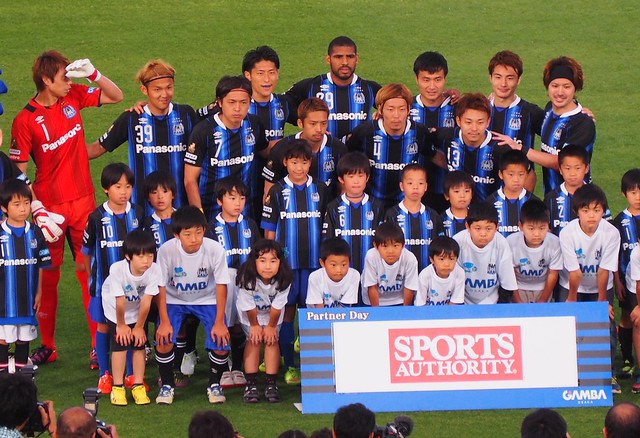
We just got back from attending the  top professional soccer league (J-league Division 1) game between the local Gamba Osaka versus south Tokyo-based Kawasaki Frontale. The top player for Gamba, Usami #39 (back row, second from left) scored in the 43rd minute of the first half. Kawasaki equalized in the 81st minute of the second half and the game ended in a 1-1 draw. I thought Gamba dominated the first half and Kawasaki the second, so it was a fair result.

The “Gamba” comes from the Italian word for leg and the Japanese “gambate – go for it”. They seem to be modeled after Inter Milan and I did see some Italian signs of the fan clubs around the stadium. They are the defending J-League champions, but are third in the table this year, behind FC Tokyo and Urawa Red Diamonds. There biggest season was in 2008, when they won the Asian version of the Champions League. The team started from the defunct B team of cross-town rival in the J-League, Cereza Osaka.

Gamba plays in Expo 70 stadium which is very close to our house in Minoh. They are building a new Suita Stadium, which is close by the current stadium. It will open next season. Both stadiums are in the Expo ’70 or Bampaku park and it is a really nice area. We bike and run around and in the park often.

Tribalism and Nationalism are present in soccer stadiums around the world, including Gamba Osaka

My favorite player for Gamba tonight was striker Takashi Usami. He is only 23 years old and an aggressive, exciting player. He took a lot of shots on goal, which I like to see. He spent a couple of years in Germany, one playing for Bayern Munich. Attendance was over 18,000 and the stadium, although a bit old, was quite comfortable. The crowd was not as big or crazy as the Hanshin Tiger game. A nice evening out!

Oh No! Hanshin Tigers are in Last Place.

The boys and I went to Koshien stadium again last weekend to watch the Hanshin Tigers host the Hiroshima Carp in the Japan professional baseball league We had a great time, however, the Tigers lost 2-7 and fell to 15-20 for the season, good for last place in the Central league standing, just below the Carp who improved their record to 16-18 with the win.It was a gorgeous day and a full crowd at Koshien stadium. and we had a lot of fun. The left field section was a sea of red Hiroshima supporters. Leading the way for the Carp was catcher Tsubasa Aizawa, who went 3-5 with a home run and three RBIs. Yuya Fukui pitched 7 innings and allowed only 1 run. Randy Messenger, the import pitcher for the Tigers, lost, allowing 5 runs in 6 innings of work. Particularly disappointing for the Tigers was Mauro Gomez, who struck out twice and weakly grounded to third twice with runners in scoring position. The bright spots for Hanshin was our man, Tsuyoshi Nishioka, who made several brilliant fielding plays at third base and had a clutch, two-out hit to drive in their first run. (He has the best individual player song.) Toritani, the shortstop also had a double and triple, and was robbed of another big hit by a spectacular catch by Carp centerfielder Yoshihiro Maru. Matt Murton, another import for the Tigers, did not play today, although during batting practice, he gave Oliver and Kenta rubber wrist bands and said hello. It made the boys day.

The Hanshin Tiger Fans are the most passionate in Japan

The passion the Tiger fans have for their team is incredible. Like in the US around some professional teams, people get dressed up to go to the game and make a full day out of the stadium experience. I enjoy going occasionally, but it is a serious time commitment. Considering the 1 hour drive to the stadium and 3-4 hour games, it does take up a day. I think it is fine once in a while, but I would never be a season ticket holder or go every weekend.

3B Nishioka with Matt Murton in the background

I taught the boys how to score a baseball game. They also got down to the field and watch the teams take infield practice and batting practice. One does not appreciate the skill and athleticism of professional baseball players on television. In person, you can see how every throw they make it perfect. I think they now like baseball and I hope to get them to play on a Japanese club in the neighborhood besides the school team. We shall see.

Our First Professional Japanese Baseball Game

Tiger left field Matt Murton at Bat

On Monday we went to see the Hanshin Tigers to host the Chunichi Dragons. The Dragons won 9-2, and the 44 year old player-coach for the Dragons, was 4-4 with a home run and double to lead them to victory. Both teams are around the .500 mark, being fourth and fifth in the standings respectively.

It was a fascinating afternoon to experience the differences between baseball in Japan compared to the USA, especially the stadium experience.In the USA, most people go to baseball games for day or night out and many times the game is secondary to the food, the music, the attractions at the park, the in-between inning entertainment etc. The crowd is also much more subdued in the USA. In Japan, I think people go to let off steam and shout and sing. There is much more noise and group singing here in the games. It is a tradition in many Japanese games to have spectators release balloons during the seventh inning stretch and it is as enjoyable for kids as singing “Take Me Out to the Ball Game”.

Koshien Stadium is the most famous ball park in Japan. It is 80 years old this year and is one of the few outdoor stadiums, as most of the teams play in domes. It rains a lot in Japan so I see why they do this. Koshien also has a totally dirt infield and real grass in the outfield, rare for Japan as well. It also hosts the high school baseball national championship tournament, which is almost as popular as the professional league, every August.

The Tigers are the second most popular team in the league, behind the Yomiuri Giants from Tokyo. They are owned by the same company, Hankyu, that started the school I am working at. The Tigers however, have only won the league only 9 times compared to the Giants 45 titles and they have been compared to the Boston Red Sox while the Giants are the New York Yankees. The Chunichi Dragons, from Nagoya, also have won 9 titles, and with the Hiroshima Carp, are one of the strongest organizations. All of these teams play in the six-team central league. It is a shame that there is only a two week window in June that the central league teams play with the pacific league teams.

My favorite part of the experience were the songs the best players had. The Tigers have an official song writer and when a player comes up to bat, the crowd sings a particular song written just for that player. Only the veteran or best players have personalized songs. They are catchy tunes and the fans know all the words. My favorite was the song for Tsuyoshi Nishioka’s song. I would have loved to have a song written for me, although it must get tiring to hear it during every at bat.

The Hanshin Tigers are one of the big national teams. There is a second team in Kansai, the Orix Buffaloes, who play in the Osaka Dome. Koshien stadium is halfway between Kobe and Osaka and is about the same distance away as the Osaka Dome, which is just south of downtown Osaka, from our home in Minoh. I hope to go to a Buffaloes game, and get a chance to see some of the other Pacific league teams. The Tigers get about 1 million more fans yearly at their games than the Buffaloes.

I would like to thank our friend Kenta for inviting us to the game! We are going again Sunday with him to see the Tigers take on the Carp.

Happy Birthday Oliver

We had a delightful afternoon celebrating my son Oliver turning 10 yesterday. We invited 10 of his friends from his class. The party started with a visit to a local park to play “Hunger Games” dressed as ninja fighters. Everyone got a Daiso (the famous 100 Yen store) plastic kendo sword and Japanese headband. We also played soccer and some games and gave away prizes. We then walked over to the house for grilled hamburgers and chocolate cake. The kids also popped a lot of balloons and drank ice cold Sprite soda pop.

Nadia and I can’t believe Oliver is 10 years old! It only seems like yesterday (being a parent turns cliches into dogma) that he was born. I will never forget that night! Nadia wasn’t due for another month and she had just finished working at the school on the Friday April 29, 2005 to start her maternity leave the next week. That night however, she started bleeding and she needed to undergo an emergency cesarean. Our regular doctor was in a conference in Caracas and the hospital we planned to use was a 90 minute drive north to the coast, too far to travel in the state Nadia was in. We ended up staying in the small town of Anaco, Venezuela and met a colleague of our doctor. It was a stressful night of uncertainty, but Oliver did arrive, a bit blue, but healthy. I remember holding him in my hand and placing him in the warm incubator so I could sleep with Nadia. What a night!

Oliver has brought so much joy to our lives! He is a fun-loving, crazy little guy that uses his charm to connect with people of all ages. He is the most even-keeled of our children emotionally and many of his personality traits are similar to Nadia’s. Ollie likes to move and school is always going to be a challenge for him. He really likes legos, fantasy and the typical boy adventure things, like playing war with nerf guns, etc.  Oliver also looks up to his brother Owen and plays with his sister Ocean all the time.

Happy 10th birthday Ollie – We love you!

Last fall at the Tottori Sand Dunes – October 2014