The Climate of Osaka

Not much evidence, but we did feel the snow flakes – December 18, 2014

Men turn into their fathers as we get older. I am more and more interested in the weather as I age. I remember my father always mentioned the weather when I talked with him from afar and he had thermometers outside all sides of the house to check daily. I guess a part of it is my background in science and my interest in the earth sciences like geology, astronomy, and meteorology. Understanding and observing climate, wind patterns, tracking precipitation, etc. is fascinating.

After living for 13 years in tropical countries, my past two posts, Serbia and Japan, have been refreshing because of the change of seasons. This is my seventh consecutive year of living in latitudes outside of the tropics. Osaka is 34 degrees north of the equator, which generally the same latitude as Los Angeles, California, Atlanta, Georgia, Nicosia, Cyprus and Kabul, Afghanistan.

The awesome red color and comfortable weather of autumn in Osaka.

Osaka’s climate is classified as humid subtropical. It has hot, humid summers and cool “mild” winters and a definite change of seasons. The summer was incredibly hot and wet and the fall was gorgeous with perfect weather. This winter so far has been cold, not northern Michigan cold where I am from, the more like the Balkans cold with temperatures around 0 C. We even had snow flurries yesterday, which is very rare for December here, and over the year on average it only snows 3 centimeters (1 inch) per year. That is a bit sad because I love snow.

A warm summer day in September.

It feels much colder because of the lack of insulation  and central heating in Japanese homes. They tend to close off rooms in the winter, use small heating devices like electric rugs/blankets, pocket hand warmers, portable gas and electric heaters, instead of a furnace like in European or North American homes. I was joking that living in our house is like living in our summer porch in my childhood home in Michigan. We had a non-insulated room in the back of our house that was used for storage or sleeping in the summer (before the days of air conditioning). I find this interesting why the homes are not insulated well, as things here have a developed infrastructure, like highways, buildings, etc, why not have insulated homes? It is a mystery I hope to answer in my time here.

The students at our school from India and Brazil were very excited to see snow yesterday. I am looking forward to see how the winter progresses into spring.

Japan’s College Football Championship Game

KG in blue on offense against Nihon in red

Owen and I attended the 69th Koshien Bowl yesterday. This is Japan’s equivalent to the NCAA Football Championship Game. This is North American football, not soccer for my international readers. The bowl began in 1945, probably due to the American occupation after World War II. I happen to be working for the “Alabama Crimson Tide” of Japan’s college football scene, the Kwansei Gakuin University “Fighters”. They are known as “KG” to us. They defeated Nihon University 55-10 to win their fourth consecutive championship and their 27th in the history of the game, the most of any university. The game is named after Koshien stadium, the famed baseball stadium of the Hanshin Tigers professional baseball team. The game pits the east champ (Tokyo/Nagoya) versus the west champ (Osaka/Hiroshima). KG represented the west region.

The view from the field

It was a great atmosphere on a sunny, chilly, December afternoon in the stadium, located near Kobe, about an hour’s train ride from our home in Minoh. There were marching bands, cheerleaders, probably about 30-40,000 fans and most importantly,  some excellent football. Both teams were well coached, especially the KG Fighters (blue uniforms). The Phoenix of Nihon University (red uniforms) didn’t stand a chance however against the mighty fighters. KG controlled the line of scrimmage and had many long drives. I was surprised at the technical skill of the players, it looked like a very well played high school game in the USA, much like the Arctic Blast, a semi-professional team from my part of Michigan. They were not as athletic as American teams, but totally organized and fundamentally sound. There were screens, traps, misdirection, read option, KG even tried a flea flicker play. The field goal kickers were excellent as well, one being from 40 yards.

The Fighters now go on to play in the Rice Bowl next month. The winner of the collegiate championship plays the winner of the corporate league in a game called the Rice Bowl. No doubt this was made up by Americans. The corporate league are teams sponsored by companies, some with only employees of that company or teams that hold tryouts. They usually have an older and better quality of player. The college guys have not won since 2004, but KG should have a pretty good shot this year. The past three years they have lost to the Obic Seagulls, once only by 5 points. As you can see in the video below, the action was quite good in the game.

https://www.flickr.com/photos/billkralovec/15403871604/

https://www.flickr.com/photos/billkralovec/15403871604/

I enjoyed the day more just because it was father and son time. Nadia took the two little ones to Universal Studios Japan, while Owen and I had a great day at the stadium. We played basketball in the morning at the gym, rode our bikes to the train stationand ended the day with a stop at Owen’s favorite restaurant, Subway. It is a day that I would happily relive over.

The best part of the day was spending it with my son!

Happy Birthday Owen

It is a cliche that kids grow up so fast, but it does seem like it. I can’t believe Owen, our eldest son is already 12 years old. It seems only like yesterday that he was a little, chubby baby and in my jogging stroller drinking his bottle while I ran around Anaco. Where does the time go?

I took the photo above last week showing Owen in his basketball uniform and holding his MVP trophy. He won the award as the best player on his team at the Western Japan Athletic Association (WJAA) middle school boys basketball championships hosted by the Marist Brothers International School in Kobe. He really enjoyed playing basketball this year and we are very proud of him.

Yesterday we took him to the Hard Rock Cafe, made him breakfast in bed, and allowed him to use his iPad as much as he wanted. Typical of a boy nearing his teenage years, he was thrilled to receive headphones. We got him the popular “beats” by Dre type.

We are so proud of Owen and we love him very much! Happy Birthday!

The Towers of Kansai

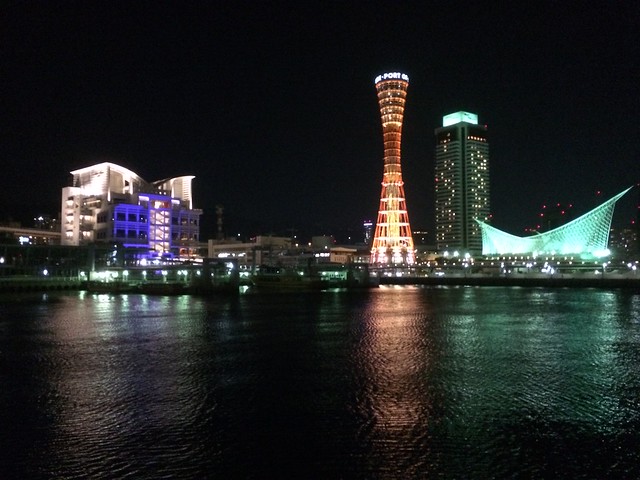
Last Saturday we drove with friends over to the west side of Osaka Bay to see the lights of  Kobe. We intended to go see the luminarie, a display of lights commemorating the victims of the Kobe earthquake of 1995. We did see them from the highway, but instead, ended up at the water front, pictured above. There is a nice mall, Mosaic, with many restaurants, cafes, and stores. We had dinner at an Italian restaurant and then strolled along the pier to soak up the view. As you can see is the prominent, Kobe Port Tower. a 108-meter high tourist attraction built in 1963. To the right is a hotel and museum and further on is the port. Kobe historically was a port city and one of the few areas in Japan open to foreigners during their long period of isolation. The port dropped from the second busiest port in Japan to the fourth after the earthquake as it is today. We hope to see more of Kobe.

The other tower I wanted to highlight in the post is the Tower of Sun located in Expo Commemoration Park near our home in Mino. The park is on the site of a former world’s fair that took place in the summer of 1970. The tower was designed by Japanese artist Taro Okamoto. Two of the three original faces on the tower remain and represent the sun of past and future. The red lines represent thunder. In its over 40 years, it has been opened and closed and refurbished many times. At the time of the expo, it was encircled by a plaza building, but today it is long gone.

The park is huge, although really crowded on weekends. We have been there a couple of times and it is a good place to run, ride bikes (outside only) and they hold distance runs there often.


Nadia Excels in First 10km in Japan

Nadia ran a 55:02 10 kilometer race on Sunday in the Suita Bampaku Marathon race. This was her first competitive race here in Japan. The race took place in the Expo ’70 Park in the nearby suburb of Suita. Our school’s biathlon team participated and Nadia joined several of the faculty. We all had a fun day with an exceptionally beautiful autumn sunshine and fall colors.

The race differed from others she ran in that the crowd was very quiet and the only people cheering loudly were the family support for our us. Usually in Europe or America, strangers cheer on the runners to give them support.

She was a bit nervous because of her back, but it did not give her problems. Nadia wanted to be under an hour so she completed her goal.

We would like to thank Marcella, Dawn, and Tara for inviting us to run with them. We are planning to all run as a family in January for our next race.

Christmas in Japan

We had a funny experience earlier this week when we tried to buy a Christmas tree. We heard that Ikea sold real trees so on the last day of our rental car, we drove south to the store. Ikea is located on reclaimed land in the Osaka Bay, close to the mouth of the Yodo River. The waterfront in Osaka is not developed as a tourist destination, but instead is very industrial with a large port and factories.  My guess is that land was cheap and it was easy to receive imported goods so Ikea put their store there. The store is not near public transport so Ikea runs their own shuttle bus from the Namba station.

After about a 45 minute drive we got to the parking lot and there was a frenzy of activity near the entrance. They were selling “trees” around the corner from the entrance and when Nadia asked a salesperson how to buy a tree, she tells us that they are quickly selling out and to hurry to buy a ticket for a tree and stand before they run out. Nadia left for the sales desk and I went out to select a tree. When I got there however, I saw that the “trees” were just large branches. The locals were presenting their tickets and wrapping their branches in newspaper and were carrying them to the cars like babies. Hilarious! They were very happy with their branches. I guess it is all relative and in thinking about the size  of most Japanese apartments, a large tree would not fit. I quickly called Nadia and told her not to spend the 2,000 yen on a branch. Being from northern Michigan and having spent several years shaping Christmas trees at Hanson’s Tree Farm in my home town, I couldn’t get myself to buy a branch. It was a full branch, but it would have been worse than a Charlie Brown Christmas tree.

Instead we ended up getting an artificial tree. The main point was the kids, especially Ocean, loved trimming the tree and we infused some Christmas spirit into our house. We decided to put up the tree early this year because we are traveling to Australia for the holiday and want to enjoy the tree for a longer time.

The view from the Ikea parking lot back towards Osaka

I didn’t want to take any photos of people, so we sent Oliver to snap a photo of the branches to give you an idea of what they looked like. He took the photo that led this post, this branch sitting on a pallet, waiting for pickup from some happy customer.

I find it interesting as well that the Japanese love Christmas! There are decorations everywhere and Christmas carols playing in the stores. Nadia bought some ornaments and decorations at the local Ikea version, Nitori. Halloween was big here as well.

The view from the Midosuji Highway – downtown Osaka

Tottori Sand Dunes

On the way home from Daisen, we stopped at the Tottori sand dunes for the day. The audible gasp from the kids when we walked over the hill and saw the dunes for the first time was worth the trip. The dunes are located just outside the city of Tottori and run along the coast for several kilometers. We had a lot of fun running up and down the hills and with temperatures in the 70s, I even went for a swim, my first in the Sea of Japan.

There were a lot of people there, but it didn’t feel crowded. All one had to do is walk a short way to get some privacy. Most of the tourists stopped for photos with the camels near the road and then walked up the nearest dune. It would have been nice to have a picnic lunch and walk to another part of the dunes away from everyone. The size of the dunes is impressive and despite the fact they are shrinking, they still attract a lot of tourists. We were the only non-Japanese tourists in the mountains and at the dunes. This area is really off the beaten track for foreigners. Below is a video from the day.


Daisen National Park

Our first view of the Mountain

I can see why ancient people worshipped volcanoes. There is a sense of awe at the force of nature of something that big coming out of the earth. Above is our first view of Mount Daisen, located on the Sea of Japan coast of the main island of Honshu.

During this fall break from school, we rented a car and drove to the Daisen-Oki National Park.  We had a fantastic stay, enjoying the peace and serenity of the forests and mountains of the park, gourmet meals at a cozy bed and breakfast, and some quality family time. It was a holiday I won’t forget soon.

We only began to explore the park as it includes a large mountain range and even several islands. My highlight was the hike we took to Misen Peak. The trail goes through the Daisen-ji, a Buddhist temple dating from the eighth century. We are getting into the Buddhist and Shinto traditions of washing away the negativity in one’s life and ringing the gong to awaken our ancestors. The kids were pretty good and we made it to the snow line, which is over 1,100 meters. The peak is about 1,700 meters, but I don’t think Nadia was ready to go all the way. There were plenty of old growth trees and spectacular views of the snow-capped peaks. It was great to get away from the crowds of urban Japan as there were only a handful of people on the trail. The mountain is called a “mini-Mount Fuji” and is so far our favorite place in Japan. The fall colors were also out in full force and the drive through the forests reminded me of my home in Michigan.

The trail leading from the back of the temple.

I am really interested in the geology of Japan as it is one of the most seismically active places on earth. Daisen last erupted about 10,000 years ago, but an earthquake in 2000, made one of its flanks unstable. The pre-Buddhist sect, Shugeno, a group of acsetic monks, used to call it the mountain of the great god. The god may awake again someday. Another interesting thing about the mountain chain is their proximity to the Sea of Japan, which you can see from mountains.

We will definitely be back to explore more of the park and maybe even for some skiing this winter.

Safe and sound back in the Daisen village

Latest Reading: “Nothing to Envy: Ordinary Lives in North Korea”

During the fall break holiday, I completed Barbara Demick’s book about North Korea. Demick. She is the Los Angeles Times Beijing bureau chief. Nothing to Envy focuses on the lives of six North Korean defectors over 15 years. They are all from the city of Chongin, an industrial port city near the border with Russia and China. She goes into detail about their lives before they left, their escape and how they got on in South Korea.

I am fascinated with North Korea’s totalitarian regime. I can’t believe that a family can maintain control over an entire country in this century. Nadia and I watched a documentary in 2001 about a North Korean family living in the rural north, who had to send their 5-year old child away to the capital because they couldn’t feed him. It broke my heart then, before I had kids, and seeing it today I would have a stronger reaction.

When I hear of government repression, I always think about the men that are actually doing the repression. Why do they agree to round up ordinary citizens, interrogate them, hold them prisoner in work camps, etc? And to do so just because of one man (Kim Il-Sung) and his descendants?  I understand human nature and resistance to change and their limited experience and perspective, and I marvel at the ability of humans to adapt to circumstances so that almost anything can be regarded as normal. The book made me angry at the North Korean government. The people featured in the book understood the lies, and fought against them, but they were the minority.

It would be nice for the US and other rich nations to help them, but with nuclear capability and a 1-million strong armed force, it would be crazy to interfere too much. Everyone sees eventually the influences of the outside world breaking down the government and them losing control and I predict that it will happen in my lifetime. It will be extremely tough on South Korea, but with economic help from neighbors China, Japan, Russia, and the west, I think they will eventually work it out. Not as fast as Germany because of how low North Koreans are, but they will get there.

I highly recommend the book. I have been reading a lot about Japan and the region and hope to get to both South and North Korea in my time here. Demick also wrote a book about life in one street in Sarajevo during the siege that I would also like to read.

Inner City Night Patrol

I got to see another side of Osaka last weekend when I accompanied the students from our school on a community service activity. We went to the Sanno Childrens Center in the poorest ward of Osaka, Nishinari-ku. The ward is infamous in Japan for its crime rates, red light district and homeless. Now this being Japan, a country with one of the lowest violent crime rates in the world, I felt quite safe and yes it did seem a bit run down and not as new and tidy as other parts of the city, but compared to disadvantaged districts in cities in other parts of the world, it is extremely safe.

The Childrens (Kodomo) Center was founded in the 1960s by German missionaries. To this day, it continues to provide after school care and other services for children from the ward. As you can see from the photo above, one of the children the center cares for was fascinated with my European, bald, head. One of the initiatives of the center is a monthly yomoguri or night patrol. Volunteers led by the pugnacious director of the center Mami, lead groups into the streets to deliver food (onigiri – spheres of rice wrapped in seaweed) and blankets to the homeless men sleeping in the streets of the shopping arcades in the district. I was filled with a sense of goodness seeing how grateful and kind the men were in talking with the students, including my 7 year old daughter.

Mami gives us instructions for the patrols and you can see Ocean leaning over the middle of the table.

Within Nishinari-ku is a neighborhood called Kamagasaki. This area is home to many male day laborers, who through a variety of circumstances (gambling, alcohol, mental illness) are homeless. The government forbids the official use of the name and they try to hide media from portraying issues in the area. A recent NHK documentary about the Sanno Childrens Center featured one of the orphans the center cares  for and it has brought increased donations to them. It was sad to see them laying on newspaper with cardboard boxes around them as their only protection against the elements. It gets cold at night in Osaka in November. There are several organizations helping them, including a center to organize them finding short-term manual labor, free or reduced price shelters, etc.

We also walked through Tobita Shinchi, another neighborhood within the ward. Tobita Shinchi is infamous for its red light district. As in Amsterdam, the women are displayed for street view, although here, it is open air and the architecture is old Japan style. They were only protected by an elderly woman minder that sat to the side of them. She yelled at me when I tried to take the photo (see below). The police tolerate prostitution, but again, I felt sorry for the girls, as it is a tough way to make a living.

I was so inspired to help and want to make it a regular part of our experience while we are here. I would like to thank Lyn and Hannah for assisting me and Ocean and introducing us to the center.