Miyajima: UNESCO Cultural Heritage Site

30125162988_43e2dbb97e_c
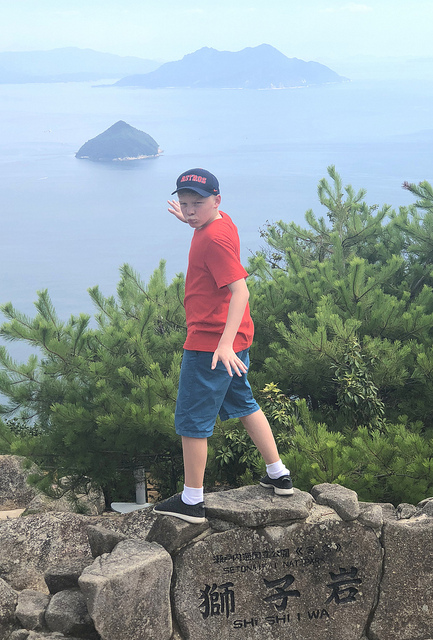
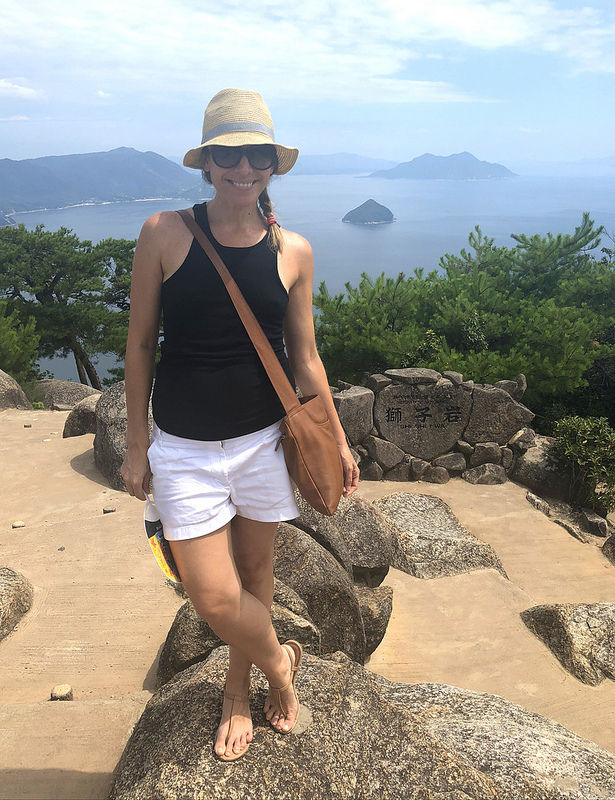
Nadia on the Shishiwa Overlook

The Itsukushima shrine on Miyajima Island is one of 18 United Nations Cultural Heritage sites in Japan. The Shinto shrine has an unusual Torii (gate) in the tidal bay that draws hundreds of tourists daily. Besides the gate and temple, the island is dramatically beautiful with sharply rising green hills and rocky outcrops. There are also breathtaking views of the islands of the Seto Inland Sea. After the Atomic Bomb Dome / Peace Park, it is the attraction to see in Hiroshima.

43993758721_4fd101432e_z
Oliver giving his best “Blue Steel”

It was a super hot day with temperatures close to 100 F. In my previous visits, we usually hike to the summit of Mount Misen, the highest point on the island, but instead took the cable car up to the top. The views did not disappoint, but we were ready to cool down after walking around at the top station.

42184471370_0bb54d9104_c
Ocean under the Torii as the tide is going out

We stopped for ice cold Summer I.P.A. on tap at the Miyajima Brewery and they really hit the spot. Before leaving the island, we had to try the Hiroshima-style okonomiyakiThe four-hour drive back to Osaka went well. We recovered this weekend. It has been nice to have my uncle visit in this last week of summer holidays.

43088040805_5e30de70eb_z
Miyajima Brewery 

Japanese Whisky

42146523930_84abc3471b_z
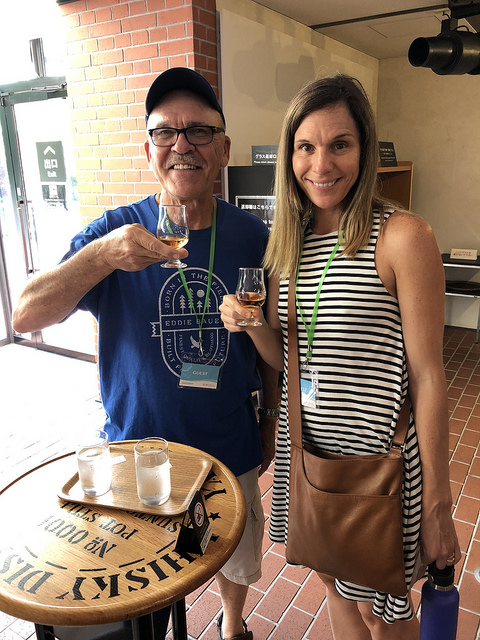
Nadia & Jack sample some of Suntory’s best whiskeys

I am not a big drinker but I do love the science behind fermentation and distillation. We visited the Suntory Yamazaki Whisky distillery in Kyoto on Wednesday. I recommend the tasting tour if you enjoy whiskey. Note that in Scotland and Japan, whisky is spelled without an “e” and in Ireland and America, we add the “e”.

Whiskey comes from barley and after fermentation and distillation, it is a clear liquid. The distinctive color of whiskey comes from tannins in the storage barrels. The longer it stays in the barrel, the darker the color. Turning barley, water and yeast into whiskey only take a week, but aging in barrels can take up to 30 years.

42146520640_d429d034d8_z
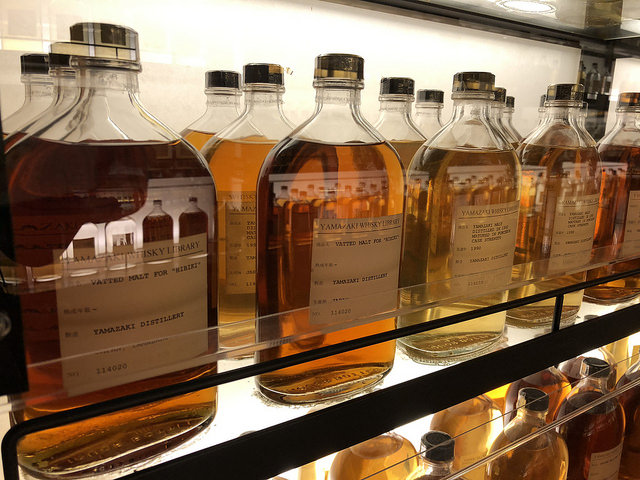
whiskey library

The elusive Yamazaki 18 Whisky was not available for sale. It is the crown jewel whiskey in the Suntory range of whiskeys. We hope to find a bottle for my uncle someday.

I particularly liked the whiskey library on the premises. The researchers at the distillery try different methods and blends to come up with better tasting products. They also sample other whiskeys from around the world. Visitors can buy these test whiskeys and they come in really cool bottles.

29017139927_d2194949df_c
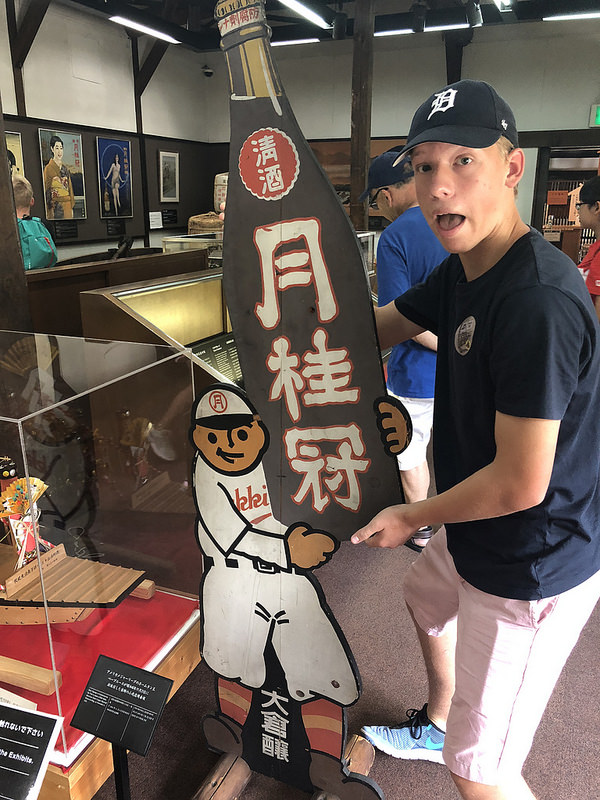
Babe Ruth visited the brewery in 1931

After lunch in a restaurant near the distillery, we went to a sake museum in Kyoto. After navigating the narrow streets of the city, we eventually arrived at the museum. Sake takes more processing than beer and wine and there were informative displays going through each step. The highlight was a sign that commemorated Babe Ruth’s visit to the brewery.

42146516270_8aeb9fbe02_z

Visit to Hiroshima

43049570005_cf5c659ba9_z
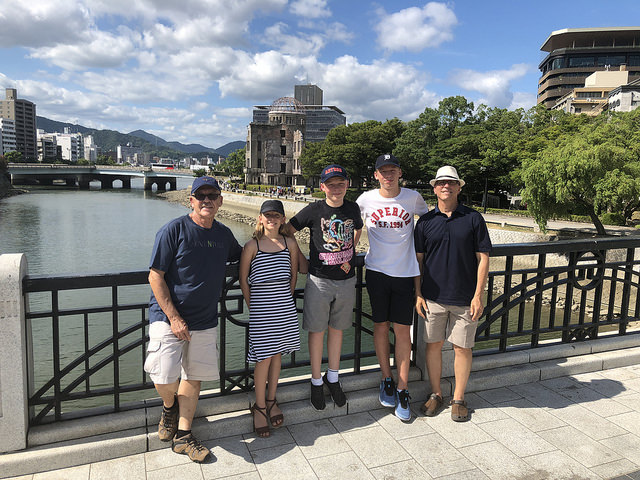
Jack & I with the kids in front of the Atomic Bomb Dome

Hiroshima is one of my favorite cities in Japan. It is the perfect size for a city, about 1 million people. Osaka, the city I live in, is a bit too big, but our suburb of Minoh is really nice. Hiroshima also is beautiful, surrounded by mountains and it has wider streets than most Japanese cities. This is my fourth visit to the city, twice for school business and twice with my family. Because of the history here, the beauty and the proximity to Osaka, it is an easy place to take guests and give them a taste of a different part of Japan. My uncle is visiting this week, our last of summer holidays, so we took drove the 4 hours from Osaka to Hiroshima this morning.

43954715931_42f07b6382_c
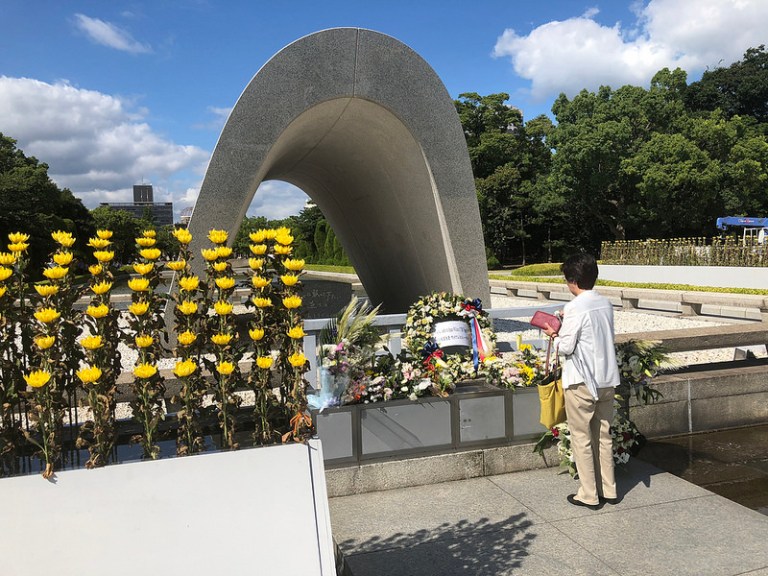
Flowers to mark the anniversary August 6, 1945 

71 years ago Monday, US forces dropped “Little Boy” above what is now the Peace Memorial Park. Going through the museum is always emotional for me. Reading the stories and seeing the photos of the children killed by the blast is tough, especially as a father. Not only the 140,000 people dead is a tragedy, but the families of the 140,000 that survived. As I’ve written in the past, every world leader should come and visit the memorial. Hopefully, it will make them consider more the human toll behind ordering bombings. Today is the anniversary of the Nagasaki bombing, a city I hope to visit before leaving Japan and one that does not get recognized enough for what it suffered.

43954713341_5f43cfe096_z

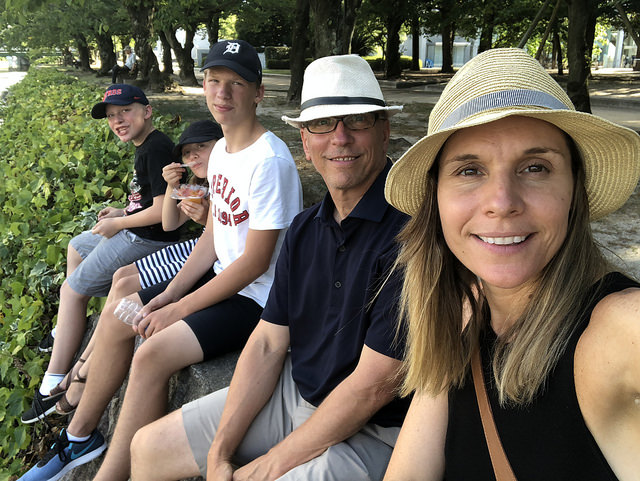
It was so pleasant in the late afternoon sitting along the Motoyasu River that we spent several hours, just watching the river under the trees. That is one good thing to come from the nuclear bomb, a beautiful green park in the center of the city. Our relaxation came to an abrupt end when an unnamed member of our family (perhaps my spouse) dropped my iPhone 8+ into the river. Oliver climbed down the embankment and retrieved it in about a foot of water. We learned that the iPhone 8 is water resistant and when dropped in water for under 30 minutes and less than 1 meter, it should be OK, which so far, my phone has been fine.

43049547625_f9e50b9a3c_z

We are staying in an Air BnB apartment near the park. Nadia and I went for a drink at a local sports bar and watched the extra innings of the first place Hiroshima Carp against the Chunichi Dragons. The patrons were totally into the game and it was fun to watch the outcome of a replay challenge of a close play at first base.


Bike Ride to Minogawa Reservoir

43165530034_ccbccb9877_b
Minogawa Reservoir

I am absolutely loving cycling through the Minoh Quasi National Park this summer. This morning I completed a 30 kilometer (18 mile) loop through Minoh and Ikeda. The highlight was the beauty of the Minogawa (Minoh River) reservoir. Using Strava, a cycling and running tracking app, you can see exactly how far you rode, your speed and the elevation profile. It feels like the Tour de France. I wish they had this when I was younger!

30013656258_c17dc715c3_c

It was very hot and humid today with temperatures in the high 90s. On the way back down the mountain, I got some gorgeous views of Ikeda and the Shin Inagawa Bridge.

43165530124_425bc509df_c
View of Ikeda City and the Inagawa River

Cycling is so enjoyable and refreshing for me. I wish I could go every day!

Latest reading – Shoe Dog: A memoir by Nike Creator Phil Knight

shoe-dog-9781471146725_hr

Besides getting a lot of exercise this summer, I also found some time to read more. Using the Great Lakes Digital Library and access through the wonderful West Iron County District Library in my hometown of Iron River, Michigan, I can download digital books and audible books. I still like a paper copy, but living abroad, digital gives me access to books I would have to order and ship.

I didn’t realize how long of a struggle it was for  Phil Knight to build Nike into the global behemoth that it is today. He started in 1962 and for many years was on the verge of bankruptcy and fighting legal and financial battles with suppliers, US customs, banks, etc. I took it for granted that people always ran long distances for physical and mental health. However, in the 1960s and most of the 1970s, running was a something very few people did.

Phil ran track at the University of Oregon and many of the early employees of Nike either coached or ran track and field there. The “hippie” or “alternative lifestyle” of Oregon and dedication to track and field carried his company through hard times. For a long time they were a private company and on the verge of bankruptcy many times due to cash flow problems. They went public in 1980 and Knight and the founding employees became super wealthy. The term “shoe dog”, refers to a person who is obsessed with shoes and spend many hours designing and constructing better shoes. Thanks to the University of Oregon and Nike, running shoes today are much better than a generation ago. The recent attempt to run a sub 2: 00-hour marathon shows Nike continues to try to improve human performance and athletic shoes.

Knight has strong ties to Japan. He started the Blue Ribbon Sports company by importing Onitsuka “Tiger” shoes. Today Onitsuka is still based in Kobe and is known as ASICS. ASICS is an acronym for the Latin phrase, “healthy soul in a healthy body”. Onitsuka in the 1960s made some of the best shoes around and combined with the expertise and passion Knight and his friends from University of Oregon athletics program, they pushed ADIDAS and Converse, the two giants in the shoe industry of the 1970s. Knight eventually manufactured his own shoes and clothing, etc. and with powerful marketing, they are almost more of a lifestyle and sports/celebrity agency than just a shoe company.

It was sad to hear his regrets regarding his son and his regret of not spending enough time with his wife and children while building Nike. His eldest son tragically drowned in a diving accident in El Salvador in his 20s while working for an NGO.

I highly recommend the book. It gave me a new appreciation for the athletic shoe market, finding a balance between work and family and it was interesting to hear how long and hard Knight and his early partners worked on building Nike.

Swimming in the Sea of Japan

43680181361_b752016e9f_c
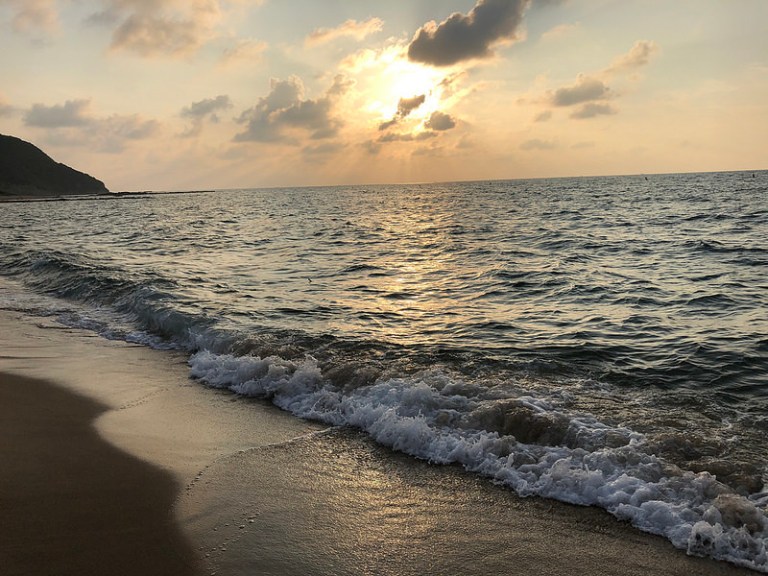
Swimming at Sunset 

With a typhoon coming later this weekend, we took advantage of the final day of sunshine and headed north to Kotohiki Beach on the Tango Peninsula. Spending a day outdoors at the beach is so much better than staying at home in these days of ubiquitous personal digital devices. It was so nice to have the family playing together and the kids enjoying nature. The water was a perfect temperature and 5+ hours at the beach goes by quickly.

The Sea of Japan is an interesting body of water. Like the Mediterranean, it is mostly enclosed by Japan, the Korean peninsula and Russia with narrow straits on the north and south. The Tango Peninsula makes a good place to keep an eye on (radar) North Korea and the Japan Self-Defense force and US military have a “sub-base” there. The dishes are located on the top of a mountain near the tip of the peninsula. We saw some US soldiers swimming at the beach the last time we went.

29810439848_6a3f33d7da_z

Like the Persian/Arabian Gulf, there is a naming dispute. The Japanese call is the Sea of Japan and that is the most accepted name. However, the Koreans call it the East Sea. Biologically, the Sea of Japan has a higher oxygen content that the Pacific Ocean and fisheries are a major piece of the economy.

As you can see by the sign below not everyone approves of the military bases on the peninsula. We saw this sign near the exit of the expressway as we were driving to the beach.

29810302148_b137b5eb84_z

We ignored the geopolitics of the region and had another fantastic day. The coast is so beautiful and the small towns on the peninsula are quaint and laid-back. It is one of Nadia’s favorite places in Japan.

43680183091_500bb8c69c_c


Cooling off at Lake Biwa

42943423604_f3e1f01ec0_b

Climate change has been on my mind this summer here in Japan. Japan is known for hot, humid summers but this year, the government declared a national emergency because of extended temperatures in Tokyo over 40C (104F). 65 people have died, over half being elderly. Typhoon Jongdari or in the Japanese numbering system, 2018-#12 is predicted to pass directly into Osaka this Sunday evening (see map below) ending the heat wave.

41851475170_9067974be1_c
Courtesy of Japan Meteorological Agency (my dates added) 

Weather and climate are complex systems and causes of heat waves are from a variety of factors. However, the frequency, duration and higher temperatures that the earth is experiencing are definitely caused in a large part by climate change. The Economist’s excellent science podcast, Babbage has a short piece with a climate scientist that explains the role climate change is having on world heat waves.

41852065140_e02496870d_c

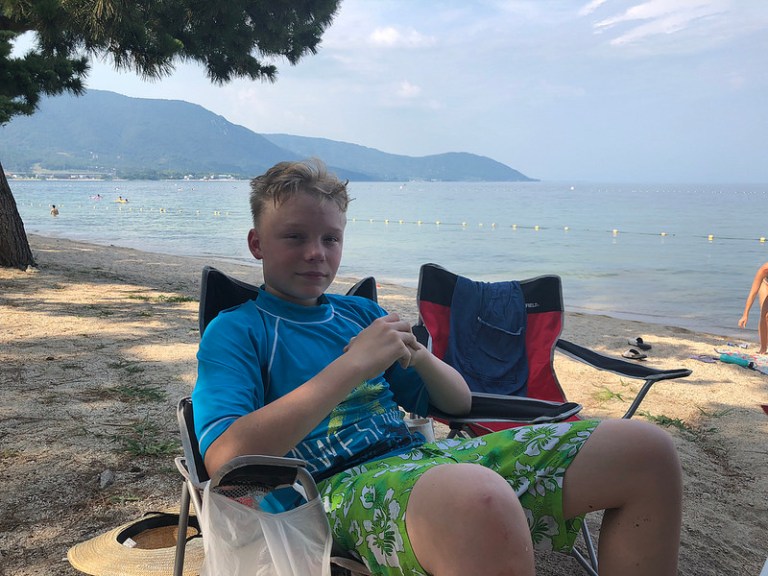
My family did what a lot of people are doing in Japan this summer – head to the beach! That is a nice thing about living on an island, the ocean is never far away. However, yesterday, we visited Lake Biwa, the largest freshwater lake in Japan. It is located in the adjacent prefecture of Shiga. We drove 1 hour and 30 minutes to arrive on Omi-Maiko beach, the most scenic public beach on the lake. Lake Biwa is huge, although not as big as the Great Lakes of my home in Michigan. It has 146 miles (235 km) of shoreline, with a maximum width of 14 miles (23 km) and maximum length of 40 miles (64 km). It is an ancient lake, scientists estimating 4 million years old. It gets its name from the shape, which resembles a biwa, a traditional Japanese instrument. I think it looks like a loon.

We had a delightful, refreshing day at Omi-Maiko beach. Large black pine trees (Pinus thunbergii) provide shade over the beach consisting of a pebble/sand mix. We found a quiet spot on the long beach. We spent the day snorkeling for “treasure” and found a pair of swim goggles, a fake gold watch among mostly glass, plastic and old fishing lures. We had a home run competition, using rocks and a plastic bat. This time we packed tables and chairs which was much more comfortable than our last visit to the beach.

It was our first time swimming in the lake. We did several snow-hiking and ski trips in the Hira Mountains that overlook Omi-Maiko beach last winter, so it was nice to see them in the summer. An interesting observation about Japanese culture. They do not value waterfront the same as Americans and so the lake is not surrounded by private property, which is nice for a change. We will be heading back to the Kotohiki beach today for one more day of water before the typhoon arrives this weekend.


The Beauty of the Tango Peninsula

43565623571_ed96f44cc2_c
Kotohiki Beach, Kyoto Prefecture

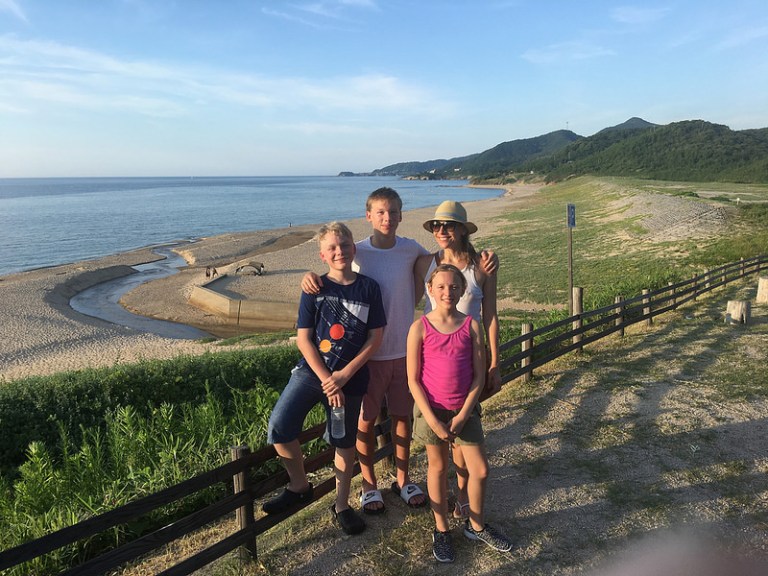
Although it is not promoted with international tourists, the Tango Peninsula is one of the most beautiful places I’ve seen in Japan. It juts out like a thumb into the Sea of Japan. It is 146 kilometers by car (2-hour drive) from our suburb of Minoh. We spent an idyllic summer day at Kotohiki Beach on Saturday. With some beaches in Japan, especially during the “swim season” it can get crowded, but Kotohiki had relatively little people and lots of golden sand and turquoise water for everyone to enjoy. We rented a tent, brought the cooler, blanket and books and had a delightful afternoon of swimming, playing Uno, snacking and exploring the tidal pools formed on some of the rocky sections of the shore. As you can see by the pictures, it compares favorably to any beach I have been to.


42653111855_071305f97b_z
Lots of dramatic views along the highway 178

I love spending the day outdoors. Being close to nature recharges my soul and being able to share the experience with my family is pure bliss for me. It took some nudging to get the kids out of the house in the morning of course, but as usual, once they are there they have a great day.

41750260700_8c59425d7f_c
Camp Kralovec

We are experiencing a heat wave with temperatures in the 90s daily and humidity over 50%. I love the hot weather and am not really bothered by it. I feel worse in the winter in cold weather. I love summer!

42653114925_477dcc88dc_z

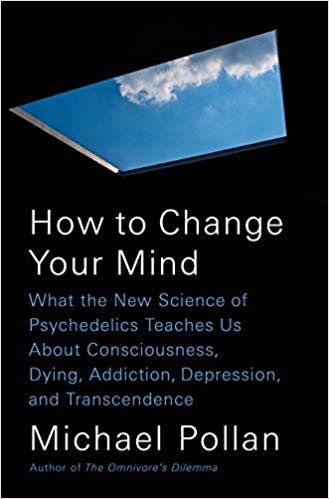
“How to Change Your Mind” Michael Pollan

41yw3jt4kal-_sx327_bo1204203200_

Michael Pollan, the Harvard and California-Berkeley professor is one of my favorite thinkers and writers. I have read all of his books and his horticulture and healthy eating books have deeply influenced how I live my life. His latest book, “How to Change Your Mind: What the New Science of Psychedelics Teaches Us About Consciousness, Dying, Addiction, Depression and Transcendence” discusses the history of and current research of using psilocybin and LSD to treat mental illness and for people with healthy minds, a way of bringing meaning to one’s life. I’ve listened to him as he made the rounds of the podcasts I listen to, New York Times Book Review, Slate, Fresh Air, etc. His ideas are engrossing and I am thoroughly enjoying the book.

Pollan illustrates the growth of how psychedelics are being used in conjunction with therapy, to cure people with mental illnesses like depression and addiction and help terminal illness patients deal with death. Doctors and therapists use psilocybin (the active ingredient in “magic mushrooms”) LSD (Lysergic acid diethylamide) and other drugs to break the mind out of obsessive thought patterns of people in these situations. Like many, when I think of “acid” or “magic mushrooms” I think of former Harvard professor Timothy Leary and the 1960s counterculture movement. Pollan shows how medical research into psychedelics started decades before Leary and before the “turn on, tune in and drop out” mantra became popular, scientists were conducting research on how the compounds could be used to help humanity. The current trials of using psychedelics by New York University, John Hopkins, and Imperial College of London are quite promising and it is a shame that reckless recreational use and bad publicity caused governments to make them illegal so long ago.

The most interesting part of the book for me, especially as an educator, was Chapter 5, the section explaining the neuroscience of the human brain on psychedelics. These compounds quiet the DMN (Default Mode Network) of the brain. Discovered in 2001, this network links the cerebral cortex to the deeper, older inner networks of the brain, which control one’s emotions and memories. The DMN controls all of the different networks of the brain, keeping them separate and using the brain’s energy most efficiently to survive and solve problems. The DMN is our “self” or “ego”, or in other words and it is the story we tell ourselves about who we are. This “sense of self” was a great evolutionary achievement and other animals lack such a developed cerebral cortex. However, having a conscience separates us from nature and others. Buddhists and other ancient civilizations have said this for a long time. Even Albert Einstein saw this when he said:

“A human being is a part of the whole called by us universe, a part limited in time and space. He experiences himself, his thoughts and feeling as something separated from the rest, a kind of optical delusion of his consciousness. This delusion is a kind of prison for us, restricting us to our personal desires and to affection for a few persons nearest to us. Our task must be to free ourselves from this prison by widening our circle of compassion to embrace all living creatures and the whole of nature in its beauty.”

Pollan also interestingly talks with researchers working with children. Young children do not have the ingrained patterns of thought of adults and this section of the book reminded me that often novel or “out-of-the-box” solutions to problems come easier to younger people who do not have such a highly developed DSM and entrenched thinking patterns as adults.

Psilocybin and other methods like meditation, fasting, etc. quiet DMN activity and the ego dissolves. This allows the other brain networks to connect with each other and you get all sorts of crazy ideas, visions, feelings, memories, etc. The DMN also filters what input we take in. This helps us get things done and not staring at the clouds or sunlight filtering in through the window. However, something is lost. When the networks are able to connect and take in stimulus from the environment that is usually filtered, sometimes profound insights and new ways of thought take place. That is why people often say they have been profoundly changed after an acid trip.

Pollan describes his experiences in trying psilocybin, LSD, toad venom and ayahuasca. He is a California Berkeley and Harvard professor and celebrated author so he is not going into these like a hippie from the 60s. Pollan is also in his 60s and entered it with fear of heart failure and the impact the experience would have on his health. He experiences these “trips” with a trained therapist who guides him through taking the drugs and then making sense of it afterward. Pollan is enthusiastic about “healthy normals”, people without mental or a terminal illness using psychedelics to reinvigorate their minds and see life through the filters of a range of their brain networks. It is like a brain “shake-up” and it changes how one interprets the world.

Pollan makes a compelling case for trying psychedelics, especially older people in controlled situations. In his detailed history of psychedelic research and use, he discusses the risks and rewards. I do not want to sound like former Harvard researcher and doctor, Richard Alpert, now Ram Dass, and do not think it is for everyone. However, as I enter late middle age, it may be a good way to refresh my thinking and redefine meaning in my life. I never would have considered trying it, but after reading this book, I see the potential benefits. The book also reinforced the practice of meditation and how good it is for the mind and I should be doing more of it. Currently, most psychedelics are illegal and there is still a negative view on their use in our society, but more government agencies and universities and hospitals are changing their thinking about this. After reading about the research taking place at New York University, Johns Hopkins, London, etc., it seems like they should be used more in therapy.

I highly recommend the book. It is a long, detailed read but worth the time investment. Below are some other notes I picked up from the book.

  • Albert Hofmann, a Swiss chemist, identified, synthesized, and named both LSD and psilocybin. LSD was originally derived from the ergot, the fungus that infects rye and other grains. Psilocybin is a blue chemical compound found in species of  the mushroom genus Psilocybe that has profound effects on the brain. There are approximately 180 species of “magic mushrooms” containing psilocybin found on all continents. Most are in the Psilocybe genus, but some are found in several genera. All are considered LBM (little brown mushrooms) and are difficult to find and identify.
  • The top expert in Psilocybe mushrooms is former Evergreen State College professor Paul Stamets. The love his TED Talk linked here and his description of the millions of mushroom threads (mycelium) weaving through the soils of forests allows trees to communicate with each other.
  • Aldous Huxley the British author of Brave New World was a fascinating thinker and I should read some of his work. He comes up time and again in the book.

My Fervour for Cycling

43428938772_11f5f07270_c
Terraced rice paddies in Toyono, Osaka 

My favorite aspect of living in Japan is being able to road cycle relatively safely. Because there are a lot of pedestrians and cyclists, they have the right-of-way, which is opposite in my home country of the USA  where cars rule. I think it is part of the reason people are healthier here than in the USA because everyone walks and rides to do their daily errands. I think it was a mistake for American society to make the car “king” and make it almost impossible in many places, to walk or ride to get your daily activities. Things such as zoning laws, lack of bike lanes and sidewalks, low-density housing, etc. have all contributed to this. These topics have been addressed by many before and there is some progress, but America has a long way to go to reach a level citizens being able to move daily for health and reduction of reliance on fossil fuels.

I have a long glorious summer to cycle every day and I absolutely love it. It is pure pleasure to ride up and down the rolling hills in the northern Osaka and Kyoto prefectures just outside of our suburb of Minoh. I feel myself getting stronger.

43428940082_efc51b07cd_c
View from the Osaka Hokusetsu Cemetery 

Watching the Tour de France also helps get me motivated to get out daily. Using a VPN, we are able to watch the SBS (Special Broadcasting System) coverage. SBS is similar to National Public Radio in the USA except that it is specifically geared to multiculturalism. Their sports programming included the World Cup and Tour de France.

There are risks to cycling and I try to be as safe as possible. I try to obey traffic signals, am cautious around intersections and high-traffic areas. I also go much slower than I possibly could downhill and always wear a helmet. Cycling has prolonged by exercise by giving my knees a break. My knees have a lot of running miles on them as I have been active in distance running since my early teens. I can only now run a couple of times a week and cycling has taken the place of running.

29606194588_ab649c2d5e_c
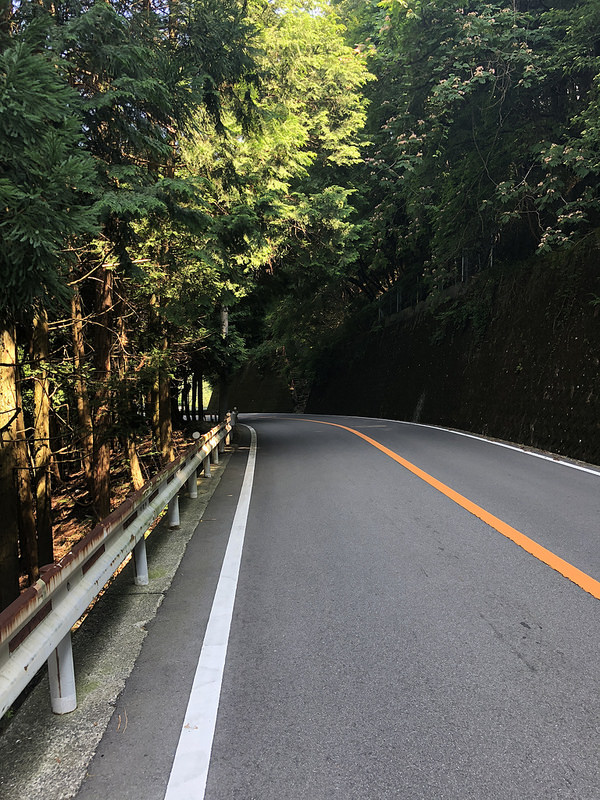
Sugi (Cryptomeria japonica) trees line many of the roads in northern Osaka Prefecture

I ride a Merida road cycle which was a hand-me-down from a departed faculty member. He left it and it sat unused in the parking lot until I took it into a shop to refurbish it and get it road worthy. It may be time to buy a proper cycle with biking shoes and pedals. I am still resisting wearing Lycra shorts and top and going all in on the gear and equipment, but I see the appeal. I read some articles about the MAMIL (Middle-Aged Man in Lycra).

The other part of cycling I like is the stress relief it gives me. Going for a ride first thing in the morning or after a day at school is such an uplifting mood-boosting activity.  The camaraderie with friends is also  great. Kids are back from running with mom. I’ll blog a bit more about cycling later this summer.