One Week in Bangkok…

I am spending a week in Bangkok and am taking pleasure in getting to know better this busy, odiferous, sensual enriched massive tropical city. It is one of the biggest tourist destinations in the world, with over 16 million foreigners visiting each year. Buddhism, brought to the Thais in the fifth century and strengthened in the thirteenth century, gives the culture a welcoming openness. Combined with inexpensive standard of living, warm weather and nice beaches/forests (rapidly being lost however), I can see why so many people come here.

The video above shows a bit of the Chao Phraya River, which the city was founded in 1782, succeeding the ancient trading post of Ayutthaya. It has grown to over 14 million people since then. The Thais are a distinct ethnic group, with influences from the Khmer (Cambodia), Mon (Burma) and the Chinese among other groups.

My view from a tuk-tuk

Mainland Southeast Asia is one of the most fertile, biodiverse biomes on earth because of the high temperatures and high levels of rainfall. The modern countries of Myanmar, Thailand, Cambodia, Laos and Vietnam have had their cultures shaped by this. I would guess there are probably many similarities among the populations and I hope to visit all of them sometime during my time in Asia. I especially want to see Angkor Wat, which was once one of the largest cities on earth.
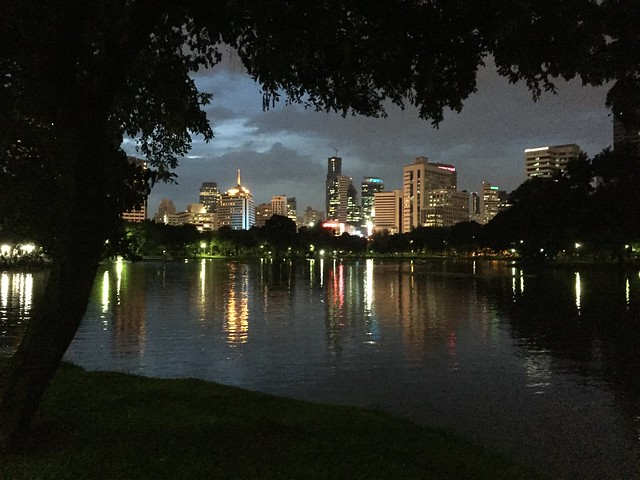
The view of the CBD from the shores of an artificial lake in Lumpini Park.

We are staying near Lumpini Park and it is my favorite part of the city. At dusk and dawn, there are hundreds people jogging, walking, doing aerobics and practicing thai chi. It is a SE Asian version of Central Park. I run the 2.5 kilometer loop in the evenings to get some exercise after sitting and eating all day at the conferences. My least favorite part of Bangkok is the traffic. It is very noisy and the stop and go traffic, with motorcycles zipping by, even makes walking on the sidewalk risky. It really lowers one’s quality of life here. It makes getting around a logistical problem and forget about running/riding a bike here. The pollution levels alone would make it unhealthy, let alone safe from being struck by a vehicle.

This our typical view from the taxi each morning on the way to the conference.

 I hope to get some more blog posts out this week as I get to know more about this fascinating city.
Geocaching and Small Moments

A historic moment in the Kralovec family: our first geocache! We joined the world of geocaching this weekend. It is such a good family activity because it is outside, something we can all do together and it gets the kids away from the computer or TV. I highly recommend it. In our neighborhood of Minoh, there were three geocaches within a mile of our home. We found two of the three. The geocaches are small, about the size of a box of tic-tacs, with a log to write your name and date. With mobile phone technology, you can read about other people’s experiences and they also post photos if you are really stuck. There is a hint provided as well. My children were very enthusiastic and we rode our bikes to the three sites. The beautiful autumn weather continues.

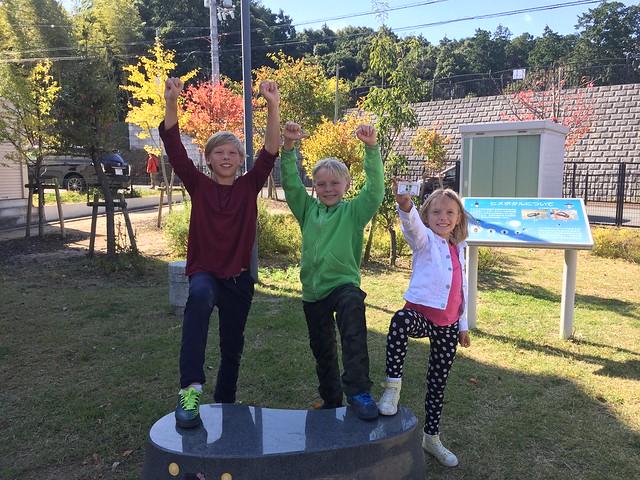
The second geocache in Kita Senri park.

It was a nice family weekend. Owen played his first basketball games of the season. His team won both games quite easily. I have been thinking a lot about capturing the special small moments of family life. It seems life goes by so quickly and by stopping to document or note those special, not milestone moments, it gives you a chance to relive them. They would otherwise just pass by. Anyway, Ocean bought a pair of plastic glasses at Daiso, her favorite store in Japan. They came with a big nose and mustache. She took the nose/mustache off and was following me around the house, saying she looked like me. I snapped this photo below. Ocean is so loving, smart and has such a sparkling, positive personality. I feel so blessed to be able to raise a daughter.

Harvesting Rice

Owen operating the Mitsubishi VMS 11 rice harvester

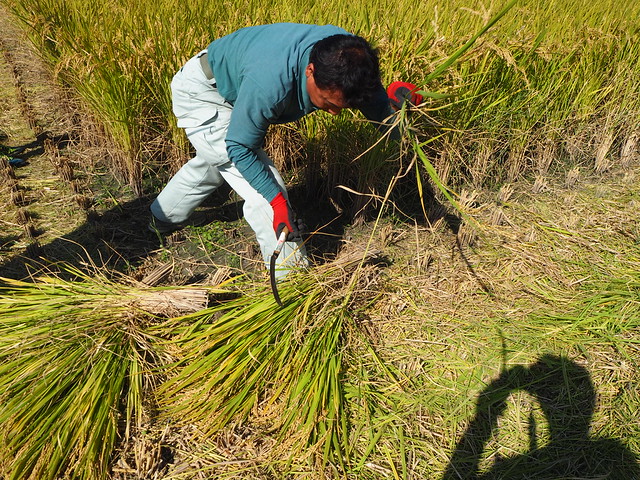
On a perfect autumn morning we got to harvest rice in the nearby Shukonoso neighborhood. Our suburb of Minoh is dotted with paddies and rice is such a central part to the Japanese culture and diet, I always wanted to help out in the harvest. Our CAS coordinator arranged the opportunity through one of her neighbors, Kubo-san. His family have been harvesting rice for the past 800 years, so to say it is a family tradition, is an understatement. Osaka, like many metropolitan areas through the world, has grown immensely to overtake what was once a quiet village, Shukonoso is now part of the city. The families of Shukonoso continue to harvest rice, although, it is not a necessity today. Kubo-san is an expert garden and landscape designer, and told me his family does not make much money from their paddies, but they do it more for tradition than anything. Japan is not a big exporter of rice and the government subsidizes its production. Japanese prefer the short grain, glutinous rice that is good for sushi and chopsticks. My children prefer the this short grain rice, especially when we add the rice vinegar. I prefer the long grain jasmine variety, produced in Thailand.

Kubo-san shows us how to cut the rice bundles.

Kubo was very kind to put up with us wanting to “help”. He showed us how to harvest in the traditional manner, with a sickle. Rice seedlings are planted in bundles and 3-5 bundles are cut and laid on the field at a time. They would then be hung and dried before the grains are pulled. Instead, we fed the rice stalks into the harvester. Kubo then allowed us to drive the harvester along the rows. It was like mowing lawns, slowly going down the rows.

Spending time in the field also gave me the chance to look at the irrigation system. There is an intricate system of reservoirs, damns and canals like a spider web going from the Minoh hills down through the city to the Osaka bay. It makes it easier for the rice seedlings to combat pests and weeds to have them grow in a few inches of water. That system must have been developed over the centuries. I am not sure how it works, but everyone must work together to get the water where it needs to go to at the proper time.

We counted between 44 to 62 seeds per stalk.

The experience gave me a better appreciation of rice and brought me closer to Japan. Thanks to Lyn and Kubo san for allowing Owen and I to participate.

It is funny to me that I eat so much rice now. Growing up in 1970s  rural Michigan in the pre-globalization era, my mother never served rice and we didn’t eat at ethnic restaurants. I really didn’t eat much rice until university and my first international posting in Colombia. Rice is as popular in South America as Asia. We were strictly a “meat and potato” family growing up. We eat rice on an almost daily basis and the staples of my youth, bread/butter and potatoes are rare at the dinner table for the Kralovecs.

Shinsaibashi

Last night we ventured downtown Osaka to the neighborhood of Shinsaibashi. The goal was to pick up money sent by Nadia’s father (thank you Popa!) through Western Union. He likes to send money to his grandchildren occasionally.

Shinsaibashi is one of the main shopping areas in Osaka. The word bashi means “bridge” and it is named after a bridge over one of the many canals in the city. It was the first western-style stone bridge built in 1909 and it became an icon of the city. In 1964 the canal was reclaimed and turned into a road due to increasing traffic and some of its parts were used in the construction of a pedestrian overpass.

Lots of high-end shopping to be had in Shinsaibashi

We walked around the streets for a bit, soaking up some of the vibrant urban scene and then had a nice dinner at Brooklyn Parlor . It is easy to get to by taking the Midosuji train line from Senri Chuo to the Shinsaibashi stop.

Unusual columns in front of a hotel in Dotonbori.


Why Japanese Kids Can Walk to School Alone & My Lost Wallet Was Returned

A couple of weeks ago I lost my wallet. It fell out of my pocket/bag on a ride home one evening. I realized it the same night and searched the entire route from the store to my home in my neighborhood, but could not find it. It caused much angst in our family because if I didn’t get it back, it would mean hours of obtaining new identification cards, a driver license, credit card, etc.

A few days later, it turned up on the bench outside my front door with a note stuck inside. All the money, credit cards and identification cards were inside as well, untouched. On a gum wrapper the person who found my wallet wrote, “Today I picked up this. To KRALOVEC 9/23” and he left an email address. I contacted him and thanked him profusely and asked where he found it. He apologized for looking up my address (on my Japanese residence card, my home address is written on the back) on Google maps to find my home.

This is typical of Japanese society. Everyone has a responsibility to help out each other and they are always concerned about others’ feelings and they do not want to disturb others. Now there are good people everywhere, but I would guess here in Japan, there is a higher chance of my intact wallet getting back to me than in other countries.

There is a downside to this mentality, but in most ways it is quite good. It is one of the best things about living here, especially with children. They will be safe and looked after. Single women are not cat-called or harassed by men (except on trains occasionally by drunk salarymen). The elderly are respected.

This article appeared in the Atlantic recently. It is hilarious to see very young children, some that don’t look more than 8 years old, taking public transport and walking to school alone. There are several reasons they can do this.

The first is overall, Japan is one of the safest countries in the world, and this bears out in the crime statistics.  Japan ranks at the bottom (in a good way) in every category of crime. Here is how it compares to the USA and other OECD countries. (all categories are per 100,000 people)

  • Homocide – Mexico 18 / USA 5.0 / Japan 0.5
  • Rape – Sweden 58.6 / USA 28.6 / Japan 1.1
  • Robbery – Spain 1,180 / USA 133 / Japan 4
  • Assault – Germany 630 / USA 262 / Japan 44
  • Burglary – Australia 1,017 / USA 715 / Japan 117
  • Vehicle Theft – France 333 / USA 258 / Japan 85

Second, public transport is safe and is the preferred mode of transport over private cars. In my city of Osaka, 24% of all trips are by bicycle, 24% walking, and 36% by rail. Private transport is only 15% . Compared to Chicago (63% private), New York (33% private) and Sydney (63%), this shows that Japanese society has a reliable system of public transport, used by most people, not just the poor or urban population. It helps to be in a high population density environment. As in other European countries, government policies make it more difficult and expensive to use private transport.

Third, and the most important in my opinion, is what the Atlantic article describes,

What accounts for this unusual degree of independence? Not self-sufficiency, in fact, but “group reliance,” according to Dwayne Dixon, a cultural anthropologist who wrote his doctoral dissertation on Japanese youth. “[Japanese] kids learn early on that, ideally, any member of the community can be called on to serve or help others,” he says

People care about and trust others! That is so refreshing to live here and know that everyone is looking to help others. I don’t see this level of caring or trust in any other society I have lived in.

Oliver Saves the Day

Another post from a proud father! I spent the first part of the school year coaching the grades 3, 4 and 5 soccer team getting them ready to participate in the Falcon Cup. The tournament, hosted by Canadian Academy, took place yesterday on a beautiful fall day. This was the first time in many years that the elementary had a sports team and the kids were so excited. My son Oliver, a fourth grader, was ready bright and early yesterday morning, which is different from most days. You could feel the positive energy as we departed from school on the big bus.

Selfishly, it was a way for me to spend more time with my son and share the experience of being part of a sports team. It really doesn’t matter to me if my children are good or bad at sports, I just love watching them enjoy healthy competition and the camaraderie and learning that comes from being part of a team.

The highlight of the day for Oliver’s team was their exciting victory against the Kansai Christian Academy. The game was tied 1-1 in the round of 16 knockout round and was decided by penalty kicks. The format was five-a-side futsal and after one complete turn through the team, neither team scored. In the second round, KCA scored and they were celebrating and many thought they had won. But it was Oliver’s turn because KCA went first in the penalties. He calmly put it past the keeper into the back of the net to keep his team in the game. Ollie jumped for joy and was surrounded by his teammates. A few players later  his team won the penalty kick game. His team made it to the final 8 in a 24-team tourney. They got beat in the next round to the eventual champions.


Owen Stars in WJAA Championship

Owen doubles down the third baseline, driving in his fourth RBI of the day.

Owen’s team completed the perfect season yesterday with a 12-2 win over Canadian Academy in the finals of the Western Japan Athletic Association middle school baseball championship. Also participating in the the two-day tournament were Sons of Light Christian School, Nagoya International School and Marist Brothers International School of Kobe. The Senri and Osaka International Schools Sabers went undefeated this year, including 5 wins this weekend.

Owen slides into third base against Nagoya IS.

Owen was the offensive star of the game. In the fourth inning in a 2-2 tied game and two outs with the bases loaded, Owen hammered the 1-0 pitch to the wall in right center and made it to third with a triple. The 3 RBIs blew open a tight game and the team went on to score 7 more runs in the last three innings. The pitcher for CA was the son of former MLB player, So Taguchi. He also had a ground rule double and another double (photo above). He walked and struck out in his other two at bats. MVP Keito Sasaki  completed his middle school career with the complete game win.

WJAA MS Baseball Champions 2015

Owen played center field for both games today. He has played third base, first base and pitcher this season. He was much more comfortable playing as the season progressed. I saw him develop confidence in his abilities and begin to enjoy the sport. I hope he continues to play and has an even better season next year! Here is the article about the tourney from the SOIS  website.

A beautiful day for baseball on Rokko Island.

Watching my son play has given me immense pleasure. It is better than playing myself and I am happy that he is experiencing interscholastic sport which game me much pleasure during my schooling. Basketball season is next up, already starting next week.

Dead Wake: The Last Crossing of the Lusitania by Eric Larson

Eric Larson is a New York Times best selling author. His books are unique in that he researches historical events and tells the compelling story by weaving actual diary entries or newspaper accounts into the narrative. This is the second book I’ve read by him, the previous (In the Garden of Beasts) being about the rise of the Nazis in Germany from the viewpoint of the US ambassador’s daughter to Germany at the time. “Dead Wake” refers to the wake left by a torpedo ejected from a World War I German U-boat. It is the tragic tale of the cruise ship the Lusitania, a contemporary of the Titanic. It was one of the largest passenger ships in the world at the time.

The Cunard line Lusitania left from New York in May of 1915 heading for Liverpool. The British ship was full of mostly American and British passengers. At this time, the German submarines, called U-boats, were taking down many ships coming to the UK. They did this to stop arms and other supplies from reaching their enemies in World War I. The German embassy in New York warned Cunard publicly that they would try to sink the Lusitania, but with its vastly superior speed and carrying thousands of civilians, no one thought they were in actual danger. The captain was aware of the possibility and they did take some precautions, but not enough. On a lucky shot, the submarine, Unterseeboot-20, sank the boat, killing thousands of civilians, including women and children. Larson describes daily life on the Lusitania and U-20, bringing the two together on that fateful day in May.

There are several villains in this story, the biggest being the U-20 captain Walter Schwieger, who was on his own in charge of the submarine. I don’t know how he could have lived with himself, knowing that his shot killed entire innocent families. Schwieger got his a couple of years later, running into a British minefield with his submarine. There were some arms being carried on the boat, but not enough to make a difference to the war effort. Why Cunard lines didn’t give the boat more protection, why the British navy didn’t warn Lusitania when they had good intelligence that the submarine was in the area, are beyond me. Cunard takes a lot of the blame for in the name of profit, risking the lives of passengers by traveling in an unsafe area during a time of war. It is somewhat like the recent downing of the Malaysian airlines over the Ukraine.

Some of my other notes and vocabulary words are below:

Those weeks of openhearted American hospitality and forth-comingness, of frankly expressed pleasure in meeting one, did something for me that made a difference to the whole rest of my life.

A British passenger describing her time in the USA.

Vocabulary words I want to use more:

  • milieu – social environment of a person
  • pewter – silver or blue gray
  • deposition – a report of evidence; Deposition – taking Jesus down from the cross

Happy Birthday Ocean!

Ocean is pictured with her new bicycle on the way to school.

Ocean turned 8 years old today. We celebrated the occasion with inviting 10 of her girlfriends to our home yesterday, as her birthday, September 26, fell on a Saturday. Ocean was so excited and woke up early to prepare for the 11:00 AM start. We had balloons, flowers and a beautiful table setting for the occasion. There were two trips to the 100 Yen shop (Daiso) to load up on gifts for the girls in attendance. Oliver performed a lip synch to the Bruno Mar’s song, “Uptown Funk” to get the girls feeling comfortable dancing. The big hit was One Direction’s “What Makes You Beautiful”. Ocean had to open all of her gifts and mom noted who brought what gift for thank you cards. We had a variety of finger foods. We then went to the park and had races and games and all girls won two prizes. Upon return, we sang happy birthday (video) and ate the huge Costco cake. Ocean loved the Barbie makeup kit and her friends Retaj and Monica put makeup on her.

Birthday parties are rare in Japan. Most families here have smaller affairs, so the fairly large party created quite a buzz in the social life of the girls. This party contrasted with Oliver’s birthday party in April. Little girls get excited, but in a controlled manner. They were all so cute in their dresses and ribbons in the hair.

We got Ocean the bicycle of her dreams. A turquoise Japanese-style bike. She can’t wait to ride it. On the way home, the larger tires allowed her to go much faster than she does with Oliver’s hand-me-down bike. One of the things we do together is our “night bike rides” that are very special to me. It gives us a chance to be alone and she likes talking while riding. Hopefully we will go for more rides now that she has a nicer bike.

Ocean has brought so much joy into our family’s life. She is such an intelligent, caring, calm girl. She has also taught me a lot about females and it has been such a delight to raise a girl. I grew up with two brothers and never had that in my family.

Happy Birthday Ocean – we love you!

The Tigers are in a Pennant Race!

The boys are watching batting practice at yesterday’s Nippon Professional Baseball League game. The Hiroshima Carp defeated the Hanshin Tigers, 3-0 behind the stellar pitching of Kenta Maeda and an early home run by Brad Eldred. Despite the loss, we enjoyed the day at Koshien Stadium. Eldred, the left fielder for the Carp is one of those “4A” players, which means he was a star for several triple A MLB teams, but every call up to the big league team, resulted in poor results and a demotion. He seemed to be too good for the AAA, but not quite good enough for the  majors, although, he never had an extended opportunity to find his place at the big league level.

For many years the Detroit Tigers have won the Central League division and/or been in a race for the playoffs. Finally, this year they are in last place, but my baseball season was saved by moving to Japan and cheering for the other Tigers, the Hanshin Tigers. They are in first place and it is good once again to have meaningful September games.

The stadium was full to watch the first place Tigers, in the midst of a tight pennant race. With 17 games to go, Hanshin is tied for first place in the Central League with the Yakult Swallows, with the Yomiuri Giants a 1/2 game behind and the Carp 3 games behind. The top three teams make the playoffs and the first and second place teams get a game advantage in their playoff series. It is a big advantage to finish first and a good advantage to finish second.

Baseball offers a chance for the usually reserved Japanese to let off some steam. They will sing and cheer the entire game, even when there is not much action going on. Many fans also sport these baggy pants (above) and colorful jerseys. I had to buy a pair!

$7 for the Matt Murton Pork/Crab on rice!

I love the quirkiness of the Japan and it shines through in the fan experience at the stadium. I had a delicious “Murton Katsu Don x Crab” lunch. The bentos and entrees are named after players with some of the bentos shaped like a baseball diamond. A regular rotation of Asahi beer/snack girls tempted Oliver with junk food throughout the game. The girls carry beer kegs on their backs or heavy boxes of refreshments in front. It must be a long day as they are constantly moving. They must have a set circuit they take in order to evenly offer beer, sweet and salty snacks at regular intervals. I walked out to the deep left field line to video the release of balloons during the seventh-inning stretch, a tradition in many Nippon league stadiums.

Former Chicago Cub Kosuke Fukodome is having an excellent year with the Tigers (.281 – 19 HR)

The game was well played. The Carp outfielders made several spectacular catches, robbing the Tigers of extra base hits and possible runs. Maeda made Tiger hitters look weak in the first half of the game. It was nice to see that they still have the relief pitcher car here, as it was phased out in the MLB years ago. I think there is too much bunting here. In the MLB, advanced stats have shown that a bunt used to advance the runner one base is not as valuable as giving up one of the 27 outs a team has per game.

Owen, Oliver and Kenta were star struck watching infield practice. It is nice that Matt Murton acknowledged their shouts. They also got a close up view of how fast and accurate the players can throw the ball. We will be following the pennant race down the stretch and hopefully come October, we will be celebrating a Tiger’s series win!