First Day in Sucre Bolivia

The flight from Santa Cruz to Sucre is only about 30 minutes, but the difference between the two cities is vast. Sucre is the judicial capital (home of the supreme court of Bolivia) and on my birthday, May 25, 1809, the first call for independence from Spain was declared here. Ironically, Bolivia was the last South American country to be liberated from Spain after 14 years of war in 1825. Most likely that Bolivar was a Venezuelan and started there. I need to re-read the history of Bolivia and to read the latest biography of Simon Bolivar.  The city is named after Simon Bolivar’s right hand man, Antonio Sucre. It is cool to think that Bolivar was here The historical center of the city is a UNESCO world heritage site and is known as the “white city” or “cultural city” by the Bolivians. They kept the Spanish Andalusian colonial  style with most of the buildings being white.
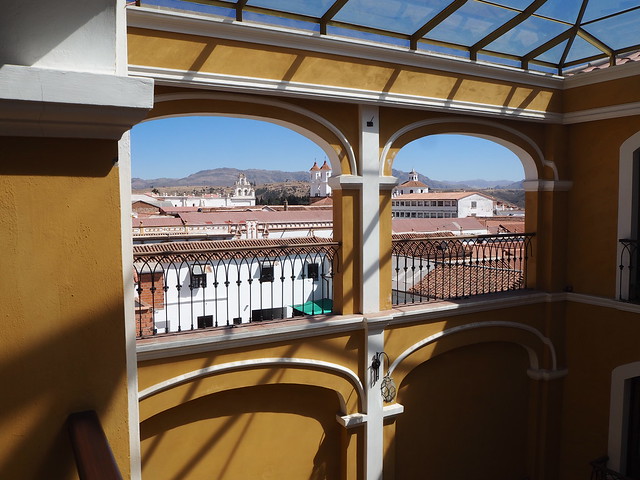
The hotel that we are staying at, Parador Santa Maria La Real. The hotel is a 17th century mansion of the Spanish court, when Sucre was known as Real Audiencia de Charcas. The owner beautifully restored it to its past glory and it is a pleasure to stay in. The Spanish loved the inner courtyards, which were open air and the center of life in the house. Rooms built off of the courtyard, like rooms of a motel, were used for sleeping, clothes cleaning, the kitchen, etc.. When they were restoring the place, they found a basement that they are unsure what it was used for. The owners turned it into a museum/dining hall with his collection of colonial antiques
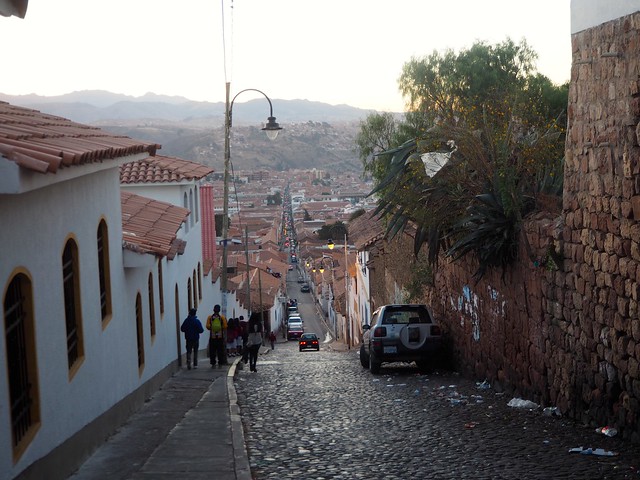
Nadia and I have fond memories of walking up to La Recoleta Church when we visited in 1998.

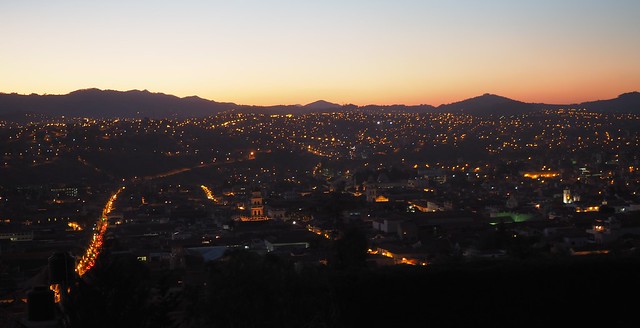
As with most of Andean Bolivia, the city is at altitude, over 9,200 feet (2,800 meters). If Denver, Colorado USA is the “mile high city”, then Sucre should be the “two-mile city”. It is so bright, with blue skies and it reminds me of a Mediterranean look, but drier and higher. It is a small city, with a population between 250,000 – 300,000 people and has a small town feel. Lots of European backpackers coming through the city, as this must be on the South American circuit. Altitude gives me a headache the first day and today I had a slight one. We are also a bit sluggish and it was a slog up the hill to spend the late afternoon at La Recoleta Church. There is a nice cafe there and some good views of the city. Nadia and Ale enjoyed the shopping in the markets and bought some beautiful rugs/textiles. The prices are so cheap here in Sucre. I am glad to show the children the Andes and they can learn about dealing with altitude.
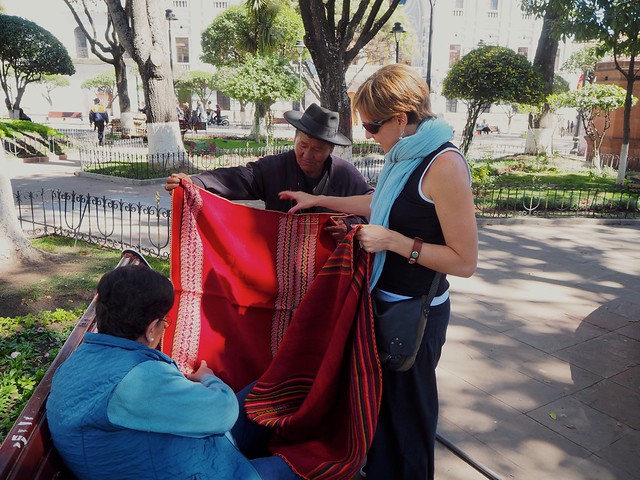
Nadia shopping for textiles in the central plaza of Sucre.

I wonder how these mountains looked like before the Spanish arrived, or maybe for that matter, before the Incans came. I guess there were probably more trees and vegetation which helped for a wetter climate. Sucre is at 19 degrees south latitude and most of the deserts and arid areas are found around 30 degrees latitude like the Atacama, Sahara, etc.

Sucre is being touted as a place for globally mobile foreigners to settle and live or for a place to retire. The cost of living is incredibly low (contrasts with the drug-boom bubble economy of Santa Cruz), there is nice sunny, dry, cool weather, and the third piece, which I question, is it is a culturally rich place with lots to do, both intellectually and outdoors. We will be here for a few days so I will be weighing in on this topic.
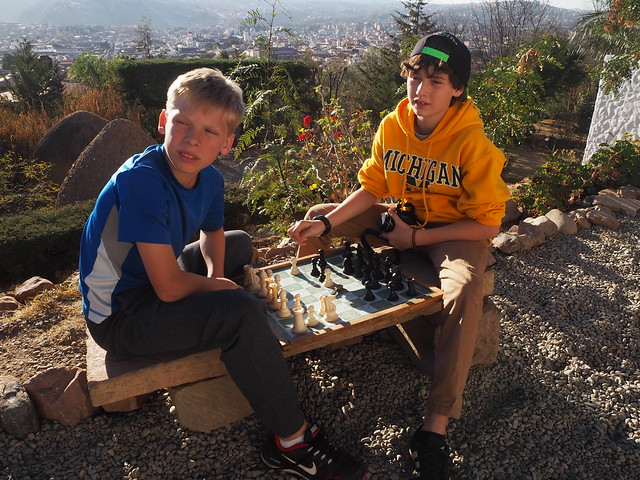
Owen and Sebey playing chess above Sucre.

I finished the night playing cachos with my nephew, Oliver and Ocean in the hotel bar. I tried a local drink called a chuflay which is made of the Bolivian spirit singani, which is a type of brandy distilled from wine, and ginger ale on the rocks. It was OK, but nothing special. I preferred the kids’ chocolate submarines, hot milk poured over a bar of chocolate. We laughed a lot and it was a great way to end our first day in Sucre.
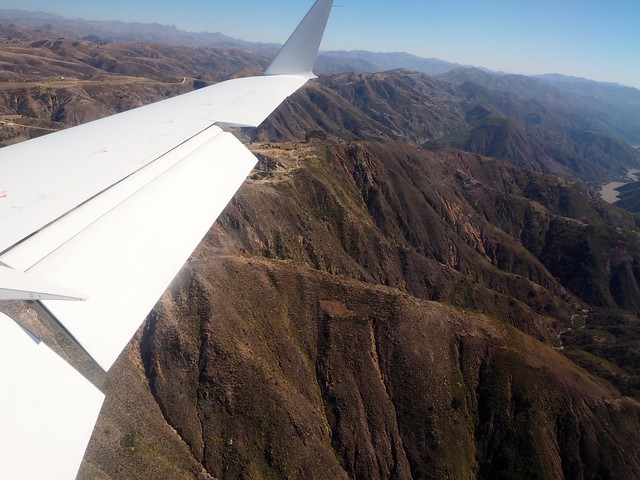
The mountains of Sucre as seen from the plane.

A Bolivian Hacienda

Kids enjoy time in the pool.

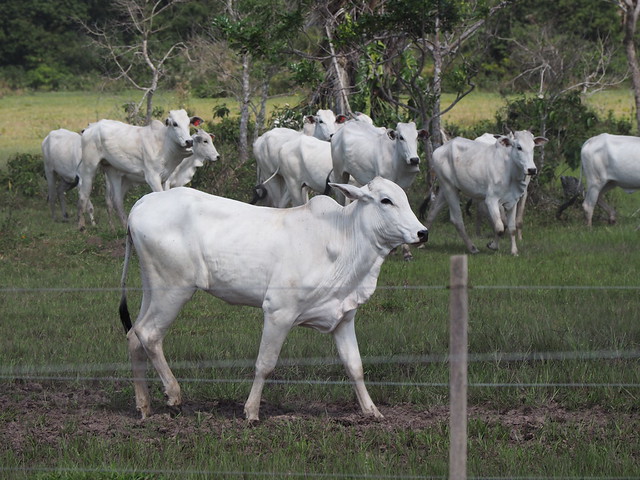
We had a nice three days at La Hacienda Santa Maria La Antigua, a 2,500-hectare ranch 95 kilometers north of Santa Cruz. It is a working dairy (1,000 head of Holando-Argentino  cattle) farm and beef ranch (2,000 head of Brahman cattle). The ranch has a small hotel and spa which caters to foreign and domestic tourists. We had a wonderful stay which has been the highlight of the summer for us. We were the only guests staying at the hotel so we had the place to ourselves. It felt like our own private ranch!

The 2,500 hectare property is located about 6 kilometers via sandy road from the village of Buena Vista. It is very close to one of my favorite places in the world, the Amboro National Park. We were not able to get into the park on this trip, but we did get to do some walking in the forested areas as well as explore the pantanals (wetlands) of the ranch.

We learned all about the dairy industry, watching the whole process of getting the cows into the corral, showering them with a misty spray for 15 minutes to calm them, and then the mechanized milking. We got to sample fresh milk straight from the cow and drink from the refrigerated tanks. I learned that the biggest milk producing cow on the farm produces 37 liters of milk per day and the average life span of a dairy cow is six years. They are in milk production about 6 months a year.

Sebey and Owen on the walk in the forest.

The kids were more interested in the swimming pool, games area (billiards/table tennis) and karaoke. They also have pet caimans, toucans, cats, etc. that the kids enjoyed playing with. I went out for walks in the wetlands and saw a huge variety of neotropical birds. You can see my nature blog for more photos and stories.

Ocean and Oliver loved the puppies at the hotel.

I have mixed emotions about ranches. It was nice to see cows actually eating grass and being outdoors. They eat about 60-70% forage and 30% grains. The industrial-agricultural model of meat and milk producing in the US reduces this. The owner treats his employees well and has really made a tourist service for the local and brought income to a poor area. I don’t like however, the loss of habitat for wilderness and I hope he can preserve more land for forest. He is probably one of the better land managers, as most Bolivians are ignorant to environmental concerns. I will definitely reduce my consumption of beef, which I don’t eat a lot of, just because I see how much energy it takes to bring it to the table.

Brahman beef cattle were also abundant on the ranch.

The silence, darkness, stars and the sounds of a tropical night were intoxicating. It really lifted my spirits and recharged my psyche to be at the hacienda. We also benefited from a lack of internet connection and it was good to interact with the children in an old-fashioned way.

Andamios Hermes

Andamios Hermes is my father-in-law’s business. An andamio is a scaffold and my father-in-law, Hermes Chavez rents and sells scaffolding to small and large construction projects. He got the idea when living in Australia and has been quite successful for the past 10 years. Hermes loved working with metal and was a welder in Australia. He also had a metal factory in Santa Cruz for years that made galpones (metal roofs) and scaffolding for sale.

Andamios Hermes in the streets of Santa Cruz

This is the ideal business for him in his later years. He owns around 400 meters of scaffolding and most of the time, it is being rented. As I say, easy money! Working with Hermes is his right-hand man, Horacio Surubi. Horacio has been working with the family for a long time. He is originally from San Jose Chiquitanos. You can always identify the scaffolds by the green and white colors, the colors of Santa Cruz Department. It keeps him busy, with either calling customers to remind them to pay or check on the status of the rental or dealing with clients either picking up scaffolds or dropping them off. There are also the details of paying Horacio, upkeep of the scaffolds, etc. It is not a full-time job, however, and gives a pace that an older gentleman can keep up with, as well as, giving him a good income in his later years.

Horacio is the muscle behind Andamios Hermes.

They rent to both small constructors, who will rent one module for a couple of days, and also to big companies like Palco Cement, who has rented 50 modules for several years. There are lots of construction projects going on in one of the fastest growing cities in the world. Best wishes for continued success for Andamios Hermes.

The Bolivian Yahtzee: “Cachos”

Oliver rolls the cup of die to start the game.

We have been playing the Bolivian dice game of cachos. I remember playing with Nadia a lot when we were living here, and when I saw the game in a souvenir store last week, I bought one. It is a popular game to play with friends, especially at parties or in bars. The origins of the game are sketchy, but it is said to have been brought to Bolivia by Spanish soldiers, who liked to play dice games.

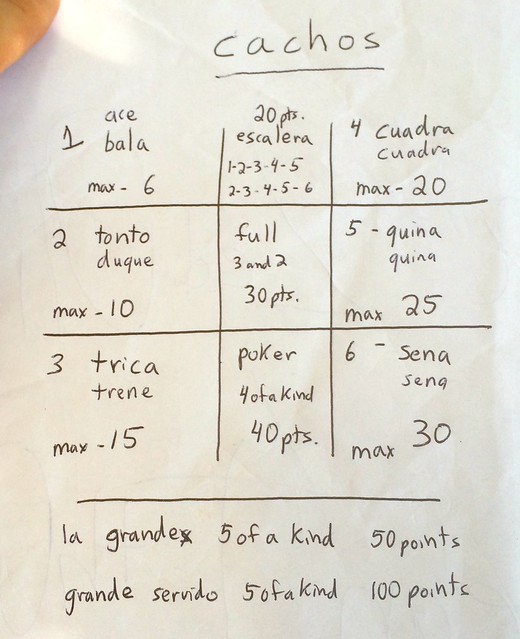
Cachos is easy to play and I included a scoreboard below. You should make your own for each player, the same format as a tic-tac-toe board. The object of the game is to fill the squares with as many points as possible. Each turn consists of rolling the 5 die out of the cup twice. Players attempt to gain as many points on each of the squares. For example, a roll of three “4” and two “2” would be a “full” and if done on the first roll, it would be worth 30 points + 10 points bonus for the first roll. If a player rolls three “4” and one “2” and on the second roll, picks up the one dice and rolls a “2”, they would get 30 points. Depending on the first roll, you can go from everything from trying to get five “1” or five of a kind. You need to select a square to fill or eliminate at the end of every turn. The Spanish names of each of the squares are included in the diagram. In different parts of Bolivia, they are known by different names. I am not sure why the game is called “cachos”, which means horns in Spanish.

A twist that we play is a player can call “abajo” or “bajo” before lifting up the cup. The results then of the roll are taken from the bottom, instead of the top of the die. For example, a “6” becomes a “1”.

Book Review: El Cartel by Don Winslow

Being in Latin America for the summer and with El Chapo, the Mexican drug cartel king in the news, I wanted to read something about the drug trafficking business. Don Winslow’s El Cartel fit the bill. It is a novel, but based on years of research on the Mexican cartels, and having lived in Colombia, Bolivia and Venezuela through the years, the book really rang true with me. Winslow certainly knows Latin America. Mexico despite being neighbors with the USA, is one of the few countries of Latin America, I do not know much about. The novel gave me a good background in the history, politics and geography of the country.

I was shocked at level of sick violence in the battles between the drug cartels. In the novel, it mentions a blog detailing the gruesome and awful violence of the cartels, and in looking at the real blog, Blog del NarcoI immediately was repulsed by what I saw. I could only watch for a few minutes, but there are poor souls being tortured, with beheadings, limbs being chopped off, etc., This is much worse than what I saw in Colombia in the 1990s when I was living there and on the level of the ISIS thugs.

The book got me thinking again about the “war on drugs”. I have seen the effects of this first hand in Latin America and with more America putting more people in prison per capita than any other country, it does not make sense to continue down the path of prohibition. If I was czar of the US, I would legalize all the drugs involved in the trade, marijuana, cocaine, methamphetamines and even prostitution. When these products are illegal, it brings high profits (fact – cocaine alone is a $30 billion market in the USA annually and a kilo of cocaine costs over $50,000 in Europe)) and violence and a corruption of societies. The money and efforts being spent on curtailing this can be used for better purposes. The author came to the same conclusion and explains some of this in a recent interview on NPR’s Fresh Air. He mentioned the large percentage drop in the Mexican cartel’s profits from legalization in Colorado and Washington.

Winslow is a thriller writer so the 600-page novel has lots of action and not much analysis or deep philosophical or emotional insights into human nature. It does give some basic background on the politics of Mexico which made me do some more research on the history of the country. I really want to make a visit to Mexico someday!  There are a few tidbits however:

  • “how corrupt does a society have to be when its citizens need to get high to escape their reality, at the cost of bloodshed and suffering of their neighbors?”  – The eternal question of the drug trade, who is more to blame, the users or the producers?
  • Drug cartel members are “sociopathic murderers whose sole contributions to the culture has been the narcocorridas sung by no-talent sycophants.” – It is sad that Latin America is known for the drug trade when it does have great writers, actors, artists, musicians, etc.
  • “So it’s chaos here now, and the people who pay the price for it are the people who always do, and who can least afford it – the poor, the powerless, the ones who can’t lock themselves up in gated communities, or commute from El Paso” (describing the  effects of the drug war in the border city of Juarez)

New vocabulary

  • pocho – An Americanized Mexican
  • ennui – pronounced an-wee, listlessness
  • inchoate – pronounced (in-ko-it), newly formed, not quite ready
  • assignation – a secret meeting with a lover

In Favor of MSG

Bags of MSG on the shelves of the local supermarket.

Since moving to Japan I have been bothered by the possibility of effects of Monosodium Glutamate (MSG) in my diet. I was reminded of this when I saw packs of MSG on the shelves of the Fidalga supermarket here in the barrio Las Hamacas. I know that MSG associated with Chinese, Japanese and other Asian cuisines. There has been lots of negative press towards MSG and Chinese restaurants in the US advertise as being “MSG-free”.

I was relieved to listen to The Gist podcast, The Telltale Story of MSG. I trust Slate and Maria Konnikova because she has read the research studies done on MSG. Basically, she tells us that MSG is not bad for us. It is found naturally in tomatoes, parmesan cheese, mushrooms among other foods. It is the umami taste. MSG was first isolated and identified in seaweed, as scientists were wondering why it tasted so good.

I now feel better about MSG and am a bit annoyed at people overreacting and creating a scare about it. I guess that is human nature and is true in many human endeavors, not only in eating healthy.

Santa Cruz Journal: July 27, 2015

The past few days we spent going outside of the city, visiting some small towns in the area. Above, the boys and our friend, Pablo are shown during a hike in the hills beyond the  town of El Turno. It is located to the west of Santa Cruz, in the foothills of the Andes. A perfect climate and amount of precipitation for plant growth. Absolutely beautiful! The boys were a bit scared hiking through some of the thicker forested areas that made me laugh. I kept joking we were going to stumble into a clandestine coca processing lab, which sadly, is a possibility in eastern Bolivia.

The government completed a paved road from Urubo to the village of Porongo. Previously, one needed to go towards La Guardia and then take a 3km unpaved road to go there. The main Porongo plaza above, was very tranquilo on a Friday afternoon. I fear that Santa Cruz will keep growing out to Porongo and it will lose its rustic charm.

We ran into a procession (above) celebrating the Day of La Paz, the legislative capitol of Bolivia. The parade was happening in El Torno, a small town here in the Santa Cruz department. It shows the incredible amount of internal immigration from the Andes to the eastern lowlands. Andean immigrants almost outnumber cambas (the people of the eastern lowlands) here. The girls above are wearing the traditional bowler hats of the chollas of La Paz. The short skirts are an homage to the long skirts of the chollas as well.

I snapped this cool photograph of my daughter Ocean and our dog Lulu on top of las dunas de Urubo. These are sand dunes similar to the more famous las lomas de arena in the south of Santa Cruz. There is a new housing development going up there. I don’t know who would want to buy land near shifting sand dunes? Anyway, the kids liked running around and exploring the area.

I have been impressed with the Bolivian wines! The city of Tarija is known as the wine growing region on the southern border of Bolivia with Argentina. They are known as the “vinos de altura” (wines of altitude) because the city is over 6,000 feet in elevation. I especially like Campos de Solano and Kohlberg. It would be a fantastic get-away to go on a wine sampling trip and some hiking there.

Santa Cruz Journal: July 22, 2015

It is nice being back in Santa Cruz this summer and I am enjoying getting reacquainted with the lifestyle here. One of my favorite dishes typical of the Santa Cruz region is majaoThe name comes from the Spanish word, majado or golpeado which means “pounded” in English. Cruzeños do not pronounce all of the syllables in many words, so majado becomes maja’o. The main component of this dish is beef, and it is fried and pulled (or shredded). Before it is mixed with rice, it is pounded with a wooden mortar and pestle. Included in the dish is platano (plantain) and a fried egg. The mixture of sweet plantain and salty beef/rice mixture is delicious and topped off with a runny, fried egg. It is one of my favorite oriental dishes, although probably not the most healthy. The origins of the dish come from Spain, as it is similar to another rice dish, paella. The Spanish settlers to the region probably used what was available here in land-locked tropics and used plantains, beef and eggs instead of seafood. The Valencian version of paella is also beef. There are many different recipes for majao that can be found on the internet.

We tried to visit one of my favorite places in the region, Las Lomas de Arena (Sand Dunes) which are huge sand dunes just south of the city. It is a really beautiful area and the shifting sand dunes prevent people from developing the area, thus there are many birds and plant life. We camped on top of the dunes when I lived here and had a wonderful evening. With the recent rains, the path to the dunes was impassable and we got stuck in the mud. Some construction workers pushed us out and so we turned around about a kilometer from the entrance. Typical of the region, one of the best tourist attractions is not accessible due to poor infrastructure. A paved road and promotion of the area would help bring more tourists to the city. We did get to drive by the infamous prison, Palma Sola. I think the “rehabilitation center” would be a misnomer. I wonder what Pope Francis thought about his recent visit to the prison.

Santa Cruz is a frontier town, although it is losing this quality as it is becoming more populated. There are so many large tropical trees in this fine city and surroundings. I hope that officials develop the city smartly and keep much of the lovely green vegetation and forests, but I do not have much hope for that.

Finally, we had a somewhat nice visit on Sunday night to the 24 of September Plaza. It is soothing to go to the city center and mingle with many people. In this age of the internet and people looking at their screens instead of each other, it was refreshing to people watch and enjoy the sense of community here. There still is a laid back vibe to Santa Cruz and it is one its best characteristics.

Chavez Family History – Severiano Chavez

This was one of the last photos taken of Severiano Chavez, the great grandfather of my children on Nadia’s side of the family. It was taken around 1965 at the finca Brasilia near Warnes, Bolivia. Behind Severiano is my father-in-law, Hermes, who was around 25 years old at the time and his sister, Graciela (around 30 years old). Severiano died in April of 1968.

Hermes told me a couple stories that I wanted to save for the family history I am building on my blog. The first takes place in around 1909. Severiano at age 26, left the ranch to go to Argentina to buy mules. He returned with 90 mules and went to the Pando department (an Amazonian state north of Santa Cruz) and traded the mules for rubber. He put the rubber in a boat and sent it to Manaus, Brazil where he sold the rubber for 4,500 libras de Queen Victoria in gold. This whole adventure took almost a year and he returned in 1910.

On the estancia there lived about 20 families, all part of the Perez family. They had fled another estancia where the patron was mean. They were not slaves, being paid a wage, and they were free to come and go, but they were at the mercy of land owner. They are referred to as peones, peons, which is a Spanish American agricultural worker. Severiano treated them well and there was a total of around 80 people. He even built a school for the children and hired a teacher. My father-in-law remembers going to school with them.

Hermes told me when the Chaco War started, the population of the workers increased with people fleeing from being drafted in the war. Severiano gave refuge and work to them. During the war years, he became richer because of the increased workers and he sold rice and corn to the army. Severiano later had a sugar cane production mill and made molasses to sell and make aguardiente, a distilled alcoholic beverage. Severiano bought a 1935 chevrolet 3-ton truck.

I will try to get more stories from Hermes while I am here on holiday in Bolivia.

Â

Impact Run

It was a special morning because many of our family members completed the 5 kilometer Impact Run. My nephew Sebastian completed his first 5 kilometer with his cousin Owen. I ran with my son Oliver, who at 10 years old, completed the course in around 34 minutes. Nadia ran ahead of all of us and finished with a very good time.

The run took place at the Villa Olympica, a large sports complex in the south part of the city. I used to live past it on the Avenida Santos Dumont when I first game to Bolivia in August of 1997, so I am familiar with the area. The complex has a nice running path and organizers (MO Competencias) made 3 kilometer and 5 kilometer courses.

Sebey ran his first 5 kilometer run! (photo above)

Money was raised for La Fundación Boliviana para el Desarrollo Social (FUNDESOC) The Bolivian Foundation for Social Development in English. The program was founded by the Hydrocarbon and Energy Chamber of Bolivia and its purpose is to assist petroleum and gas companies, like Repsol and Total,  in their government-mandated social development projects. Some of the work they do is provide fresh water for rural villages, treat drug and alcohol abuse, construct housing, and initiate businesses for the poor among other projects. Under Fundesoc for this run, Bridge 2 Life, Fabrica de Heroes, and Programa Sergio Andres