Nebojša Čović – Industrial Magnate / Basketball Fanatic


Arena #2, originally uploaded by bill kralovec.

For those of you following my blog, our team won the grand final game against Gimnasium Milos Crjnanski by 2 points and were crowned CEESA champions for 2009-2010. More on this later. I am blogging about today is the basketball machine called FMP.

Saturday we played the final games of the CEESA basketball tourney at “Basketland” which is a wonderful basketball/steel factory facility. Above is one of the two gymnasiums on the basketland grounds. We took the tour of Basketland and between the two gymnasiums are the assembly lines and warehouses for making metal products like aluminum cans, silverware, etc. This combination of factory and basketball training center is the vision of the owner of FMP (Fabrika Metahl Proizvoda), Nebojsa Covic.

When Covic bought the basketball club ILR Zeleznik in 1991, they had folded due to the increased cost of competing in the higher leagues in Serbia. They started out as a neighborhood (Zeleznik is a large suburb of Belgrade with about 20,000 inhabitants) team that played their games outdoors in the 1970’s. They eventually got better, but could not afford the costs of maintaining the team in a higher division.

Covic has made KK FMP into the third Belgrade basketball team after Red Star and Partizan. They do well in the NBL, or Adriatic Basketball Association. Note that the KK stands for kasorka (Serbian for basketball) klub. The strength of the club is its youth program. Covic has several basketball complexes in Zeleznik and they really develop great players. On Saturday, a group of 14 and 15 year olds were practicing in the other gym. One of them had to be close to 7 feet and was dunking with ease.

FMP is represents for me, Serbia’s serious approach to basketball. I can see why there are so many Serbs in the NBA and European leagues. They just play a lot and many of them are very tall. The neighborhood also has a lot of Communist era block apartments. This combination of beautiful basketball facilities surrounded by industrial and grey ugliness impresses me.

The Factory Grounds of "Basketland"

All of the CEESA teams had a fantastic final day at Basketland. With four games, it was an orgy of basketball and the great facilities. Thank you Mr. Covic.

USA Stays Alive in Davis Cup Tie

Janko Tipsarevic & Nenad Zimonjic, originally uploaded by bill kralovec.

Update: John Isner lost in five sets last night to Novak Djokovic. He made Novak work hard and we have a new favorite player from the USA. Good on ya’ John. Serbia advances to play Croatia

This weekend Serbia is playing the USA in a Davis Cup Tennis round of 16 “tie.” Tie is Davis Cup speak for team match. Nadia and I attended the “rubber” yesterday, which was the middle doubles match of a 5 match series. A Davis Cup tie consists of 4 singles matches and 1 doubles, and the country that wins three, wins the tie.

We really enjoyed yesterday’s game between the Serbs (shown above) Janko Tipsarevic and Nenad Zimonjic and the USA team of 6’9″ John Isner and Bob Bryan. Nenad is the number one ranked doubles player in the world, but he usually plays with Daniel Nestor, a Serb born in Belgrade but Canadian-raised. Instead of Nestor, who can’t play for Serbia because he represented Canada in Olympic and Davis Cup play, Janko played with him. Tipsarevic is currently ranked #36 in the world and is the third ranked Serbian tennis player behind Novak and Victor Troiki. Isner was playing for the US in place of Bob’s twin brother, who contracted food poisoning. (I wonder where he ate?) Isner looked really good and should be playing more doubles tennis. He is suited for doubles with his powerful serve and quick reactions at the net. His mobility is not a factor in doubles and I hope he takes my advice and plays more doubles.

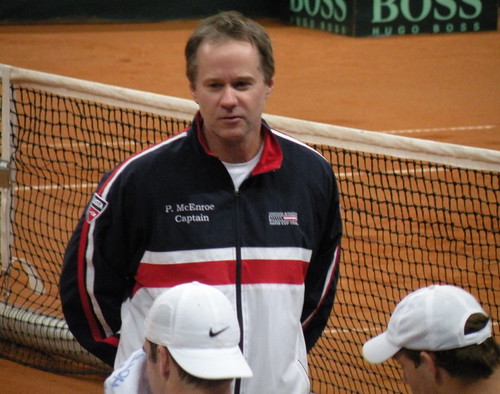
John's brother Patrick gives instructions to his team.

The US duo were clearly the stronger team and won in four sets. This gave the US their first win after losing the two singles matches American Sam Querry takes on Victor Troiki (#35 in the world) if necessary.

Whoever wins this tie will advance to the quarterfinals to take on Croatia in Croatia. A Serbia – Croatia will be a fascinating match and the first time the two nations have met since the breakup of Yugoslavia in the Davis Cup.

The Davis Cup is great and it has created a buzz in Belgrade. They even made a clay court in the Belgrade Arena to give the hosts an advantage. But what is lacking however, is a world buzz for a world championship event. I propose big changes in the event to make it better.

First, I would play the whole tourney in a two week Grand Slam format instead of stretching it over the year. Currently, they play Davis Cup weekends during lulls in the over crowded ATP schedule. It would be like the World Cup of Tennis and the top 8 teams in the world would be invited. You could have a playoff to determine teams if there are several closely rated countries. It could become the fifth Grand Slam on the ATP Tour.

The current Davis Cup is to determined by surface and host. Usually, the home nation wins because it has the crowd behind them and they choose the surface that best suits their players. In my Davis World Cup, I would have the surface selected randomly for each rubber, then the teams would have to find their best on a variety of surfaces. To make it even more interesting, lets select the surface AFTER the players have been selected to play. The four surfaces would be clay, grass, two hard court surfaces, perhaps one indoor and one outdoor.

It think if they select a good time, it would really take off and be a big event. I think the best players would play and there would be more worldwide fan interest.

We had great seats in the US Section

Russia Defeats Serbia in Federation Cup Tennis


Ana Ivanovic vs Svetlana Kuznetsova, originally uploaded by bill kralovec.

Saturday we went to the Belgrade Arena to watch the first singles matches of the Federation Cup Tennis Tournament. The Fed Cup is the women’s version of the Davis Cup. Serbia is playing this weekend in the quarterfinals against Russia. We also watched the reverse singles and doubles matches on RTV (Radio Television Serbia) on Sunday. With four singles matches and one doubles match, whichever team wins three, wins the “tie” as they say in tennis jargon. 

Russia defeated Serbia 3 matches to 2. Ana Ivanovic was awful and lost her two singles matches and was the “weak link” in the doubles match she played with Jelena. 

Serbia as you may know, is a power in world tennis because of the big three, Novak Djokovic (#2 ATP ranking), Jelena Jankovic (#8 WTA ranking), and Ana Ivanovic (#23 WTA ranking). Jelena and Ana make a duo that can match up with any pair of women in the world. Russia, is currently in my opinion, the top women’s tennis nation with 6 players in the top 20 and 15 in the top 100. The number two ranked player in the world, Marat Safin’s sister Dinara, was not playing, but we saw world number 4, Svetlana Kuznetova play.

In the first match, Ana Ivanovic (above) lost in straight sets to Kuznetova. She looked horrible in the first set, rallied in the second set to lead 4-2, before collapsing. I thought she looked rushed and off balance most of the match. Both Nadia and I remember watching her a couple of years ago defeating Venus Williams. She showed flashes of that, but mostly showed a very inconsistent effort and lack of intensity. In the second match, Jelena Jankovic played much more aggressively and defeated world #31, Alisa Kleybanova in three sets. Jelena came back on Sunday and won again in three sets, defeating Kuznetova. She never gave up, played with great intensity, and I have a newfound respect for her. I hope she wins a Grand Slam this year and makes a push for #1. Ana looks like she has a long way to go to be back in the top 10. It would be nice to see her dedicate herself to training and the tour this year and get back into the elite of the women. 

Jelena serves in the first set


One of the most noticeable things about yesterday’s matches for any male, was the beauty of the Serbian girls. I enjoyed the tennis and respect the athletic ability of the women, but it is natural to notice things like that. Both Ana and Jelena are slender and carried themselves with a more feminine air than their Russian counterparts. They both play up the “babe” factor on their web sites (Jelena’s web site and Ana’s web site)and when they promote themselves.  I felt they were at a disadvantage against the bigger, stronger, Russian girls yesterday. I think both of them would benefit from strength training. The Russians looked like linemen (North American football reference – these are the players that push against each other to create clear lanes for the faster and smaller running backs) and not what I think of as tennis players. Both girls are listed at over 150 pounds on the tour web site. 

We enjoyed our first indoor tennis tourney


I also think Serbia should develop their women’s sports program significantly. Walking around Belgrade, I see a lot of tall (6 feet and over) women. With the history of success of the men’s basketball, I am surprised that women also haven’t done more. It might be that women don’t regard themselves like American women athletes do. They are more likely to stop competing in sports as adults and girls are not really encouraged and clubs and schools do not have female sports programs. I would like to start a women’s club program like Partizan, to develop women basketball players. Many would earn US university scholarships and they would be a force on the world basketball scene. In the US, law dictates that schools must have equal male and female sports programs. This has definitely helped women in the USA.

(A side note – In the photo of Ana Ivanovic, the gentleman in the background with the white shirt and light blue tie, is former Yugoslavian tennis great, Slobodan Živojinović. He was the first Serbian to be ranked number one in doubles and won the US Open doubles title in 1986.)

Visit to the Roma Settlement in Rakovica


Roma Children, originally uploaded by bill kralovec.

Monday a delegation from our school visited the Roma Settlement in Rakovica, a suburb of Belgrade. The purpose of the visit was to deliver clothes and to entertain the children of the settlement. The High School Choir sang and we brought a truck load of clothes that were donated by the school community.

This settlement is one of several places that the Roma people that lived under the Gazelle Bridge were moved to. Earlier this fall, the large, Gazelle Bridge, makeshift village was plowed under by city officials. With the help of the United Nations and other organizations, new settlements were found for the approximately 20,000 people living there.

I spoke with a government social worker who helps the families in the settlment we visited. She said that the municipality of Rakovica donated the land. Rakovica is a suburb of Belgrade located on the south side of Kostunjak Park. It is a heavy industrial area and we noticed many factories near the site. There was also what appeared an older Roma settlement on the hill above the site. Trailers donated for 37 families. Each trailer has electricity, plumbing, and running water. All utilities are free.  The Bread of Life, a non-governmental organization provides one hot meal a day for the community. The site is near one of the regular city bus routes into the city where children go to school and adults can go to work. 

The trailers are well kept by the families.


The Roma people have been an endless source of fascination for me and the family. Most are very poor and we see them often picking through the garbage for cardboard, plastic, etc. I spoke with several Roma community members and they are quite happy with trailers and the new living conditions. Much improved from the slum they were living at, although they are a bit further out of the city. One of the community leaders was concerned about the values of the children and wanted the school to help with giving the message to the Roma children the importance of education. From what I have read about Roma, and from talking with the social worker, part of this is cultural. Roma have a difficult time adapting to Western cultural values of employment, delayed gratification, and long-term thinking. They were all very friendly and welcoming to us. 

Photo from October 2008 of the Gazelle Bridge Roma Slum


It was great for our students to see the other side of life. We have an affluent community, and it is important to develop in our students, a community conciousness. I am a firm believer in a judgement of a society is how it treats its lowest members. The Roma need to be taken care of and supported so future generations can integrate into modern society and contribute to the good of Belgrade and Serbia. The generosity of our community was outstanding. A huge amount of clothes were donated. So much so, that some will be delivered to various places needing it. We also work with an orphanage near the school and we’ll be visiting them next week. The choir sang in a large trailer that serves as a community center (photo above).  The Roma children enjoyed the music and it brightened up the day for the mothers and children. I noticed a lot of people hanging around on a Monday, especially men, and that may indicate that many are not working or have steady jobs. 

I hope that our school and me personally can do more for the Roma and the poor and needy of Belgrade.

Serbia World Cup Draw


Last Friday the World Cup Soccer draw took place. There was a lot of hype and attention on the event, as everyone was hoping for an easy draw. I was most interested in Serbia’s group and this post is an analysis of their chances of winning the World Cup. 
I think people put too much emphasis on which group their team gets placed into. I look at it like it doesn’t matter when you face the tough opponents, whether in your group or in following rounds, eventually you are going to have to beat a quality opponent. For each group of 4, the top two qualify. Then the 16 teams in the 8 groups advance to the single elimination bracket. Qualifying from an easy group, a team will likely play a tough opponent in the knockout round of 16.
Serbia’s group is one of the tougher groups of the eight. Of course, the favorite is Germany. The Germans have been in the championship game 7 times in their history and have won three World Cups. The team cruised through its qualifying group, easily defeating Russia and Finland. The team once again is solid, with Chelsea star Michael Ballack leading the way. Germany’s discipline, physical play, and talent will be hard to beat.
Serbia is ranked second in the group on paper, but I would say that all three teams are just about even.  Ghana is a country of 23 million and are a traditional African power, winner several African Cups over the years. “The Black Stars” recently won the Under-20 World Cup and last World Cup, made it out of the first round, losing to Brazil 0-3 in the round of 16. The team features another Chelsea superstar, midfielder, Michael Essien, and also, former Vojvodina FK coach, and Serb, Milovan Rajevac is the coach. 
Australia qualified through Asia for the first time. Usually they compete in the Oceania group, but wanted tougher competition to prepare for the Cup. They beat Japan to get in, and their star is Tim Cahill, from Everton. 
Serbia has a good of chance as anyone. They won a tough qualifying group, finishing higher than France, Austria, and Romania. They have top league European based players, with the star being Nemanja Vidic for Manchester United. They looked out classed against France however, and I fear that both Germany and Ghana, may have a faster game than the Serbs. I do feel good with Vidic in the back, and the Serbs do play tough soccer. 
If they do get through, they will have to play either #1 or #2 of group C which features England, USA, Algeria, and Slovenia. Suppose they finish second, they could play England. The winner then plays either group 1 winner France or group 2 runner-up Argentina. That would put them in the semifinals. As you can see, it will be very tough odds for Serbia to win it all. 
There has only been a small number of teams that have won the World Cup in recent years. Realistically, the winner will be Brazil (192 million), Germany (82 million), Italy (60 million) England (50 million) France (62 million). The Netherlands, with 16.5 million, is the smallest country to consistently appear in the semifinals. Note that Croatia did make it to the 1998 semifinals which is an anomaly. My idea would be to have a large nation and a small nation World Cup. Set it at say 20 million, and nations with a population smaller than that would compete in one tourney and larger nations in the other. You could even have the winners meet. I know other factors come into play other than population, like coaching, financial support, youth programs, etc, but long-term, the chances of a very small nation winning it are remote. There are many smaller nations with excellent soccer, like Denmark, Paraguay, Portugal, etc. that would make for an interesting World Cup, small division. There is a nice article in the Wall Street Journal that has similar thoughts to my ideas. 
I would also modify the game of soccer to allow more goals. Because the extreme difficulty of scoring goals, too many games come down to a lucky bounce or an acting dive in the penalty box. I don’t like to watch a game where one team dominates play the entire game and then loses with one counter attack that results in a goal. The modifications I propose would be larger goals, more lenient offsides rule, stricter penalties for players faking a trip (automatic red card and forced to wear a pink tutu for the rest of the season or tourney), etc. I would rather see games finish 8-7 than 0-0 and a team wins with penalty kicks. 
Anyway, I’ll enjoy watching the games in June and there will be a lot of excitement here in Serbia. Living an expat global nomad lifestyle, I have several alligences to other teams including Australia and the USA. My South American teams did not qualify this time (Colombia, Bolivia, and Venezuela). 
 

Serbian Parliament


Serbian Parliament Building, originally uploaded by bill kralovec.

I took this photo on last Friday’s field trip to the ivo Andric museum. Both the Parliament building and Andric’s former apartment on on Pioneer’s Park. It was a beautiful sunny morning. This week has been grey and rainy. Temperatures are in the 40’s and 30’s (F) and the sun is supposed to be back on Friday. It looks like temperatures will dip below freezing next week and I am hoping for snow. 

Serbia’s parliament has one house called the National Assembly consisting of 250 members. That is one representative for every 26,000 Serbian citizens. I don’t know how that compares to other countries, but it seems to be a bit of overkill. The school is planning on having some of our older students serve internships in the parliament next semester through an international NGO. I am looking forward to that. The public can visit the parliament on the last Saturday of each month. I would like to do that with the boys. 

Naive Art of Kovačica, Serbia


One of the more interesting pieces


Sunday we took a drive over to Kovačica, a small town located about 50 kilometers (30 miles) north east of Belgrade. The town is famous for its naive art style painters and its majority Slovak population. Nadia loves art and we’re exposing the kids to art so we decided to go and check out the galleries. Naive art is a genre that emphasizes color,  childlike simplicity, and patterns. I never heard of this art style before and was curious to learn more.

The gallery/museum is well maintain and features the works of around 25 artists from the town and neighboring villages. The styles vary, from the more realistic depictions to pure fantasy. The use of color differs also, some being extremely bright and others more subdued. Most of the subject matter is a romanticized, rural lifestyle. For example, many show scenes of the harvest or hunt, sledding in the winter, etc. I preferred the more realistic works of Jan Bačur and Mihal Povolny while Nadia liked the more colorful pieces, especially of Ana Knjazovic. The town of Jagodina in southern Serbia is more famous for its naive painting and maybe someday we’ll visit there. 

It was a bitterly cold morning and we walked around the main plaza a bit. It was strange to see a priest walking near our car when we pulled into town. The town is mostly descendants of Slovak immigrants and they have their own church. We usually see the Orthodox holy men with the long beards and black robes. We bought a small piece for our house and some souvenir calendars. It is a nice day trip and better than hanging around the house on a cold, foggy day. 


The Kralovec Family is not the best for cold weather!


Hike to Đavolja Varoš


Last weekend I went on a hiking trip to the UNESCO Heritage site called Đavolja Varoš (Devil’s Town). The main attraction advertised were the 200 odd pillars you can see in the photo above. These huge pillars are formed through many years of erosion. You can see the hikers on the far right of the photo. They are set in a beautiful canyon which we climbed into. The sun came out as I was taking this photo and the beautiful fall colors added to the scene. Legend has it that the devil made a secret potion into the spring water at the site, and when the local settlers drank it, they forgot their familial relationships. A brother and sister were about to get married when a protective fairy in the village prayed to god and he swept down and turned the entire lot into these stone pillars. I like this explanation better than the erosion one. I guess with the small pockets of population a long time ago, incest was a big issue for the community. 

I took a group of students and we stayed at the Prolom banja spa. It is a communist era hotel that many elderly people go to for the healthy waters. The place was not very modern, but it was clean and somewhat comfortable and the staff was very friendly and helpful. 


The Sacred Spiral Plum Tree

The second day we took a 3 km walk from the town of Prolom Banja to a small church called St. Lazar. It is one of the legends surrounding the Serb battle against the Ottomans in 1389. The church is about 10 kilometers from the Kosovo border set amidst some forested hills. The area is great for hunting deer, wolves, foxes, etc. according to the locals. The guide from the hotel told us that before doing battle against the Ottomans, the Serb soldiers walked around the church 6 times and they also planted six spiral plum trees which were regarded as sacred. The photo above shows the oldest remains from one of the trees. There are two living spiral trees next to the church. 

Lazar was the leader of the Serbs at the time of the big battle and both he and the Ottoman leader died in the battle. 

I am not sure how true this is. From my research, not much is actually known about the battle. It is a great story however and with the low clouds and mists set in the dark forest, it is easy to imagine the medieval Serbs doing battle with the Turks in this kind of setting. I really want to go back with mountain bicycles, there were roads and trails galore in the area.

Serbia Qualifies For The World Cup!!


Owen & Sebey At Red Star Stadium


Last night my friend Claudiu and I took the kids to the Serbia versus Romania World Cup Qualifying match. Serbia was leading Group 7 in the European Group and needed a win to secure a spot in next summer’s World Cup soccer tourney in South Africa. They earned their spot with an emphatic 5 – 0 win over neighboring Romania. 

We got pumped up for the game with a lunchtime soccer match

My last experience at the stadium for the Austria qualifying match was horrible and I was apprehensive in taking three young boys (Owen, Sebey & Tudor) to the game. We were crushed in the entrance at that game, but last night’s game was very well organized. Stadium officials looked at the tickets at several checkpoints on the way to our seats. The seats were numbered and there was one seat for every person. There were also many police and ushers in the aisles to prevent overcrowding in the exits like last time. 

Serbia obviously outplayed Romania and were back to their up tempo attacking football that has been lacking the past few matches. At the end of the match, there was a big celebration with fireworks and President Tadic in his luxury box opening up the champagne. Serbia qualified for the first time as an independent nation – in 2006 in Germany, they were still Serbia-Montenegro. It is interesting the there are several ex-Yugoslavia republics with chances of qualifying. Bosnia-Hercagovina will finish in second place in their group and will play off to get in. Slovenia also is in second place and could qualify automatically as group winner if Slovakia loses to Poland. Croatia is one point out of second but will probably not get into the playoff.

How will they do in South Africa? They have as good of chances as anyone else. They have one superstar, Manchester United defender Nemanja Vidic. They are solid in the midfield with InterMilan player and team captain, Dejan Stankovic. My favorite player on the team and possibly their best, is Milos Krasic. He plays for CSKA Moscow and really makes things happen for Serbia. He is fast and always moving forward and is always involved in Serbia’s goals. He is a player to watch out for as he is only 24. I can’t believe one of the bigger European clubs hasn’t picked him up yet. They also have the tallest soccer player at this level, 6’8” Nikola Zigic. He usually gets several good header opportunities in front of the goal every game. Their goalie is solid and if the role players can step it up, they have a shot at taking on the big boys. They need another big scorer as I don’t think Marko Pantelic, one of the strikers is up to World Cup level of play. He is always complaining on the field and doesn’t really do a whole lot in my opinion. They will always be in games with Vidic as center back. 


Lunch With the Romanian Supporters

The qualification means the World Cup will be much more interesting for me with Serbia and the USA in the tourney. I have photos on my Blackberry but haven’t yet figured out how to upload them to my computer. I will post some photos from the game when I get a chance.

Zlatibor

We visited the region of Zlatibor this weekend for the first time. This is a part of Serbia south east of Belgrade, along the border with Bosnia. It was a wild and beautiful part of Serbia and now my favorite place in the country. “Zlatibor” means “Gold Pine” in English and it is an area of mountains (3000 feet), pines, and rugged beauty. We stayed outside the village of Mokra Gora, and it was about a 4-hour drive from Belgrade. Nadia is shown in the parking lot of the hotel. You can see the terrain behind her. If I was to buy property here, it would certainly be in this part Serbia.

We are in the Nikola Tesla Plaza in Kusturicas Village
We are in the Nikola Tesla Plaza in Kusturica's Village

We stayed at the Hotel Mecanik which is part of the Serbian Ethnic Village that the famous movie director Emir Kusturica built. It is called Drvengrad and as an excerpt from the article in the Guardian describes it as follows:

I turn up in Belgrade as the thermometer sinks south of -20 degrees. “Come to my village,” he demands. “I have something to show you.” Three thousand feet up on Tara mountain the next morning, the full effect of his latest piece of “inspired lunacy” sits under 2ft of snow. Kusturica has sunk himself deep into debt, spending more than £1m to build a pastoral paradise, his own version of Plato’s republic, in one of Europe’s last great peasant redoubts.

“This is my Utopia,” he declares. “I lost my city [Sarajevo] during the war, now this is my home. I am finished with cities. I spent four years in New York, 10 in Paris, and I was in Belgrade for a while. To me now they are just airports. Cities are humiliating places to live, particularly in this part of the world. Everything I earn now goes into this.”

What started as a couple of salvaged traditional wooden houses 18 months ago, on a bluff above the spectacularly beautiful Mokra Gora valley in western Serbia, has mushroomed into a modern take on the great monastery-universities of the middle ages. The village is equipped with a library, Serbia’s most advanced cinema and, most incongruously of all, an underground basketball arena – a tribute to the three world championships won by the former Yugoslavia. For Kustendorf, as he calls the place, is also a hymn to Serbian cultural achievement and traditional living – a kind of cultural Alamo, as a country that has been cut off from the world by war and sanctions opens itself up to the gentle mercies of globalisation.

“I am making a stand here. I want to do something constructive. In Serbia a lot of people hate me because they want to westernise, not understanding that the western world is bipolar, with very good things and very bad things. Since they don’t have experience of the west, they even believe that western shit is pie.” Given that the prophets of the free market in Serbia often tend to be the same gangsters, war profiteers, smugglers and chancers that Kusturica lampoons in his films, you can see his logic.

I have never seen any of his movies and did not know much about him before writing this blog post. He is a very interesting character to say the least! Some people don’t like him and I can see how he would shake some people up. There are lots of articles on line that describe his conversion to the Serbian Orthodox Church from his Bosnian Islamic roots. The village we stayed at is temple to Serbia.

Emirs Unusual Touch
Emir's Unusual Touch

On one level, it was a great place to stay with my family. The kids loved the swimming pool, we all loved the clay tennis courts and indoor basketball court. The food was delicious, although the waiter and some of the help were a bit quiet to us. Not exactly rude, but a bit cold. The views are spectacular and the cool mountain air is refreshing. The cabin we rented was comfortable and it even had a fireplace. I would love to return in the winter for a skiing trip.

On another level, it was fascinating to see his take on life. He is very much anti-Western (aka Anti-USA) and against the cultural hegemony of the US. He put photos of Che Guevara, Maradona, Fidel Castro, Pancho Villa, etc. in the restaurants. I think my buddy in Venezuela, Hugo Chavez would get along great here! I don’t like Che, I think he was  an Argentian bum who got lucky to be in the right place at the right time and ended up killing a lot of people. I wish people would read up about his background before wearing a shirt of his because he looks cool. Serbs love him and his image is around Belgrade a lot. Nadia was laughing because she is from Santa Cruz, Bolivia where Che was killed by the Bolivian army. One of her relatives on her mother’s side of the family was probably in the unit that found him in the mountains of Valle Grande, near Santa Cruz. He also didn’t serve Coca Cola, and so we ordered Emir’s Revolution Raspberry Juice (delicious). There was a picture of George Bush behind bars. I think he is a bit carried away with the anti- imperialism stuff, but I do agree with a lot what he has to say. The war of the breakup of Yugoslavia was tough on him and before I can judge someone, I need to walk in his shoes.

The Small Chapel at Drvengrad

I think Kusturica is an original and I enjoyed getting to know him a bit better. I will definitely look up his films and I do plan to return again. I will probably do some more blog posts on him and his work. You can see more photos on my flickr.com account.

I recommend the place for families and I also hope to explore Zlatibor and across the border in Bosnia. I saw on the map that the city of Visegrad, from “The Bridge Over the River Drina” is very close by.