Near our house in Senjak, someone with a sense of humor has changed some street signs. To the left is a photo of sign in front of a school up the block from us. It shows children at play and a speed limit of 40 kilometers per hour. The sign below shows a slight change to a sign on the other side of the street.
This might be appropriate for some US public schools, but certainly not here in Serbia, where violent crime is very rare. It is one of the safest cities in Europe.
You can see where some jokester with a black, permanent marker, drew a gun in the hand of the boy behind the girl.
(Note – This is an update to my History of Serbia page. You can read my working draft on Bill’s History of Serbia page.)
In the early 1800’s, Serbia was on the edge of the Ottoman Empire, a long way from the capitol of the Ottomans, Istanbul. So far away in fact, that the Sultan Selim III in Istanbul did not have full control of the Belgrade province, or pashalik in Turkish. The province was run by four dahi who brutally repressed the Serbian peasants. The dahi’s soldiers, called janissaries, lived in the Belgrade fortress and periodically patrolled the sparsely populated land of Serbia.
The Serbian Uprising of 1804 began with the execution of Serbian peasant leaders in the town of Ljubenino Polje, about 30 miles south of Belgrade. The dahis had reports that Aleksandar Nenodovic was importing arms from the Hapsburg Empire from across the Danube River, just north of Belgrade. The dahis took a George Bush, proactive approach and wanted to crush a rebellion before it started. The janissaries beheaded many of the Serbian leaders. These be headings sparked, as Misha Glenny writes, “the beginning of modern history on the Balkan peninsula” as the Serbs began to get rid of the Ottoman Turks and their Eastern culture. This was the seća knezova or the massacre of the leaders. The word Knez you see today all over Serbia, and it is translated as “village headman”, “prince, or “duke”.
A French Artist Portraying a Janissary Patrol in Izmir, Turkey (1831)
The janissaries were a sign that the Ottoman Empire was in decline. They originally were an elite guard for the Sultan, but eventually turned into autonomous dictators, and in Serbia, they basically made the Serbs, serfs of the themselves as feudal overlords. This was in direct opposition to the some wealthy Serb pig merchants, who had a rich trade with the Austro-Hungarians in Vojvodina.
They eliminated around 100 knezes, but some escaped to become hajduks (guerilla insurgents) in the forests of Serbia. One in particular, became the leader and eventually would lead the Serbs not only to down the janissaries, but also to take on the entire Ottoman Empire.
Đorđe Petrović was a peasant from central Serbia. In Serb the Đ (đ) is pronounced like the English J, so his name is translated in English as George. He was called Karađorđe, which means Black George. George organized thousands of Serbs and they easily defeated the janissaries. They became so powerful, that they also defeated the Sultan’s army in 1805 in a battle close to the southern Serb city of Niš.
George's Black Hair Gave Him His Nickname
They were close to cutting a deal with the Sultan when greater events intervened. The Russians, French, and Turks were battling for supremacy of the region. Black George aligned with the fellow Christian Orthodox Russians. The Russian army came and occupied Belgrade, which was under siege by the Ottomans. Black George was in trouble when the Russian Tsar Alexander I, withdrew his troops from Belgrade to fight against Napoleon. The Ottomans quickly moved three of their armies to take control of Belgrade, and Black George fled to Austria on October 3rd, 1813.
In 1817, Black George secretly returned to Serbia. The Serb leadership assassinated him, not only because he was a threat to them, but he also during his exile, aligned himself with the Greek revolution. The Serbs wanted an independent Serbia, not one under the more populous Greeks.
In looking at the legacy of George Petrović, he may have been considered a failure. His movement ultimately did not give Serbia independence. He also died a violent death at age 47.
But looking at it from a different perspective, his accomplishments were great. He rose from being an illiterate cattle and pig farmer, to leading the largest Christian army inside the Islamic Ottoman Empire. One of his rivals succeeded a few years later in gaining Serbian autonomy, but learned from the mistakes of George. Black George’s descendants however, became a Serb monarchical dynasty. The House of Karađorđević, or House of Black George ruled Yugoslavia from 1903 – 1941. Today, Crown Prince Aleksandar, a descendant of Black George, is living in the Royal Palace, near my home in suburb of Dedinje. He doesn’t have any formal political power, but is a figurehead and there is some talk of Serbia returning to a constitutional monarchy.
The Crown Prince Alexander’s second wife, Katherine Batis, called me earlier this year to help her with a charity fashion show for breast cancer she was holding at the palace.
As you can tell by the title of this post, I am very excited for the first ever Association of Tennis Professionals (ATP) tour event being held in Serbia! The Serbia Open will begin tomorrow, Saturday May 2 with the qualifying rounds. There will be 32 men competing in the singles and 16 doubles teams competing for the title. This is a new ATP tour event.
It is certainly not Wimbledon or the US Open, as it is classified as a “250 series” which means that it is in the lowest tier of tourneys on the ATP tour. The 250 means the winner will get 250 points. The winner will also win 73, 000 Euros, which is almost $100,000. Not bad for a week’s work. Second place earns half of that. Even though it is not a high profile tour event, I am still looking forward to it because it is here. Nadia and I purchased tickets for the finals and are arranging for a babysitter.
It might as well be called the Novak Djokovic Open as he was the driving force behind getting the tourney here in Belgrade. He is also by far, the highest rank player in the tourney. There are two other events the same week, both 250 series, in Munich, Germany and Estoril, Portugal. Novak is currently ranked #3 in the world and the next highest ranked player competing in the open is Radek Stepanek who is ranked #19. Djokovic is 3- 1 against Stepanek in his career .
“Nole” as they call Djokovic here in Serbia is defending his title this week at the Masters Series tourney in Rome. He is a better player on hard courts, but has won three ATP titles on clay. This week he is defending his clay court title at the Rome Open, which is a Masters Series event. He is having a good run lately, destroying Tommy Robredo yesterday, 6-1, 6-1 to move to the quarterfinals in Rome. Things are looking up for him to win his Serbia Open. We shall see.
There are two other ranked Serbians in the singles draw, #40 Victor Troicki and #65 Janko Tipsarevic. I will be posting updates all week as the tourney gets underway.
Yesterday we toured the Museum of Aviation located on the grounds of the Nikola Tesla International Airport in Belgrade. The kids loved it and we spent an entertaining two hours in the museum. I highly recommend a visit to anyone with a interest in flight, military history, and with children.
Ollie and Owen are shown above in a cockpit of one of the planes. They were impressed with being able to move the tail and wings with the controls. The building is very cool and upon entering, is like going back into a time warp of the early 70’s. I told Owen, “This is what it was like when I was a kid.” They still had that 70’s fake wood paneling, credit card stickers from long ago, and the funky desks and furniture from the era. They had an impressive amount of planes with many having English descriptions. On display was also a tail of an US F-16 that was shot down during the NATO bombing (the pilot ejected and was rescued) and a British unexploded bomb found in Kosovo, also from the NATO bombing. Here is a link about the history of the building.
The Museum of Aviation
All eras of flight are on display including the World War I fighters, World War II, Communist Yugoslavian Air Force, and the history of JAT Airlines. As I said, a very impressive and complete collection! The boys were totally punped and were running around outside on the planes and helicopters, pretending to be James Bond.
The F-16 TailOcean next to the Mig-20
I think the visit will generate an interest in aviation for the boys. We may buy a model plane and put it together for them. We also have to watch the ultimate in fighter jet movies, Top Gun with the boys.
With all of the talk of the global economy and media buzz about the global recession, I was very curious to learn more this denomination of Yugoslavian currency I bought at a market in Belgrade.
The bank note is real and it was issued in 1993 at the height of the hyperinflation during the chaotic times of the breakup of Yugoslavia. It was the largest denomination of the ex-Yugoslavia and nominally worth 500 billion (US terms) dinara. At the time, it was virtually worthless by the time it was printed and released to the public.
I thought I had lived through tough economic times the past 6 years in Venezuela under the economy destroying policies of President Chavez. But the 30+% annual inflation and currency exchange controls pale in comparison to the craziness of 1990’s Belgrade. A bit of background…
When Yugoslavia was breaking up into the separate nations of Croatia, Slovenia, Macedonia, and Serbia, it not only generated political chaos, but economic chaos. The economic output of Yugoslavia dropped 70% from 1990 to 1994. The government tried to compensate by printing more money and passing laws making it illegal for businesses to lay off employees. On top of this were the war and UN sanctions making it more difficult manage the economy. The result was an inflation rate that peaked at 313,563,558 % per month which comes to 851 with 78 zeros behind it. Amazingly, this was not the highest inflation ever! In neighboring Hungary during WWII, they had an inflationary rate of 4.16 trillion per month and they also had the largest bank note. Serbia does have the record for the longest sustained hyper inflation.
As you might have guessed, this made people’s lives very difficult during this time. People survived through a variety of creative measures. Thankfully, Serbia has rich soils and most people have relatives living in the countryside to feed their extended families. Eventually, the Dinar died as a currency and was replaced by the German Deutschmark. Today, Serbia has an inflation rate of around 10% and a stable Dinar currency. Tim Judah, in his book “The Serbs: History, Myth & Destruction of Yugoslavia” has an excellent detailed description of this time in Serbian history.
Pictured on the front of the note is the Serbian poet, Jovan Jovanović. He lived in the late 1800’s – early 1900’s and was born in Novi Sad. He is famous for his children’s poetry. Below is an example of one his poems,
DARKNESS
You could think that darkness
is so scary strong,
powerful and dreadful,
and–you would be wrong.
Fortunately, it is
not at all this way:
You just light a candle
and it runs away.
Jovan Jovanović Zmaj Translation: Dragana Konstantinović
Another translated poem can be found on Dragana’s website. On the reverse side, pictured below, is the Serbian National Library. The library is still open today and is located next to Saint Sava’s Cathedral in downtown Belgrade.
A shopkeeper at the paint store gave Oliver a Serbian Easter egg! It is one of the Serbian Easter traditions and I love following the local customs. It is one of the nice things about living in other countries. The Serbs keep one of the Easter eggs, called the čuvarkuća in their homes for the entire year until next Easter. It is supposed to protect the home. The translation is čuvar means guard/watchman/keeper and kuća means home.
Ollie carefully handed it to me and we put it on a shelf in the kitchen. We’ll see if it makes it the entire year.
We discovered a really nice place for lunch yesterday. We visited Salaš 137 just outside of Čenje, a small village near Serbia’s second city of Novi Sad. Salaš, pronounced, salash, is the Serbian for country ranch. These places often have a restaurant, country museum, and activities for kids. This particular salaš was particularly nice, a perfect place to take the family.
The boys take a break from soccer.
I spent the morning doing yard work and playing with the kids. I managed to take Ocean for a run in the jogging stroller, I was definitely feeling the Belgrade marathon in my legs. We finally got the kids and car packed and left for ranch in the afternoon. It was warm and overcast, perfect weather! The food was traditional Serbian cuisine. We ordered the house specialty, lamb, as well as salads, potato dishes, roasted vegetables, and the special Serbian “gutbomb” of chicken wrapped in bacon and filled with cheese.
Ocean on the Teeter-Totter
The ranch was recommended by various mothers in the ISB community and thanks to them. The ranch also had a huge soccer field and playground. Perfect for three hyperactive kids waiting to eat. We also went on a horse ride in a cart around the property. Cenje is in the heart of Vojvodina, the northern part of Serbia. Vojvodina is an rich agricultural area, flat as a pancake. It looks like Iowa.
I highly recommend the place for a weekend afternoon get-a-way. They also have a hotel for longer stays. The ranch is located just north of Novi Sad, about 90 kilometers away from Belgrade. If you type in Čenje into a GPS, it will take you to right to the place. For more information, you can visit their web site.
Nadia and I had a wonderful run in the 22nd Belgrade Marathon yesterday. One could feel the excitement as the gun went off to announce the start of the race. Thousands of runners shouted and raised their hands as we moved in unison up Queen Aleksandra Street. It was a thrilling rush to be part of such a mob activity. There were people cheering and watching along most of the route. The sunny skies and cool (70 F) temperatures made for beautiful sites and nice running conditions.
We decided to run together instead of me chasing the Kenyans. Below is as close as I got to the elite runners. They swepts the top spots as expected. We ran 15 kilometers, the most we have ever done together in a time of 1 hour and 38 minutes. Vera our nanny watched the kids at home so Nadia and I treated it as a running date again. The views of the city were spectacular, such as the shot I took from Branko’s Bridge below.
I Am Trying to Pscyhe Out the Kenyans
The first 5 kilomters on the old side of Belgrade, south of the Sava River went by extremely quickly. The next 10 kilometers were the tough part as we crossed the bridge into New Belgrade. The nice thing about New Belgrade is that it is former swampland that Tito’s socialists developed and it is completely flat. We ran along the Danube all the way to Zemun and then separated from the marathon course at the 10 kilometer mark. We then finished the last 5 kilometers by crossing the main high way overpass near the Mercator Shopping Center.
The View from Brankov Most
Nadia had the best orange juice she ever drank immediately after we stopped. We then luckily found a taxi near the highway and we were back home in 5 minutes. We both pledged to train more next spring and run the half marathon (21 kilometers).
After the race, I was extremely tired and as I write this my legs are still a bit sore. I’ll go out for a run this morning with Ocean as soon as she wakes up. We took the kids to McDonald’s and played in the yard for the rest of the afternoon. Nadia made a nice risotto and then we went for a walk for ice cream. Belgrade reminds me of Michigan summertime right now.
We are beginning our Spring Break and have the next week off of school. The Orthodox Christian Easter is today and so we have our break later than most countries.
Nadia and I are shown above after registering for the 2009 “Banca Intensa” Belgrade Marathon. This is the 22nd edition of one of the biggest sporting events in Serbia. This is the first that the Kralovec family will be participating. We will be representing our countries (Australia & USA) against the best in the world.
There are four races actually today. There is the marathon, a half marathon, and the UNICEF 5 km fun run. Within the marathon, there is the military world marathon championship, with soldiers from all over the world participating.
Nadia and I, being “serious” runners, signed up for the half marathon. Nadia was the 701rst woman to register. I was too busy soothing Oliver to find out what number I was. We bought the boys UNICEF shirts so they could feel they were getting a t-shirt and registering for a run also.
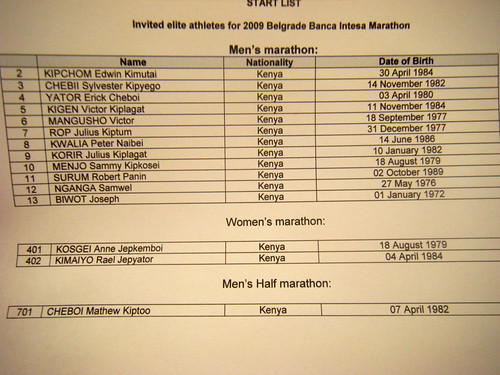
My race strategy will be to focus on the list below. Hey Mathew Cheboi, if you are reading this, I’m gunning for you! I’ll find his number (701), get next to him, and then run with him until the last 5 kilometers where I intend to pull away. Then if I am feeling good, I’ll keep going and maybe take on some of the guys in the marathon. I can’t believe that I wasn’t on the list below.
Seriously, Nadia and I intend to run 10 kilometers together and then quietly step off the course. We have not been training much. I don’t know how much my 41 year old body can do with exactly 3 training runs behind a jogging stroller. Being an international school principal and have three children under the age of 6 really cuts into training time! If I am feeling good, I’ll go on and finish the second half of the half marathon and do another 11 kilometers.
Where is Bill Kralovec USA?
This is our first really big race. We have run in lots of 10 kilometer races back in Michigan, as well as the annual Guacamaya “Run For The Earth Fun Run,” but never have we done a city marathon with thousands of participants. I wonder how far away from the Kenyans I’ll be when we start off?
My main goals are to enjoy time with my wife, get some exercise, and enjoy the sights of the city. We start in front of national parliament and get to run across the bridge to New Belgrade and back. We are three hours from race time as I write this. I’ll let you know how it turns out. I have Oliver and Owen convinced that I am going to win.
Above is a photo I took last weekend. We were on the way to an open market in New Belgrade. We stopped at the traffic light, and these three gypsies were asking for handouts from cars waiting in line. At the major intersections downtown and in New Belgrade, it is common to have gypsy beggars or window washers. It has been a source of fascination for our family since our arrival. This is my second post (for my first post, click here) on the gypsies and I intend to do more while I am living here.
I recently finished reading Isabel Fonseca’s excellent book, “Bury Me Standing: The Gypsies and Their Journey” in which she writes of her experiences of living with the Romany people of several Eastern European countries for 4 years.
There are over 100,000 gypsies living in Belgrade. They are an on-going social problem in the city. They get little support from the government and have difficulty integrating themselves into modern, Serbian society. The latest news was the government moving (bulldozing) of a settlement in New Belgrade. It seems that no one wants them to live in their neighborhood. There are gypsies that are successful, but most are extremely poor and outside of normal society. Beside hustling for money at intersections, they are also seen collecting cardboard and other recyclable materials or selling junk at markets in New Belgrade.
They remind me of the Aboriginal people of Australia. They have their completely separate culture and lifestyle living right next to a majority “Western” culture. They are closer to the North American Indians, and are more integrated than the Aboriginals, but the same view applies. Like the Slavs, the migrated to Serbia from the east. Researchers discovered they originally came from India, leaving about 16-20 generations ago (approximately 12th century). They stopped in central Asia (Armenia) and reached Serbia and eastern Europe in the 14th and 15th centuries. Their official name possibly dates back to their original caste in India. Fragments of their Indian origin are maintained today in many words in their language and their Hindu-like customs of cleanliness and superstition.
Their original nomadic lifestyle has ended in modern times. Today they are mostly poor, illiterate, living on the edges of cities and towns. There are an estimated 6 -11 million gypsies world wide with most in Eastern Europe. The biggest population is in Romania. Fonseca reasons they were used as slaves in historical Romania and that explains the high numbers there. They have been persecuted since their arrival to Europe. They are the forgotten part of the Holocaust.
The girl above is probably the mother of the baby in her arms. Gypsies have their own cultural norms and one of them is to become a mother as soon as physically possible. What is amazing is many are illiterate with no concept of history, time, and Western cultural literacy.
Ocean is up and I need to attend to her. I’ll be writing more in the near future…
Below are some excerpts from the Rom News Network a website based in Germany that produces news items about the Romany people. I took the excerpts from an article by Olga Nikolic, called, “Life on the Margins of Society” from 2001.
“Romanies form the youngest portion of the population in Serbia – over a half, 62 per cent of them, are under the age of 25, while only 4,1 per cent of them are over 60 years-old. The said age structure is accounted for by experts as the result of high birth and death rates and a low average life expectancy. According to some statistics, the average Romany life span is 10 per cent shorter than is the case when all other citizens of Serbia
Dragoljub Atanackovic, the president of the Romany Congressional Party, claims that 90 per cent of Romanies live in extremely insanitary conditions and that in Belgrade itself there are 60 enclaves with over 90 thousand Romanies living in wretched circumstances. “The social position of Romanies is exceptionally difficult. But three per cent of the population of working age are employed, only 31 per cent have primary school education, the rest are half-illiterate or illiterate. We do not have a single newspaper in our mother tongue or a radio and TV program financed by the government.
According to statistics, the rate of unemployment among Romanies is four times higher than is the case with the country’s majority nation and in the past ten years the negative ratio has doubled. Every fifth Romany of working age is illiterate and every third has merely primary education. A fifth of all Romany families have no earnings whatsoever, while the majority barely survive by doing odd jobs in the black market sector, such as selling contraband cigarettes and similar smuggled goods or by collecting secondary materials.”




 Bill's Blog