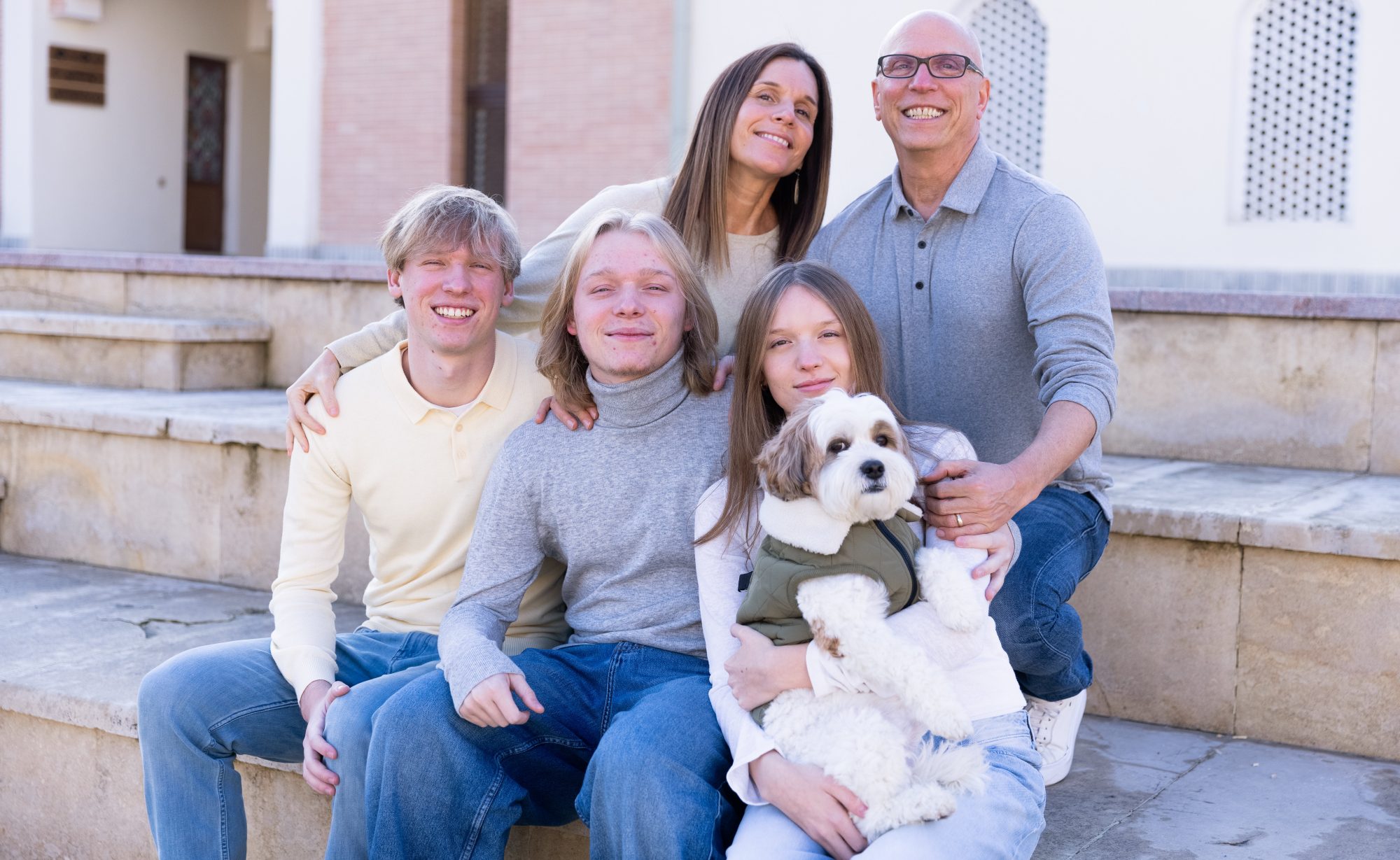
This is a special day for the ex-Yugoslavia because it was the Day of Youth and the celebration of former dictator, Tito’s birthday. It is also my birthday so I always try to do something with the family with a Yugoslavian theme. This year since we are leaving Serbia, I wanted to get a family photo with the traditional national costumes of Serbia.
Rural people actually wore these clothes into the 20th century, but like all traditional, locally made clothes, modernization has homogenized clothing for much of the western world. In some ways I see why people don’t wear these. The course woolen fabric of the pants is a bit uncomfortable and on this humid, early summer, day, it was difficult to get the kids to cooperate. The shirts had intricate embroidery, the red stitching symbolizing the blood lost in the Battle of Kosovo in 1389. A distinctive feature for both men and women is the jelek or waist coat, which looks good, even today. You can’t see in the photo above, but I am wearing opanci, which are leather sandals with hooked toes that the peasants wore for climbing. They are similar to North American Indian moccasins.
My favorite part of the costume is of course, the national hat of Serbia, the Šajkača. The hats originated with Serbian soldiers, stationed on the Danube and Sava Rivers by the Austro-Hungarians to protect the empire against the Ottoman Turks. The hats are in the shape of an overturned Serbian boat, a šajka. The hat eventually became popular with the rest of the Serbian army and also with non-military farmers. The Bosnian Serb army during the wars of the breakup of Yugoslavia brought it back into popularity. Today it is only worn for special occasions, like Serbian national soccer matches or by folkloric dance troupes. I think they are very hip and would like to see them made popular again. They are very distinctive and instantly recognizable as Serbian.
This morning Owen, Oliver and I completed a 5 kilometer run with the school’s Boys On The Move program. My wife Nadia for years has done the Girls on the Move, which is similar to Girls on the Run, with her elementary girls. One of the elementary male teachers did Boys on the Move this year so Owen was able to participate. We ran the approximately 5 kilometer course in 25:00 minutes, which was the second fastest of the group. Oliver also got in the action and ran was well, finishing the course with our school’s Athletic Director, Damian Hart and his daughter Abigail. Nadia was busy with her running buddy and organizing the whole event so I didn’t get a picture with her.
I didn’t want to have Ocean miss out on this blog post, so she is shown below riding a horse at the Belgrade Hipodrom. She has expressed an interest to ride horses to I took her down to the race track. It is a really nice setting near our house and is the oldest sports venue in the city. They hold harness racing, or the trots as they say in Australia, on summer Sunday afternoons.
Above is a video I took on Sunday. Owen and I were riding along the banks of the Sava River and watching the hundreds of volunteers putting up sand bags along the banks. I was totally impressed with the kindness of the Serbs and how disaster can bring people together. Below is a video from the news coverage, showing the extent of the flooding from the air in the towns along the Sava that were flooded. The first city featured is Obrenovac, where many of our school employees are from . Our relief efforts continue…
Sandbags line the banks of the Sava River in New Belgrade
Serbia experienced 4-5 days of heavy, steady rains this week, which caused major flooding of the Sava River. Several small cities along the river, including nearby Obrenovac, were completely flooded by over a meter of water. Several people died and thousands were evacuated. The damage must be enormous, and much livestock died. Flooding also occurred in in Bosnia, even more so than in Serbia. This is the worst flooding in the Balkans in recorded history.
Our good friends from Obrenovac were rescued by our head of security, and he told me a harrowing tale of getting through 1.20 meter deep water at night. The area was sealed off by authorities and people are being evacuated by boats now.
Owen inspects the sandbags for the expected river surge
I help organized a flood relief donations drive at our school. I was Administrator-in-Charge and earlier in the week I was dealing with possible closing of school Due to the heavy rains, all Serbian public schools closed by order of the government. We stayed open because almost all of our students live in areas that were away from the flooding and all take private transport. It felt good to help the people of nearby Obrenovac that needed to evacuate. They must be devastated to have that much water go into their homes. It will take a lot of cleaning, and drying out of things.
Laying the base for the wall – Sava River May 18, 2014
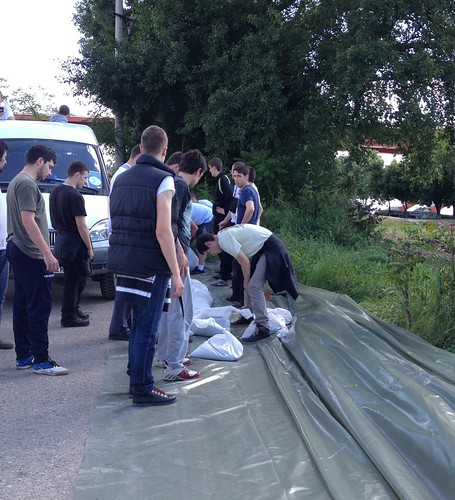
The past couple of days I took the boys biking along the Sava. In Belgrade the water was high but not flooding. Today city officials were expecting a surge coming from down river as the flood waters recede and go back through to the river. Hundreds of volunteers were filling sandbags and lining them along the river to protect the areas adjacent to the river. I hope their work is sufficient to hold back the water. There are many homes and businesses near the river, and many of the famous splavs and restaurants on the river are flooded and may sustain some damages. As you can see by the pictures and video in this post, it was an anxious ride for Owen and I today. It was heartening to see the many good people helping out strangers and working together to protect areas from the flood.
Volunteers fill sandbags and deliver them to the banks of the Sava River
We have been watching the RTS and B 92 news. I’ll try to keep updated with the progress of the flood and recovery efforts. A lot of work will have to be done with cleaning, repairing, and purchasing of new carpet, appliances, etc. for the people of Obrenovac and other cities. I hope our family can lend a hand in the next few weeks before we leave Serbia.
Ocean in Revolution Square in Bucharest where two Romanian rulers (King Carol II and Ceausescu) were forced out of office.
Ocean is pictured above in Revolution Square in the center of Bucharest. This is the large plaza where KIng Carol II abdicated in 1940 and dictator Nicolae Ceaușescu fled from in December of 1989. Bucharest has many large, open squares, and beautiful, old architecture. You can see the famous World War II-era Athene Palace Hotel in the background. We walked around the center at night are were very impressed with the palaces, theatres, etc. One bad point is the Romanians drive very fast.
We have a four-day weekend with the Serbian government declaring the May 1 Labor Day on Thursday a national holiday along with the Friday as well. We took the opportunity to visit my close friend Claudiu Fuiorea and his family in Bucharest. They are Romanians who used to live in Belgrade and last year they moved to the Romanian capital. We visited them at their home in Transylvania during the winter break of 2009-2010 and traveled with them to the Carpathian mountain resort town of Baile Herculane in October of 2009. We were supposed to also travel with them in October of 2012, but Ocean’s passport was expired so we had to stay in Serbia. We also made many shopping trips to Timisoara, the most western city and a short drive from Belgrade. Claudiu’s wife Vesna and children, Tudor and Mark, are also close to my family and through the years, we have had many good times together. As we leave Europe for Japan next month, we really wanted to see them one more time before we go.
I am in front of the Arc of Triumf, erected in 1878 to celebrate Romania’s Independence
This is my second visit to Bucharest, the first being on business in October of 2010. Through our friendship with Claudiu’s family, we have really come to know the country and culture of Romania. After Poland, it is the biggest Eastern Europe country, and with the Carpathian Mountains, Black Sea Coast, and western Pannonian plain, it is the most diverse. It also differs from the rest of Eastern Europe due to its Latin root language. This is a fascinating country regarding folklore and legends, and it has been pleasurable learning nation’s history.
The next day I went for a run around the National Arena which was constructed in 2008 and is located close to Claudiu’s apartment in the suburb of Titan. Soccer is very popular here as in all Latin European countries (Italy, Spain, France). The suburbs remind me of many Eastern European capital cities because of the communist architecture of the apartment buildings and offices. We then ventured out as a family and had a great afternoon, seeing the sites and soaking up some perfect spring weather. We first visited the Natural History Museum, that had a large and varied collection of stuffed animals from all around the world. It was started by the Romanian naturalist, Grigore Antipa and was set up very well, with it being entertaining and educational for the children and adults. We then walked through the massive Herăstrău Park for lunch at the Hard Rock Cafe. Bucharest has several lakes and parks around them and they are well-maintained. This was something I was not expecting. I also was impressed with the city’s subway, that was clean and organized. It was very convenient to travel downtown and back to Titan.
The kids in front of an extinct elephant species at the Natural History Museum
We had a special day on Wednesday to mark the ninth anniversary of Oliver’s birth. He invited four friends over for a Nerf gun extravaganza! There were bullets flying all over the house and the kids had a great time. A highlight was the weekly radio check to the US Marines at the embassy. We walked to Ollie’s favorite restaurant, Quan Du Je, in Senjak. It is a nice thing about Serbia is that they love kids and chaos, so no one was bothered by the boys chasing each other and being loud in the restaurant.
We finished the night by watching World War Z and reading a bit of the Zombie Apocalypse Handbook. It was a total boy’s party. Another interesting moment was the candle explosion during singing Srećan Rođendan (Serbian Happy Birthday) and you can see the video here.
Happy Birthday to our charismatic, high-energy, mischievous, boundary-testing, curious, knowledgeable, warm hearted, loving little guy! We love you and enjoy your tenth year!
My tour of the Mediterranean (Malta and Valencia earlier this spring) ends with our family holiday on the island of Cyprus this week. This is our second visit to the island. Due to the inexpensive flights on the Hungarian budget airlines, Whizz Air, Nadia booked us a week in a resort on the south coast, close to where we stayed last year. I enjoy learning the history and culture of the places I visit and as with all the places in the Mediterranean, Cyprus has a long history. The first settlers reached the island around 6000 BC. Recorded history began with Hellenic settlers forming city-states all over the island beginning in 1400 BC. One of these ancient cites, Amathous, is close to our hotel, and was founded around 1000 BC.
Also similar to other islands in the Mediterranean, a series of outside groups had control for generations through its history. The Persians (Iranians today) ruled for approximately 200 years, although they mostly left the Hellenic city-states alone and just collected taxes. Some of the most famous names in history ruled the island, at least as part of a larger empire. In 333 BC, Alexander The Great released the island from Persian control, and had it part of the Greek Empire. After his death ten years later, Ptolemy I of Egypt took over, and the Hellenistic Egypt administered the island for another 300 years.
The Romans took over in 58 BC, and one of my favorite public speakers, Cicero, was one of its first Proconsuls (like a Governor-General). The Roman General, Mark Anthony gave the island to his lover, Cleopatra VII of Egypt in 40 BC. After they died the Romans took the island back under Roman control. The Romans ruled for 600 years and built roads, aqueducts, and palaces.
The early Christian apostles came to the island from nearby Turkey in 45 AD. The apostle Paul and his local buddy Barnabas (Agios Varnavas in Greek), a Greek Jew, began converting Cypriots to Christianity. Paul is alleged to have blinded a magician for the Roman court for mocking Jesus, which convinced the Roman Proconsul to convert to Christianity and it became the first country in the world to be ruled by a Christian. The practice of Christianity grew, with even Lazarus, who was raised from the dead by Jesus, was the archbishop of the Church of Cyprus, which is one of the oldest independent churches in the world. When the Roman Empire split in 395 AD, the Byzantines took over and sent officials from Constantinople to govern the island.
The Arabs started raiding the island in 647 AD. In one battle, the wife of an Arab commander, was the Prophet Mohammed’s Aunt, fell from a mule and died on the shores of a salt lake near Lanarka. The mosque there is now a holy place in the Muslim world. The island was jointly ruled by the Byzantines and Arabs from 688 AD to 965 AD after a truce. This is very similar to today’s arrangement of both “Greek” and Turkish rule. The Byzantines took sole control of the island after that and due to the fighting, many coastal cities were destroyed and inland cities built.
Next up were the Brits, with King Richard the Lionheart (great nickname) taking over in 1184. He was here because of the Crusades and it was used as a Christian supply station for “the front” of the Crusades. He sold it to the Knights Templar (see my post on Malta) who could not afford to keep it and sold it to a French nobleman, Guy de Lusignan in 1192. He founded a dynasty that lasted until 1474. The City-States of Genoa and later Venice ruled the island until 1571.
Islam made an appearance again, this time in the form of the Ottomans, who captured the island in 1571 from the Venetians. I know a lot about Ottoman rule, as it is the same history as in Serbia. With the fall of the Ottoman Empire, the British came back and took over in 1878, after an agreement ceded the island to Great Britian. The Brits held the island until 1960, when Cyprus gained independence. They kept the Turks and Greeks apart on the island, with a Bosnian-type representative government of 70% Greek and 30% Turk. This only lasted 14 years, as interference from mainland Greece and Turkey, resulted in the Turkish military seizing the northern 37% of the island. Greek Cypriots living in the north fled south and Turkish Cypriots in the south, moved north. The UN came in and set up the famous “Green Line”. No one crossed for almost 30 years until restrictions were eased in 2003. Today it is quite easy to cross the border and we hope to try doing our holiday here.
The island today is similar to its past, being fought over by the Greeks, in the form of a Greek culture independent and EU member Cyprus, and an Islamic side, controlled by Turkey. History repeats itself and this arrangement is similar to when the Persians and Arabs were dealing with the Hellenes or Romans/Byzantines over who got to rule the island. As I feel about all islands, it is common sense to govern them as one entity. The water is a natural border and a protective layer. However, Cyprus is closer to Turkey than it is to Greece, so I see where conflict can arise. I like the idea of a being a separate country from both Turkey and Greece, and have both communities come together as Cypriots. I don’t foresee this happening anytime in the near future.
Last week we were in Cyprus for our Spring Break. In the photo above, we are near the city of Pafos, on the far western part of the island in front of the famous Aphrodite’s Rock. Greek mythology tells the story of Cronus, the son of the Godess Gaia, under orders from her mother, cut off the testicles of his father, Uranus (Sky), and threw them into the sea. A white foam appeared on the base of the rock and thus rose Aphrodite, the Greek Godess of Love, Beauty, Pleasure, and Procreation. Legend has it that people who swim around the rock, which we did, will be blessed with eternal beauty. I am hoping it works for me, as I am approaching 50, I need a comeback in the looks department!
We had a relaxing holiday staying at Le Meridien Resort. Two other family friends came with us, and the kids had a great time with their friends and the adults enjoyed ourselves. I am not totally into the resort scene, as I prefer a bit more active holidays. The boys learned a bit about scuba diving and I am always amazed at how long children can stay in a pool. They were in and out of the various pools and the beach all day long. The hotel also had a great breakfast.
It was also my farewell (for now) to the Mediterranean. This school year with visits to Trogir and Novigrad, Croatia, Valencia, Spain, Malta, and now Cyprus, I got a good feel for the lifestyle. The people of the Mediterranean are blessed with such beautiful, clear sunshine, turquoise waters, green pines, dramatic cliffs in addition to the distinctive pleasant odors of the sea breezes and plants of the biome. It is one of my favorite places on earth and I feel lucky to have lived so close to the sea for this many years.
This afternoon we made traditional Serbian Eastern eggs. It was a special occasion today as the Western Christian Easter and the Orthodox Easter fall on the same day. This happens every so often, the next two occasions will be in 2017 and 2025. We went “old school” and got onion skins from the market and boiled the eggs to get the nice red color. If you look closely, I drew a cross and X.B. on the front egg in wax before putting them in the onion dye. X.B. in Cyrillic means “Hristos Vaskrse” (Christ Has Risen). Serbs say this on Easter and one must reply, Vaistinu Vaskrse! (Of course He has Risen!).
Nadia is boiling the eggs with the onion skins.
We next put on some plastic designs from the company, jaje.rs. They copy designs from Serbian monasteries in the various styles and are very easy to put on the eggs. As you can see below, they are very beautiful. We will do some egg tapping later today and tomorrow, we will complete the Easter celebrations with a chocolate egg hunt.
We are all a bit sad that this will be our last Easter in Serbia, but will definitely pack some more of the jaje.rs monastery designs with us to Japan.
This morning I took the kids on a bike ride around the Sava River. We started on the New Belgrade side of the river and rode across on the new Ada Bridge. After playing in several playgrounds on the island of Ada Ciganlija, we took the famous blue bike ferry from the island back to New Belgrade. There are two boat companies (blue and yellow) that taxi people from New Belgrade to Ada. It is great for kids and they love being on the water. The boat operators say on a hot summer day they will transport between 600-800 people to and from the island. Today we were the only ones on and it cost us 1.50 Euros to make the crossing.
The air was so fresh, cool, with the scents of flowers all around, it really felt like spring. I had a wonderful day with the family!




 Bill's Blog