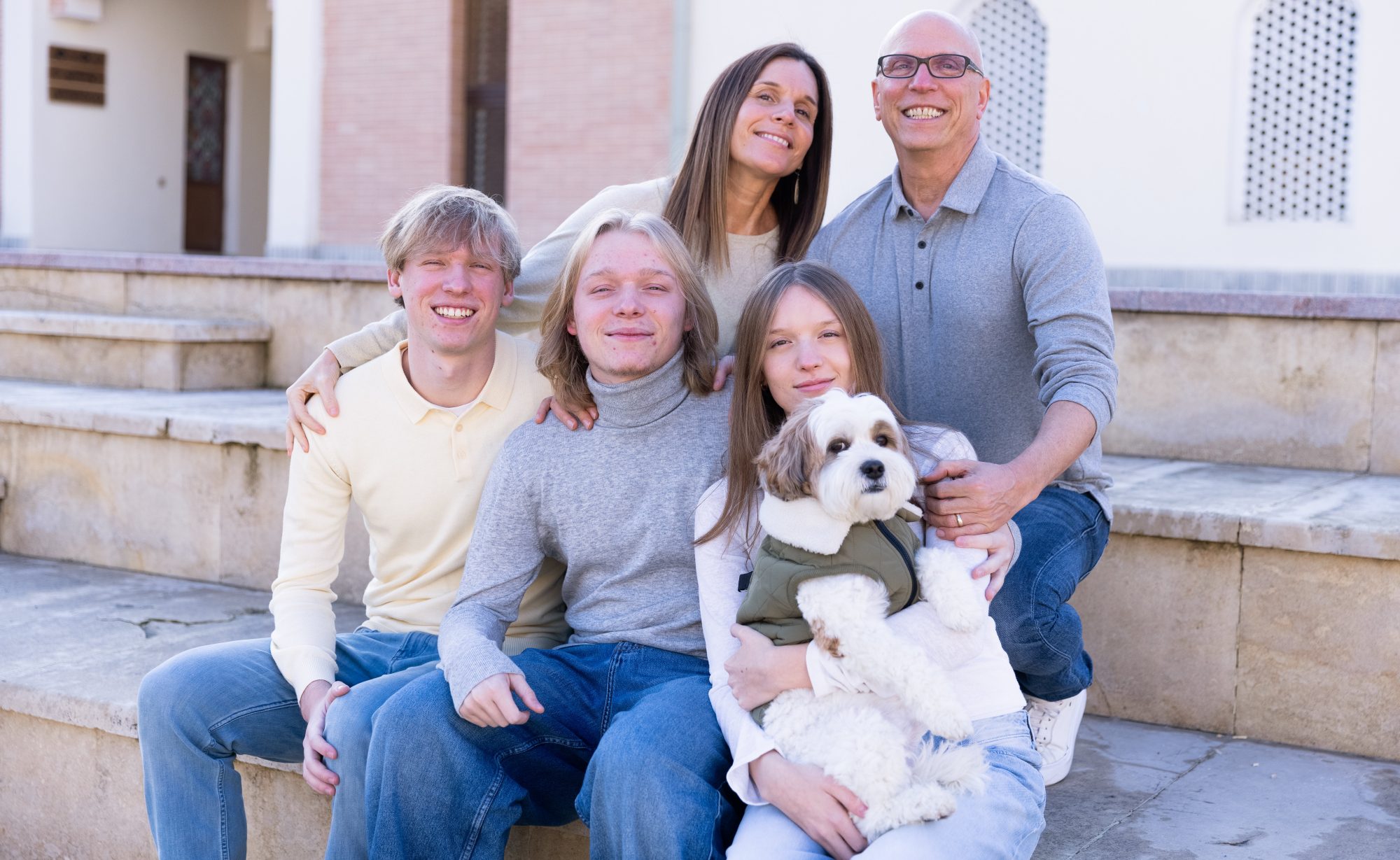
Family brunch at Arrows and Sparrows Cafe in Tashkent City. (friend of the family to my right)
Cold weather has returned to Tashkent after a couple weeks of spring, almost summer-like weather. It snowed a bit on Saturday night and it continues with below freezing temperatures and a bit of sleet today. We are looking forward to Spring Break, one more week of school to go. There are still a low number of cases in Uzbekistan and Tashkent. The government announced they are stopping administration of rapid antigen testing at airports. People arriving still need to have had a negative PCR test before boarding the flight.
I was taxi driver again this weekend, shuttling teenagers to various places. Oliver is spending a lot of time with his girlfriend. Owen plays tennis on Saturday with his friends and is always going out on the town with his friends. Ocean’s good friend Asla slept over on Saturday. Nadia had a great time with her friends Friday night at the City 21 Restaurant at the Hilton. I played 2 and 1/2 hours of tennis this morning with the regular crew and got a lot of work done in the afternoon. I took Obi out for a walk along Nukus street and enjoyed the cold, fresh air.
We had many laughs about our protective whistles. I took the girls to Щеф Бургер
Before the cold weather hit I went for a bike ride along the canal on Saturday morning. Below is another example of the glorious Soviet architecture one sees around Tashkent. The Palace of Arts Turkistan hosts concerts, festivals and events.
A really nice Sunday in Tashkent today. I started with an intense two sets of doubles tennis with friends at the Olympic Tennis Club. I was the chauffeur today for the family. Nadia got a serious haircut, which I love! We drove Owen and his friends to Paul for lunch and Nadia and I stayed and had a late lunch ourselves. We had lots of fun harassing Owen, but they were OK with us picking up their tab.
Chevrolet Sport over the curb
Not many people had cars in Uzbekistan for the first 20 or so years of their independence. With the opening of the economy, more people are able to afford cars. However, they have not learned to drive! The first car of choice for new drivers is either a Chevrolet Sport or Matiz. These are the craziest drivers, racing at all costs between stoplights. They switch lanes all the time without using their directional lights and you see a lot of accidents like the scene above. I was walking my dog Saturday night and came upon this three-car accident. I hope they will eventually learn that the roads are not a formula 1 racetrack and it is better to obey the traffic laws and get to their destination safely. My strategy to avoid accidents is staying in my lane, driving slowly and having a big car (Chevrolet Captiva). I wish I had a button on the dashboard with a laser that when aimed at a reckless driver, would stop the car, raise it in the air 20 feet and stay like that for two hours. It would teach these irresponsible drivers. Do I sound like an old man? 🙂
“Roma” cart on my street
I am noticing more what I thought were Roma people. There was a big population in Belgrade but I have not seen the large settlements like there. In doing a bit of research, I found they are Lyuli or Luli people. Today there was a family begging in front of the supermarket. They are an ethnic group distantly related to the Roma of Eastern Europe. They settled mainly in Tadjikistan, arriving in the 1200s from the area of Multan, in the Indus Valley. They call themselves the Mughat, meaning “fireworshippers” or Ghurbat “exiled”. They do not have any of the Romany tradition and the only reason they are known as gypsies or cigani (in Russian) is because of their nomadic lifestyle. There is an estimated 12,000 Lyuli in Uzbekistan. They practice a form of Islam, but face discrimination in Central Asia. I will definitely try to find out more about their population here and their culture. You can read more about the Lyuli people of Uzbekistan here.
I have not been posting much lately because of being busy at school. We start a three-day weekend because of Women’s Day holiday (March 8) on Monday. Last night Nadia and I took Obi for a walk downtown. She posed in front of the Hotel Uzbekistan. The hotel’s facade is an LED billboard and it reads “reklama” in Russian which means advertisement. Our dog Obi received a long overdue haircut and he looks so different with less fur and being able to see his eyes.
We hopefully had our last snowfall of the year on February 24-25. Overnight about 3-5 inches fell. I love taking Obi for walks in the quiet snow. Our neighborhood is gentrifying quickly, but most of it still looks like a Central Asian village. The photo above is typical of what it looks like on a winter evening close to my house.
Spring in Tashkent is often rainy which gives us very clear skies. Last Sunday driving to play tennis, the Tien Shan mountains were visible throughout the city. They are about a 60-minute drive away.
To finish this post, I always appreciate the beauty of mosques. Below is a closeup of one of the minarets from the Minor Mosque. The mosque was completed in 2014 by the city government and is next to the Ankhor Canal, one of my favorite running/biking/walking routes. Last Sunday I walked around the mosque while waiting for a shop to open.
I’ve been playing a lot of tennis lately, mostly at the Republican School of Olympic Reserve. The club was founded in 1961 as a sports boarding school and today provides high level training for local tennis players. It is the site of the Tashkent Open, a WTA professional event. My sons train at the club and I play social tennis 1-2 times per week. I would like to thank the Club Director Samuk Abidov for all of his support and kindness. We took the picture together above the other night. Nadia and I played this weekend with our friends Hitoshi and Ai at the indoor court at the Plov Center Tennis Club. Lots of fun and laughs!
Plov Center Tennis Club
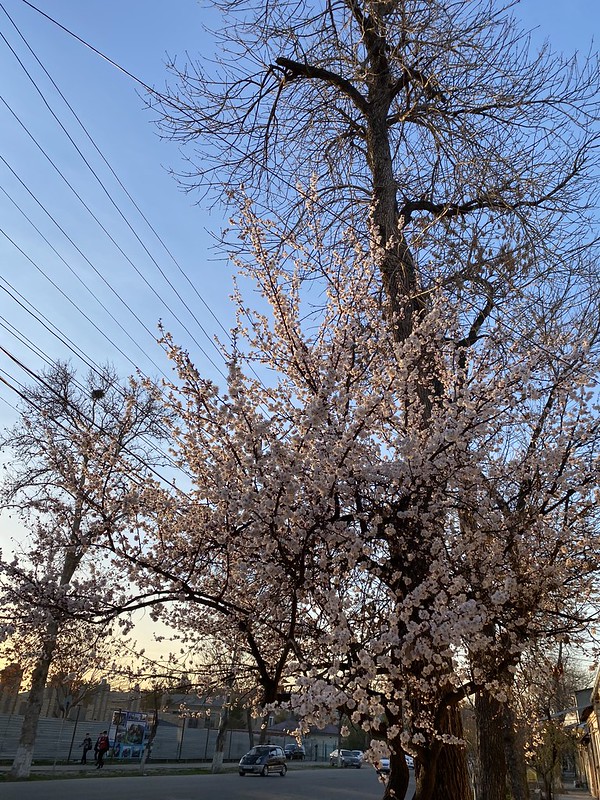
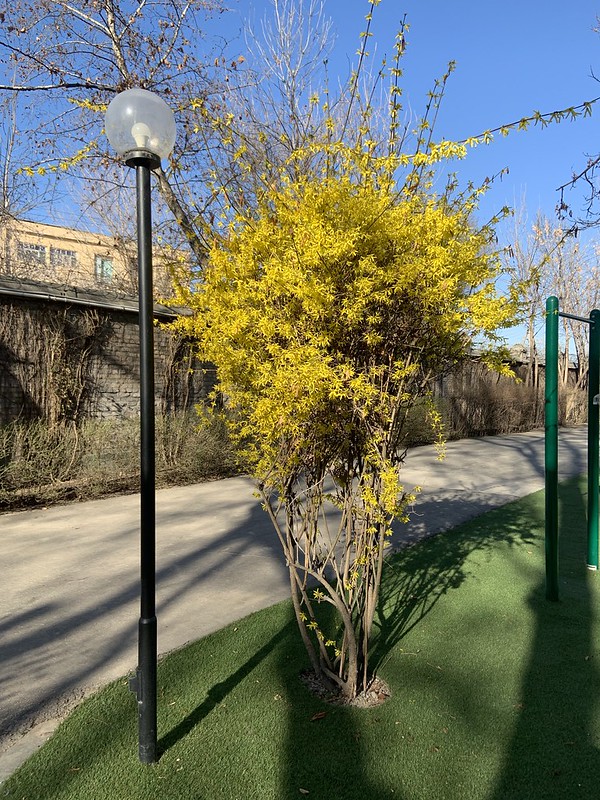
We’ve had an unusual run of extremely warm weather this month. A couple of days ago it reached 26 C (79F) and it felt like summer. The apricots and cherry blossoms are out all over the city. Forsythia, the yellow trumpet of European spring is also in full bloom on campus (see below). It is supposed to snow later this week again. 😦
Finally, I am happy to have my right-hand man back Ahad! He is our family support person and due to COVID, we’ve had limited contact with him. With the low number of cases in the city, we are now asking him to do more and it is good to have him back in our lives.
We had a relaxing weekend in Tashkent. We celebrated Nadia’s birthday on Saturday at Arrows & Sparrows Cafe. She was sick on her actual birthday (last Tuesday). The cafe recently opened in the Tashkent City development. The food and ambiance was really nice and I recommend anyone wanting a good meal. We all had a laugh at my expense. There is a fee to enter the park unless you are going to the Hilton Hotel. I told the entrance guard I was going to the Hyatt, the other luxury hotel in Tashkent. The guy looked at me funny, until my family corrected me.
Ocean got her hair cut and she looks so different. She is officially a teenager and is changing every day. I really enjoyed taking her to the clinic on Friday for a check up. I just love spending time with her. Between recruiting teachers and answering emails, Owen and I shot baskets at our school’s gym. We are bummed out that his senior season got wiped out by the pandemic. We are still trying to work on his game. Oliver is working out with a personal trainer which has been helpful for his health and mood. He is looking more like a man every day!
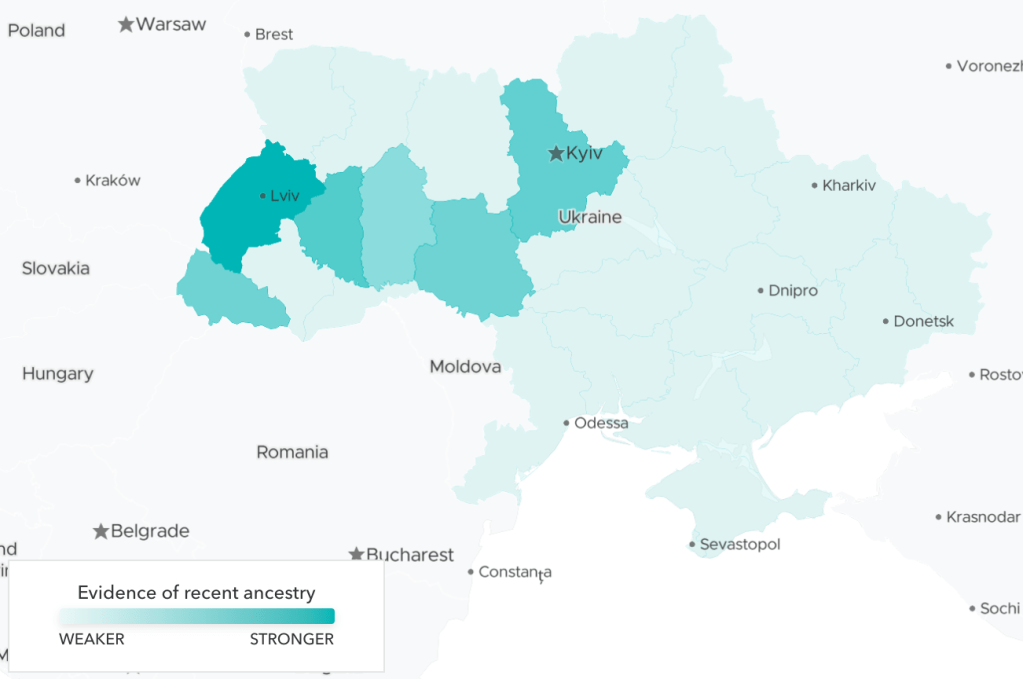
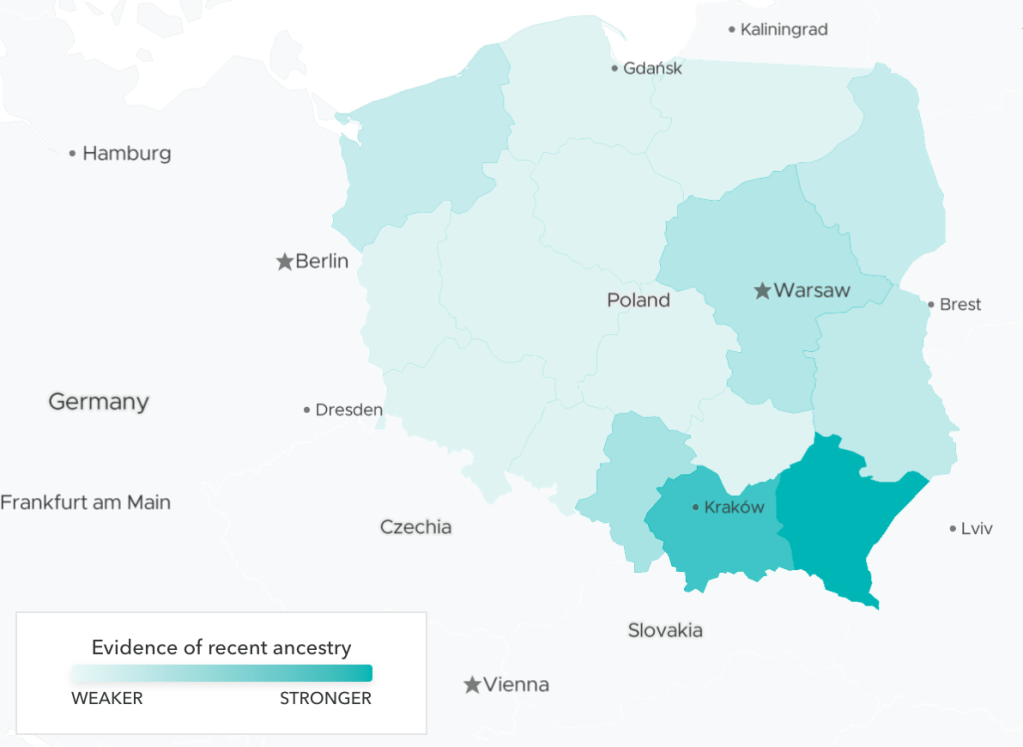
Years ago I submitted my DNA sample to 23 & Me, the genetic testing company. I was really curious because I was adopted and did not know much about my ancestry. The methods 23 & Me uses to determine DNA origin are improving all the time. They are getting more people to contribute and using better algorithms to improve accuracy. The latest results show that I have 71.5% Eastern European with Podkarpackie Voivodeship being the highest likely match. This is southeastern Poland, east of Krakow. Other strong matches in the region border on voivodeship, with Lviv, Ukraine to the east and Prešov, Slovakia. So most of my ancestors come from that region in Slovakia/Poland/Ukraine. Americans are a bit obsessed with ancestry, probably because we do not have the sense of tribalism that smaller countries with populations living in the region for hundreds or thousands of years. The latest update took out much of the “broadly” or “undefined” European categories that were in earlier versions.
A surprising feature of the update was the 24.7% Spanish/Portuguese label. They didn’t find enough exact matches between my DNA and reference individuals in their database to determine an exact region. I’ll be looking forward to seeing when they get more matches. I also registered 2.4% Greek/Balkan, which is a drop of 6% from previous readings.
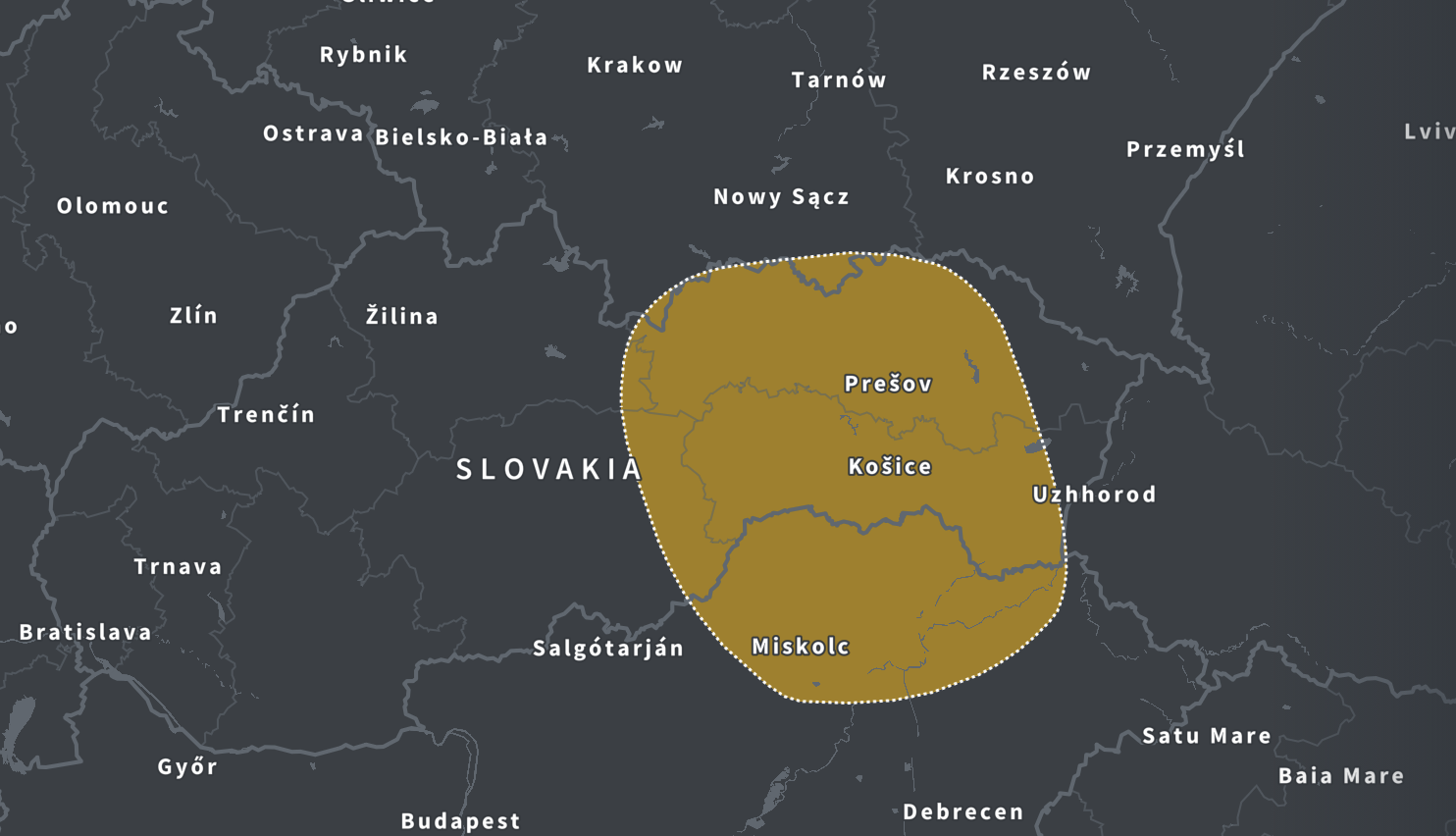
Ancestry.com highlighted Eastern Slovakia
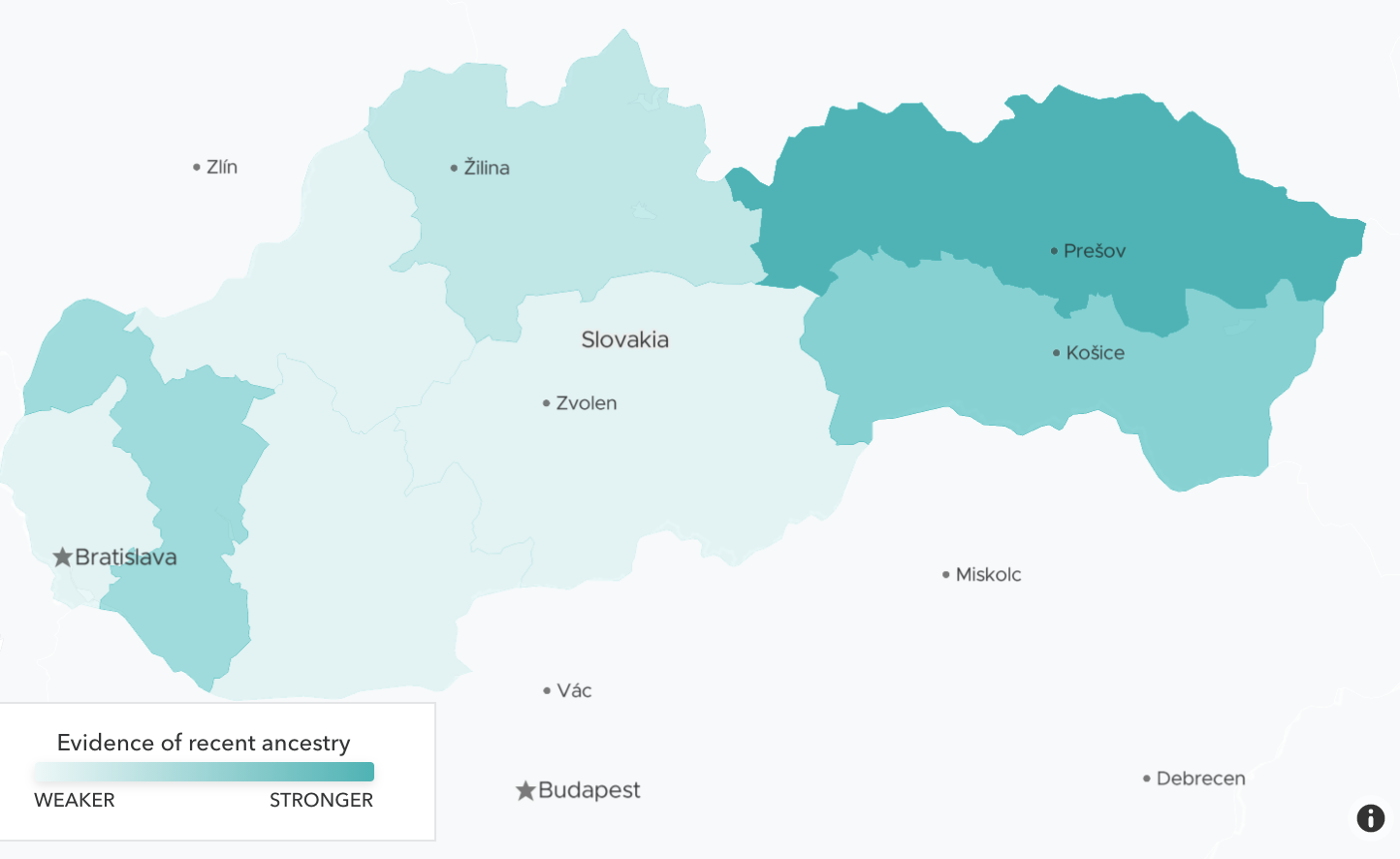
I also submitted my DNA to Ancestry.com and they to measured my ancestry as 71% Eastern Europe & Russia. They zeroed in on Eastern Slovakia. Ancestry.com’s database also identified 13.7% “Germanic Europe” primarily located in Germany and Switzerland. The Balkans and Spain both register 7% each.
My takeaway from the two companies is my ancestry is definitely strongest in the small region of eastern Poland and Slovakia and western Ukraine. 23&Me gives me a stronger link to Poland, Ancestry.com to Slovakia.
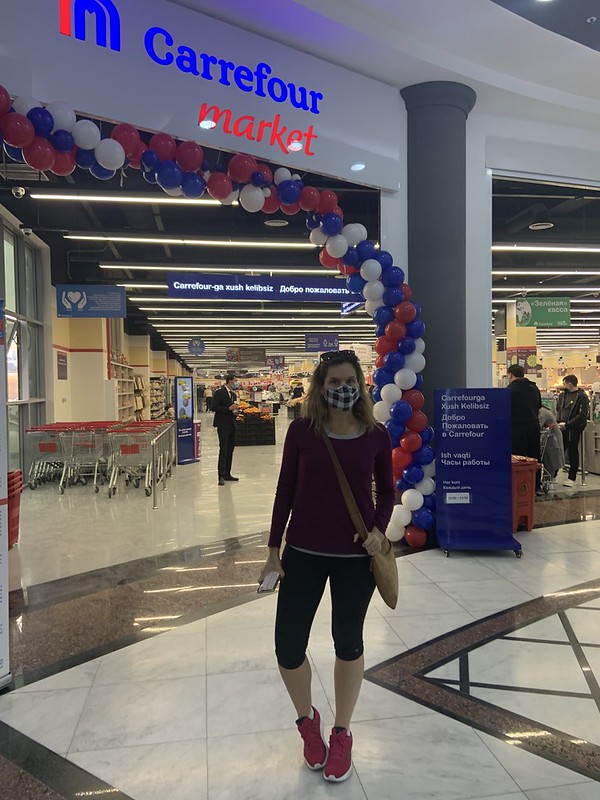
We wanted to check out the new Carrefour supermarket on our weekly grocery shopping trip yesterday. It is another sign of the economic growth of Uzbekistan and Tashkent that an international chain opened such a large store. Majid Al Futtaim, the Emirati billionaire is behind the project. He opened Carrefour franchises all over the Middle East (over 30 countries). This store is on the ground floor of the former Media Mart complex (an electronics and home appliance store). Media Mart moved to the second floor. I heard there will be other Carrefour outlets opening in the city. Carrefour is originally from France and brought the concept of the “hyper market” / department store under one roof to France in the 1960s. I think it is a slightly more upscale and smaller version of Walmart.
Learning How to Slice Cheese
Nadia loves supermarkets and when we visit countries, one of our mandatory stops is to see what is available in the grocery stores. She found some speciality items that can’t be found in the local supermarkets. We both felt that the local supermarkets, Makro and Korzinka, compare favorably to Carrefour. We will continue to do most of our shopping at the local supermarkets and Mirobad bazaar. Carrefour offers free WiFi and several deli-like venues, such as a cheese-slicing (it is French, of course), crepes, bread and somsas, even a sushi stand. It has a long way to go to reach the level of a Trader Joes, Wegmans or Whole Foods in the USA. However, they do bring some new ideas in retail to the city and an international perspective, which is beneficial to Uzbek culture.
Uzbek, Russian and English languages on the recyclable bags
The young Uzbek employees seemed proud to be working for an international company. We were able to use our international credit card easily and they even gifted us two recyclable Carrefour shopping bags.
We completed our Winter Break and started with our Virtual Learning this week. The first few days back from a long holiday are always hectic with lots of people wanting to meet with me and it is the middle of teacher recruiting season. The weather improved this week and during the day, it is quite warm, going up to 10C! The snow returns next week however. In the winter I like to take night walks to get out of the house and beat the winter blues. My favorite neighborhood in Tashkent is around the Opera House so often I drive over there and take my dog Obi for a long walk in that area.
On Thursday we ran into an army division of around 50 soldiers marching through a walking street shopping district. I was wondering why they were singing “Uzbekistan”. After a bit of research, I discovered that January 14 is “Defender of the Fatherland” Day, which is a military holiday. This goes back to when Uzbekistan was part of the Soviet Union. It marks the day of the first big draft of the Russian “Red Army” in World War I. It is still celebrated in Russia and several former Soviet republics. Uzbekistan changed the date from February 23 to January 14 to celebrate the establishment of Uzbek military in 1992, shortly after independence. I didn’t notice any large parades or ceremonies, only the men marching and some cars in Temur Square with Uzbek flags.
Luk Oil Headquarters
Navoi Museum of Literature
Uzbekistan History Museum
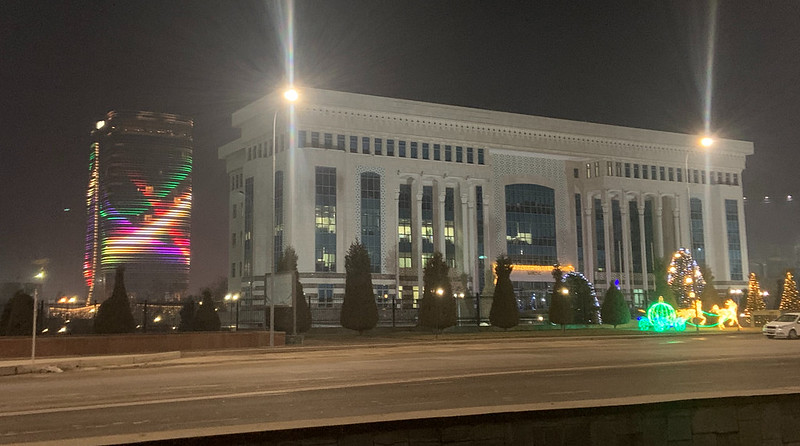
I noticed Uzbeks and Central Asians in general, like LED colored lights. Many buildings, street posts, trees, restaurants, etc. are covered or outlined in lights. It makes for colorful walks in the evening. Above are some of the major buildings around the Opera House.
On my bike ride last week, I noticed this guy at a car wash (below). He is wearing the classic Central Asian winter gear. The robe and Russian-style fur hat. Most people wear Western-style winter jackets and hats, but there is a significant minority of the robes/fur hat wearers.
I was pointing out this summer that our mahalla (neighborhood) did not have a prominent sign. Neighborhood associations in Tashkent are quite prominent and we live next door to our mahalla community center. I noticed today that our mahalla has a new sign. The name of our mahalla is Yangi Zamon (New Era) and Guzari is a place in the neighborhood where people go to relax, socialize and meet. It is nice that they renovated the part of the building and put up a new sign. There still is some more work that needs to be done as most of the community center is quite run down.
Obi and Nadia at the Clinic
Our dog Obi has been receiving treatment at the local veterinary clinic for digestive problems. Nadia has been quite anxious about his health. He is receiving a treatment of injections to help digestive system and other organs. The doctor recommended switching his diet to strictly dog food. The little guy has been a trooper, especially after the injection hurt his leg after the first day. He is feeling much better and was moving around as normal. Obi loves going for walks and despite the cold temperatures (-6C today) he enthusiastically saunters over the sidewalks and streets of Tashkent.
Nadia walking Obi in our neighborhood.
I am trying to keep fit and lose some weight I’ve gained over the holiday season. I ran 10 kilometers yesterday, barely. My calf was hurting and left knee a bit sore, but I finished. The canal is always peaceful and is exactly 5 kilometers in length so running from the starting parking lot to the Minor Mosque and back, is a nice 10 kilometer run.
During the holidays I read “Owls of the Eastern Ice: A Quest to Find and Save the World’s Largest Owl” by Jonathan Slaght. The University of Minnesota scientist describes his doctoral research of Blakiston’s Fish Owl in far eastern Russia. When I was living in Japan I became interested in Kamchatka, Sakhalin Island and the region north of Vladivostok. Slaght spent 3 winters capturing and tracking fish owls in the Primoye province of Russia.
Blakiston’s Fish Owl as the title states, is the world’s largest owl species. They are found along rivers in northern Japan, Russia and perhaps in China as well. Due to logging and overfishing, they are endangered in Russia and the goal of Slaght’s research was to understand their needs and to preserve their habitat. It is quite difficult to study these birds. They are nocturnal and can only be captured during the winter when there is limited river hunting areas. The deep snow, cold temperatures, lack of infrastructure and generally hard culture of far eastern Russia made for gripping reading. Slaght endured a lot of get the information he needed. Slaght and his team of local researchers find the owls through listening for a low tone duet call between male and female owls around sunset. The owls need old growth, hollow trees near a river to nest so they would first scout suitable areas. They were quite ingenious in figuring out how to find and catch and release these secretive owls.
They discovered fish owls are most likely to be found in valley forests close to multi-channeled rivers and they stayed near areas where rivers didn’t freeze year-round. Their average home range was about 15 square kilometers. In the winter, they stayed close to these ice-free areas (7 square kilometers) and in the autumn, they would follow the migrating fish and expanded their range to 25 square kilometers.
Protecting their habitat is the big challenge to overcome to protect them. The 800 or so pairs of fish owls in Russia live in the flat, river valleys where logging companies, fishermen and hunters build roads. It was good to hear that Slaght was able to work with logging companies to limit the amount of roads and bridges they made. I would love someday to visit the Sikohte-Alin Biosphere Reserve where much of his research was focused.
The contrast of the fate of the fish owls in Japan and Russia was also interesting. In the early 1980s Japan, the fish owls were reduced to less than 100 birds, down from 500 breeding pairs in 1900 due to logging and hydroelectric dams stopping salmon migration up rivers. The government stepped in to protect them, including artificially feeding them in stocked ponds. Because of the small population and Soviet inertia, the fish owl was not threatened in Russia until much more recently. Hopefully, Slaght’s research will help preserve them in Russia.
I highly recommend this book. It took me away from Tashkent and reading of Slaght’s adventures during cold, winter evenings brought me much pleasure.








 Bill's Blog